“Smaller People”? – Citizen Sociolinguistic Arrest!

We will be as fair as we possibly can. The smaller people will definitely be handled.

–Diane von Furstenberg, on the fate of her vendors during the COVID-19 downsizing of her wrap-dress empire

All of us have probably at one time either called someone out for saying something offensive, or been called on our choice of words.   Calling someone out for their words is awkward and takes effort. It’s a social risk.  I call these instances, “citizen sociolinguistic arrests,” those moments when someone feels strongly enough to take that social risk and call deliberate attention to another’s words: “Please don’t call us girls, we’re women” or “I’m Asian American. We don’t really use the word Oriental anymore.” Those on the receiving end of a citizen sociolinguist’s arrest might feel a bit defensive—“I was just kidding” or “it’s just a figure or speech!” or “Sorry, I didn’t realize you were so sensitive!”.  Despite defensive remarks to the contrary, when people take the trouble to call us out on the way we use our words, something larger is going on.

A Diane von Furstenberg Dress

This brings me to Diane von Furstenberg, and the statement quoted above, and, most specifically, her reference to “the smaller people.” In case you are not familiar with DVF, she is an aging fashion designer who, arguably, invented the “wrap-dress” decades ago. She is apparently, according to a New York Times profile of her published this week, struggling during the COVID-19 pandemic. While she still carries a net worth of over one billion (and is married to another billionaire, Barry Diller), her business has been losing money for years.  And now, with coronavirus, “fashion is out of fashion,” and the wrap-dress mogul is doing even worse.

DVF’s “money problems” seem laughable to most of us. Still, those who work for DVF have had to suffer because of her losses. Bad business for DVF has meant much harder struggles for those who have worked for her, and the article mentions she has had trouble paying her vendors.  One $20,000 invoice for a flower order, leftover from an event she organized in 2019, has still gone unpaid.  Given her downsizing plans, this floral designer and other vendors may go without their pay, the way of many of DVF’s former employees who have been put out of work by the incessantly shrinking demand for DVF’s fashions, and now, the pandemic. When questioned about how business consolidation might affect these empolyees, Diane offered this explanation and reassurance:  

We will be as fair as we possibly can. The smaller people will definitely be handled.

Hundreds of readers took to the comment section to take issue with nearly everything about DVF’s travails, and citizen sociolinguistic arrests zeroed in on this particularly telling turn of phrase: “the smaller people.” 

Tiago from Philadelphia in a comment that received 275 recommendations (NYT does not do ‘thumbs up’) pointed directly to that “smaller people” statement:

A screenshot of a cell phone

Description automatically generated

Dozens of others directly called out the reference to “smaller people.” A few examples:

A screenshot of a cell phone

Description automatically generated

One might argue that these comments remain in the realm of simple word choice, just an unfortunate phrase, “smaller people.”   These are “just words” after all.  DVF may have been speaking off the cuff.  Give her a break. 

However, other readers made explicit the very real and strained conditions the “smaller people,” as DVF calls them, are living through now, and the consequences of self-interest of the kind DVF is displaying with her “smaller people” word choice. Some commenters explicitly mentioned themselves as objects of the “smaller people” reference.  Those who have been most hurt by COVID-19:

Some explicitly name the suffering of the “small people” DVF is selfishly short-changing:

A screenshot of a cell phone

Description automatically generated

And some comments even came from DVF vendors themselves, literally those people whom DVF referred to as “smaller people,” like Rob Adler, still owed $9,000 which he will probably never see:

Sometimes, people believe that getting called out for our words is just a matter of political correctness. We should instead pay attention to deeds. But, when a billionaire complains about her own personal financial struggles and refers to those she is shafting as “smaller people,” we can see how her words themselves are deeds, creating the unexamined life she lives, a life in which she doesn’t see the people who work for her, who count on her for their living, as equally important humans.  These citizen sociolinguistic arresters aren’t just wordsmiths taking issue with the phrase “smaller people.”  These are real people commenting on these words because they construct a world where DVF feels little responsibility for others—the florist who was stuck with the $20,000 bill, the printer who will never be paid $9,000 owed him by DVF, and those who will never be paid severance wages owed them. 

In their sheer accumulation, these comments become the real news story, bringing the blunt reality of DVF’s way of doing business to light.  While the headline of the article reads, “Diane von Furstenberg’s Brand Is Left Exposed by the Pandemic,” nobody in the comment section is lamenting the degradation of the DVF brand. The hundreds of comments nearly unanimously condemn her selfishness in the face of COVID-19.  The preponderance of this view is so strong that, rather than raising the same issue again, some comments simply call attention to this accumulation of remarks taking DVF to task:

Another response similarly comments on the comments—praising the New York Times for the article, and complementing “the reality check the comments section is providing”:
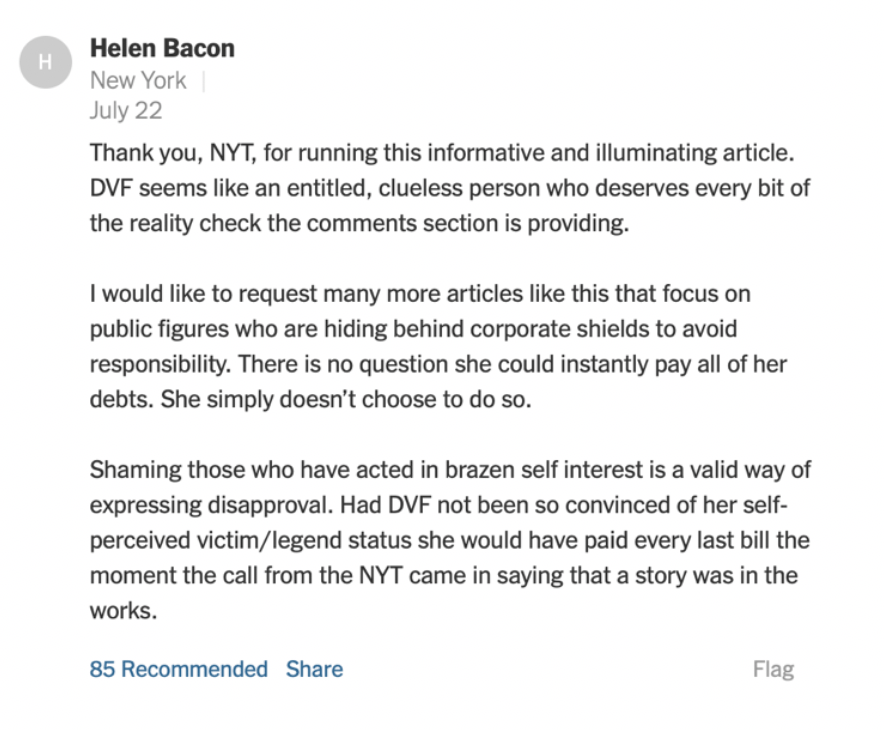
It’s hard to tell whether this commenter is being sarcastic with their big “thank you” to the NYT. It’s also impossible to say whether the author of the NYT article was intentionally outing DVF as a woman of “brazen self-interest.” That seems unlikely. However, that’s the message this article is delivering—driven home as a result of the contributions of these active readers (and citizen sociolinguists), who have called out DVF’s language and the stance it conveys. 

By engaging in these online citizen sociolinguistic arrests, these commenters haven’t just shamed DVF for her use of language.  They have shamed her for the entire way of life her language choice conveys and reenacts. Collectively, they ask, “Why, DVF, do you call your vendors, “smaller people”? We know those people, we are those people, and our lives are important, not small.”

Citizen sociolinguists’ arrests may at first strike people as trivially focusing on simple words, but these acts call attention to broader social conditions:  Calling some humans “smaller people,” like repeatedly referring to grown women as “girls,” or misguidedly greeting an Asian American who grew up in Ohio with the Chinese language greeting, “ni hao,” are not simply problems with word choice. They both reveal and reproduce unexamined social relationships. The speaker of those words enacts their own unexamined stance again and again through their language choice—until they are faced with a citizen sociolinguistic arrest.  A citizen sociolinguist’s arrest has the chance of starting an important conversation, a slim chance of pushing the utterer of each of those poorly chosen words to start speaking differently, and in the process, to start building a different way of seeing and acting in the world. By using words in a new way, one learns something about another person’s perspective, and may even develop compassion for those they don’t know or even understand.  

It may be too late for DVF, but her commenters have raised the awareness of the absurdity of profiling her in the NYT. These citizen sociolinguists changed the story from one about the fashion business, to one about people.  Comments from those who have been hurt by DVF’s world view, who have experienced hurt from others who share the world view that sees some humans as “smaller people,” may have pushed some readers to think differently about their own stance toward inequality during the COVID-19 pandemic and beyond.  

Have you engaged in “citizen sociolinguistic arrests”?  Have you been a recipient of one?  How did those encounters change your view of the world? How do words display—and produce—compassion or lack thereof?  How can we guide each other to become more understanding in how we use words, and in how we show compassion for each other?  Do you think we can? Please comment below! 

A New Lingua Franca for COVID-19

A generation from now, we will look back on this time and remember our shared language–a shared language that citizen sociolinguists have made visible and viable.   During the COVID-19 global pandemic, we have all been learning new words and phrases, and while we haven’t been able to share each other’s space and live company, we have been able to create a new global Lingua Franca for the COVID-19 era.

A generation from now, we will look back on this time and remember our shared language

To illustrate, let’s take a cursory scan of new words being popularized, circulated, re-created, and joked about these days.  COVID-19, of course, has been coined in the last few months.  Is there anyone on the planet who does not know what this refers to? And Merriam-Webster has already compiled lists of suddenly frequent vocabulary words we all have been hearing, including virus, contagious, infectious, superspreader, and quarantine. The York Times also just published a useful glossary covering these terms, throwing in state-of-emergency, incubation, containment, and R-naught.

I appreciate these careful compilations, but these are words that scientists of infectious diseases have known and been using for a while, as experts.  Everyday people experiencing this pandemic have simultaneously been creating an all new vocabulary of our own. By re-thinking some of these terms from the scientific community, having conversations about these very words, and by endlessly generating and popularizing more words related to this pandemic, we have been able to make sense of our own world in our own words, together—while maintaining a safe distance from each other.

The phrase Social Distancing, for example, has baffled some, coming across as an oxymoron.  I’ve had numerous conversations in which people puzzle over how we can be “social” and “distant” at the same time, and heard friends snappily assert that we need to be physically distant but remain socially connected.  But we keep using the phrase anyway.  And, it has expanded from noun phrase to adjective: We now have social distancing workouts, social distancing car circles, social distancing study halls, and even social distancing fun runs. We can still catch The Daily Social Distancing Show with Trevor Noah. I just googled “Social Distancing” and the first phrase that popped up on the search dropdown menu was social distancing baptism (and the first image featured a minister aiming a super-soaker at an infant).

During all this social distancing, Universities across the globe have been using the most popular video-conferencing platform, Zoom, to take learning on line, and this has led to more word play: Zoomed out, for example, to describe that zoned out feeling and glazed expression one might get after a day of meetings and classes on Zoom. That is, if you weren’t Zoombombed by a hacker, popping into your meeting uninvited, with inappropriate messages and images.

On top of these new words, certain place names have become part of everyday conversation, and now resonate with us all.  Wuhan is a huge city in China with a population of over 11 million people—more than New York, Tokyo, or London. But until COVID-19, most Americans had never heard of it. While the  coinage of Wuhan virus gave a one-sidedly negative perspective of the city,  more nuanced associations with Wuhan are emerging—as illustrated by this “The Wuhan I Know” comic recently created by Laura Gau, gaining popularity on Twitter, and featured on public radio.  Now nearly everyone in the US probably knows the name of that city, and many of us can even picture its location on a map, inside another newly familiar location, the Hubei Province. Similarly, the Lombardy Region of Italy, and even New Rochelle, New York have become commonplace in conversation.  We’ve all expanded our repertoire to include these distant—and not so distant—place names.

But we’ve also been sharing and resurrecting terms about the time we spend at home: Procrastibaking (a combo of procrastinating and baking that some are trying out for the first time) has been reappearing and featured in more social media posts.  As has the need for no-knead bread (who knew?) and pizza kits (now being picked up from favorite pizza joints to be assembled, safely, at home).

And more and more we’ve been popularizing words for new activities we are doing together (apart), by tacking the word virtual onto it all.  Now we have virtual happy hour, virtual brunch, and Zoom’s virtual background.  My son, still at college on the West Coast, but living off-campus, just had a virtual zoom birthday celebration with us, his East Coast family, along with his West Coast housemates, whom he calls his social distancing team.

We’re all in this together, and our language shows it

Some of these new words and phrases may evoke the specter of loneliness, and some of these place names may draw a momentary infamy they never asked for, but this is how we, as a society, develop a common relationship to our new, uncommon conditions.  Even in the best of times, much of the way we all experience the world together is by sharing language with each other.  As we use and talk about words together, those words themselves become our shared experience. Even just hearing certain words again and again, as they morph little by little–Zoom, Zoomed out, Zoom-bombing, social distancing pizza kit, social distancing friendship, social distancing–gives us a sense we are all living life as one collective.  In the time of COVID 19, this type of shared language experience provides a form of existential hope.  We are all in this together—and our language shows it.


Elbow, Elbow Pit, or Cough Pocket?

The human elbow is getting a lot of attention these days, as we collectively fight the global spread of COVID-19.

But what does that word “elbow” refer to?   Am I the only one who has spent most of my life using “elbow” to refer exclusively to the pointed part that sticks out when we bend our arm?   I don’t think so. Ask any person on the street to point to their elbow and I bet you they’ll point to that pointy part.  And yet…

Cough into your elbow

The part of our anatomy where we are supposed to be coughing these days (if we don’t have a tissue) has been confusingly called the “elbow.” This suggests (and this suggestion is born out in ubiquitous public service announcement illustrations) that the “elbow” is the part of our arm that gets enclosed when we bend our arm.

Screenshot 2020-03-15 16.39.15

This contradicts everything I have envisioned about elbows for my entire life.

Bump elbows in greeting

On the other hand (or the other side of the elbow), we are also supposed to “bump elbows” instead of shaking hands or hugging—apparently a time-tested greeting that has been called on during epidemics in the past, and has now been resurrected for COVID-19.   This is reassuring to me—I can visualize bumping elbows—the pointy part of our arms.  Wikipedia provides this crystal-clear illustration of elbows touching in “a stylish bump in 2008”:

Screenshot 2020-03-15 16.50.50

But it would be really hard to cough into that pointy part of our elbow. So why are people calling the inside of our elbow the “elbow.”

Maybe we just don’t have a word for it, and it’s just too clumsy to say “the inside of your elbow”.  Is it called the “elbow pit”?  I googled that and found others had been wondering the same thing: The search bar auto-filled with “Elbow pit what to call it?”

But Wikipedia tells us there is a specific word for that part of our body: the cubital fossa or… elbow pit.

Screenshot 2020-03-15 16.37.41

This wikipedia definition of “elbow pit” (aka cubital fossa) as anterior to the elbow was bolstered as my search continued. As I was googling “elbow pit,” the search bar also offered up another top search suggestion: “elbow pit tattoo.” This is what they look like—they are not on a person’s elbow.  They are nestled in the elbow pit (where we should also cough):

Screenshot 2020-03-15 16.56.04

But for some reason, the public service message is not “Cough into your elbow pit.”  Why not? Why have people insisted on calling this simply the “elbow”?

Well, the analogy to a smelly armpit may just be too much for genteel Americans to handle.  I mentioned this term, “elbow pit,” to my 12-year-old daughter and she said simply, “Ew. I find that very disturbing.”

Others seem to have also picked up on the disturbing aspects of the phrase, “elbow pit,” as represented, of course, on Urbandictionary.com, where elbow pit is defined. The top definition seems modest and descriptive:

Screenshot 2020-03-15 19.45.14

But the third definition goes directly to the problem of armpit associations:

Screenshot 2020-03-15 19.47.20

Ew, indeed!  The commonsense resistance to a bodily analogy like “elbow pit” is borne out further on Reddit, where at least one thread suggests referring to the elbow pit as, instead, “elbow vagina.”

So, maybe a more expansive working definition of “elbow,” to include the “elbow pit,” has merit. It seems that people who design these public service campaigns would rather be a little imprecise than end up in the “elbow pit” zone of associations.  Plain old “elbow” is simpler and conveniently euphemismistic, nipping any of the “elbow pit” or “elbow vagina” undertones in the bud.

Maybe it’s okay, sometimes, to be a little imprecise in our language if the precise language just leads us down a scary path?  People might be more likely to cough into something called “elbow” (inaccurately) than to cough into the more accurately named “elbow pit.”

And what if we are talking to kids—those prime germ-spreaders?  We don’t want to call it the elbow pit and immediately hear a class of 25 saying “EEEEEEEWWWWWWWW!” Definitely bad PR for good practices.

Cough pocket

Well, sometimes we just need to think a little longer (or ask a citizen sociolinguist!) to come up with the most effective phraseology.  Fortunately, this Seattle pre-school teacher, Ms. Laurie Goff, seems to have nailed it! She calls it the “cough pocket,” and tweeted a handy video demonstrating exactly what coughing into that cough pocket will look like:

Screenshot 2020-03-15 17.50.20

Her accompanying explanation is friendly and convincing:  “That’s a cough pocket.  It’s on your body! It’s free, it’s easy, and it’s always with you!” Now this video (and not a collection of germs from all her preschoolers!) is going viral, spreading the word about where to cough–arguably more effectively than any inaccurate, euphemistic use of “elbow,” or accurate, but icky, “elbow pit” ever could.

So to the question, how are we supposed to cough into our elbow?  Ms. Goff provides an answer:  Use your cough pocket!

What are your experiences with the words “elbow,” “elbow pit,” and “cough pocket” (and of course, the “elbow bump”)?  Please comment below!