Getting It Wrong and Having No Point: Brain Damage or Brilliance?

Screen Shot 2015-11-13 at 6.45.40 PMSunday afternoon conversations, at their best, tend to be luxuriously meandering. Such was case last Sunday when the topic turned to memories of a friend’s Grandfather. I had been admiring the old and crotchety orange cat strolling under the kitchen table, when my friend mentioned that his grandfather had always referred to that cat as a dog. Even in grandfather’s more youthful prime, “He tended to name things randomly and incorrectly a lot.” That was just the kind of person he was.

I had to mull that over for a while.   What kind of person, a super-competent English speaker, mind you, incorrectly labels things? The recalling of grandpa calling a familiar housecat a dog, drew a picture in my mind of a bemused, quietly confident man, pleased with his place in the world. Judging by the affectionate tone of this story, his grandson would love him anyway.

Later, in Citizen Sociolinguistic mode, I began to wonder: How else do people seize the language and playfully make it their own—metaphorically “calling the cat a dog”? And what happens when they do?

In contrast to my impression of grandpa as a creative, bemused man, comfortable in his own skin, a quick Google search for “saying words wrong” primarily yielded sites discussing dementia, aphasia, multiple sclerosis, learning disabilities and speech disorders. Some long discussion boards feature people anxiously recalling when they told their children to find a dish “in the oven” when they meant “dishwasher,” or calling their children by the dog’s name! (Nota Bene: I’ve never done that.) Many responses speculate these people have brain lesions. All these sites frame misusing language as a health problem.

But a search for “intentionally saying words wrong” leads to a much more fanciful set of examples. The Wikipedia entry for Malapropisms comes near the top of the list, and highlights a few of the more entertaining literary versions. Authors put the “wrong” words into certain characters’ mouths to bring out their whimsical or quirky nature.

The literary figure, Mrs. Malaprop (namesake of the term), most famously utters “a nice derangement of epitaphs” rather than “a nice arrangement of epithets.” The know-it-all quality of her character emerges through these silly missteps in speech. The more she tries to sound sophisticated, the more she sounds ridiculous.

That may offer insight into another great source of malapropisms: the world of politics. Wikipedia lists a few gems:

Former Chicago Mayor, Richard Daley, referred to “Alcoholics Anonymous” as

Alcoholics Unanimous

Texas Governor and one-time presidential nominee Rick Perry  once referred to states as, not laboratories, but

lavatories of innovation and democracy

Google the phrase  “political malapropisms” and even more surface, as do lengthy YouTube compilations of George W. Bush quotes, like this (https://www.youtube.com/watch?v=JhmdEq3JhoY), including the following:

  • “a single mother working hard to put food on your family.”—Greater Nashua, N.H., Chamber of Commerce, Jan. 27, 2000
  • “Rarely is the question asked: Is our children learning?”—Florence, S.C., Jan. 11, 2000
  • “Too many good docs are getting out of the business. Too many OB/GYNs aren’t able to practice their love with women all across the country.”—Poplar Bluff, Mo., Sept. 6, 2004

Obviously, Bushims are different from those malapropisms intentionally put into the mouths of literary characters. But are they as “unintentional” as someone with Alzheimer’s disease? Do these politicians have brain damage?

No. Michael Silverstein has pointed out in his “pamphlet,” Talking Politics: The Substance of Style from Abe to “W” (http://www.prickly-paradigm.com/titles/talking-politics-substance-style-abe-w.html) that Bushisms (the modern Malapropism) may even be strategic: Phrases like “a single mother with two children” working hard “to put food on your family” seem to have been a political boon for Bush. Because of the light-hearted, charmingly all-too-human light these oddities cast on him, they made him seem like good Presidential material. Strategists did not squelch Bushisms (as one might if they suggested brain damage) but encouraged the wide circulation of these malapropisms/Bushisms.

Departing further from the Internet Web for a dip into the philosophy of language, I pulled Donald Davidson off the dusty, dusty shelf, recalling his essay, ”Reality without Reference.” Davidson has captured the value of “calling a cat a dog.” Communication, he suggests, has less to do with conventions or rules than understanding one’s context and how one’s words affect it.   As he has written in that essay, “we must give up the concept of reference as basic to an empirical theory of language .” Instead, language is something we take out and play with, using what we have learned, trying new things, waiting to see what happens, acting on the world through words—in many cases ignoring their dictionary-designated reference.

The many Internet sites on dementia suggest that if we use words in new ways without meaning to, we may have a serious mental health problem. I am not denying that these may, indeed be signs of mental impairment. But “dementia” might not be the best first explanation. When the use of non-conventional language gets framed, first off, as a learning disability, speech impairment, brain damage, or some other health problem, much of the world responds by struggling hard to conform to rules of language that should be ignored.   Meanwhile, the happy few—great writers, political strategists, comfortably aging Philadelphians, teenagers around the world, hip-hop artists, university faculty—are flaunting those rules, happily using words the “wrong” way.

In a perversely malapropistic way, using words wrong(ly) doesn’t lead to the downfall of the language, but might be one of the most sophisticated things a speaker can do.

Do you know people who intentionally use the “wrong” word? To what effect? Please comment and share your examples below!

How Do Billionaires Speak?

Screen Shot 2015-10-14 at 11.41.55 AM“I wanna be a billionaire so fucking bad”—Bruno Mars

Maybe you’ve heard the above lyric from Bruno Mars’ joyously light-hearted pop song? The lyrics go on to imagine spreading money around and making friends happy–beer and scooters for everyone!

Last night during the Democratic Debates, the word “billionaire” also came up quite a few times, in not such a favorable light. At one point, Bernie Sanders even said, accusingly, that he was the only one in the debate who is not a billionaire. This came as a shock to me. Everyone seemed white, privileged, “rich” maybe, but billionaires?

What is a “billionaire” these days? Can you tell one when you see one? Can you hear it when they speak?

This brings to mind a perennial question in the world of Citizen Sociolinguistics: How do rich people speak? Decades ago, the Boston Brahmins where held up as the prototype of genteel isolated rich people who spoke in the richest of the rich type of way, as depicted in the PBS video, American Tongues.  This speaking style seemed to seep into the world of Cary Grant and Katherine Hepburn a la Philadelphia Story. And, look up “How rich people talk” now and you will find that guys on YouTube have clearly absorbed this stereotype:

Screen Shot 2015-10-14 at 12.27.15 PM

Last week, this same question, about the speech of rich people, came up in the 11th grade English class I frequent, in a discussion of Hamlet. Their teacher reminded them that the nobility usually speak in iambic pentameter (unless they are going crazy, which calls for prose). Here, a sane King Claudius illustrates:

“Therefore our sometime sister, now our queen”

Ba DUM ba DUM ba DUM ba DUM ba DUM….

So, in the fictional world of Shakespeare, rich people speak in Iambic Pentameter (and in this case, with the royal “we”). And Boston Brahmins (and their movie star acolytes or dude imitators) speak in a  “British” sounding r-less style.

But today, real billionaires don’t seem to speak like one another at all.  Consider the obvious exemplars:

Donald Trump
Bill Gates
Bill Walton  

Donald Trump may even sound a lot like non-billionaire, Bernie Sanders.  According to this article in the New York Times, one thing Donald Trump and Bernie Sanders have in common is their appealing New York way of talking.

Screen Shot 2015-10-14 at 12.34.28 PMDoes this mean we have entered an new, open-minded era in which people don’t judge each other on the basis of how they speak?

No.   People who want to move into a stereotype of white privileged society will always need to alter their speech and talk like a stereotype of white privileged society. But they will not be talking like Donald Trump. No, they will be speaking in a way that reflects an intractable language ideology: Poor, marginalized, racialized people don’t speak properly (even if Billionaires speak the same way!). From within this ideology, the necessary (though not sufficient) way to not be poor, marginalized, or racialized is to change the way one speaks.

Being a real billionaire, on the other hand, provides one with the freedom to speak pretty much any way one wants to.

So, when Bruno Mars sings, “I wanna be a billionaire, so fucking bad,” he is not talking about being genteel or enjoying tea with a Boston Brahmin while discussing Dickens. He’s talking about buying the freedom to not care about how or what he speaks about, and to spread that joy to his buddies. He may not be speaking eloquently, but he makes an idealistic point: Billionaires (and Bruno Mars may even be one at this point!) don’t need to be selfish or stuffy. They have the freedom and money to make the world a better place for more than just themselves. They don’t need to talk a certain way, and they don’t need to act a certain way.

Billionaire politicians are real. And they are precisely the ones who can talk however they want to—they are rich, and they still get along with “the people”! As these debates continue, as we find a new President, let’s see what these billionaires do with their language. And let’s see how, beyond their free wheeling speechifying, they plan to use the freedom that billionairedom buys them.

The Linguistic Color Line

Screen Shot 2015-08-25 at 9.19.18 AMW.E.B. DuBois has asserted that “The problem of the Twentieth Century is the problem of the color line.” What is the color line? Was this true all over the U.S.? And what about the 21st Century? Have we overcome the problem of the color line?

For the early part of the 20th Century, in the South, Jim Crow laws made the color line very explicit: Blacks were excluded from white public spaces: drinking fountains, sections of the bus, etc .

But these explicit laws permeated the North as well. There were “White’s Only” clubs, like The Cotton Club, even in Harlem.

What about the 21st Century? Does a color line remain? Of course. While there may no longer be Jim Crow laws on the books, there are still implicit ways in which an individual’s race is monitored in public. One key mechanism for this monitoring is what I call the linguistic color line.

Everyday, individuals in the United States modify the way they act and talk when they are in the presence of white people. This is not simply a matter of being “polite” or adjusting one’s talk to fit into certain social situations. Sometimes, it is a matter of “Talk like white people or you will be brutalized.”

This was depicted recently in a brilliant satire of a police stop, performed by Larry Wilmore as commentary on Sandra Bland’s arrest in Texas.

At point 4:16, of the clip linked below, Wilmore identifies precisely the linguistic color line that Sandra Bland was being asked to toe:

http://www.cc.com/video-clips/yjv4ys/the-nightly-show-with-larry-wilmore-mess-within-texas—sandra-bland-s-arrest

WILMORE: I mean, it’s easy to say, “Black people, why aren’t you acting like the Dowager Countess when a cop pulls you over?”, right?

WILMORE (Channeling Dowager Countess in English Accent): Oh, hello, officer. I’m so pleased you’ve unexpectedly dropped in on me. Would you like some tea I brewed in my glove compartment here?

Apparently Sandra Bland was not allowed to act and talk certain ways in her own car when addressing a police officer.

As Wilmore sums up, “We live in a world where black people have to strategize so they’re not brutalized by police.”

And, much of this strategizing involves modifying one’s language.

The linguists Nicole HollidayRachel Burdin, and Joseph Tyler, in their detailed and revealing blog post on the linguistic nuance of this encounter, have, with irony, labeled Sandra Bland’s crime, “Talking While Black.”

As the Sandra Bland encounter illustrates, while we may have fewer explicit laws about where black and white people can congregate, we continue to have tacit rules about ways black people are allowed to talk and act in certain spaces.

This, lately, has been dramatically illustrated in the case of police encounters. But it is often also the case in schools, where certain (white) ways of talking and acting are expected from all children—even (especially?) when most or all of them are not white. Schools have been legally desegregated, Jim Crow laws have been abolished, yet, as soon as any student steps across the threshold of a public school, they are expected to talk and act in certain ways that match white notions of polite and proper.

This is the linguistic color line. Enforcing that color line in classrooms may not be so dramatic as the Sandra Bland encounter, but it can, for children, be silencing.

Have you encountered the linguistic color line? Have you witnessed it being enforced? In institutions? In schools? In service encounters? In social activities? Is it time to lift what W.E.B. DuBois called “The Veil” and let people speak?

Please comment!

Sociolinguistic Persona Hacks: Ce n’est pas grave, mon cherri

Screen Shot 2015-07-28 at 11.41.07 AM

“Hacking,” as a liberating activity (see previous post on Google Translate Hacks) coordinates well with “Citizen Sociolinguistics.” Both take the tools of a highly standardized and hierarchically controlled world, and try to put them to work in new, even quirky, ways.

Combining the two yields endless possibilities for quick ‘n’ easy Sociolinguistic Persona Hacks. As a Sociolinguistic Persona Hacker, one can draw on easily accessible Internet based sociolinguistic portraits of speakers and combine those with one’s own specific language needs.

This week, I attempted such hacking with my 8-year-old daughter. She came home from Performing Arts day camp gushing: “I am going to be a Frenchman and all my lines are in French!”

Trouble.

“Cherchez la femme” being the only French phrase I know, I wasn’t sure how I was going to be a helpful mom with practicing these lines.

Fortunately, if you want to learn a few words in French to be in a play, you don’t need to absorb the three-year curriculum of French I, II, and III.

Using tools of the Internet, specifically YouTube and other helpful video sources, my daughter and I took a few shortcuts in language learning. We didn’t care about everything French speakers do with language. We just wanted to get the gist of how “The Frenchman” in the play Slick Macarons would say this:

“Ce n’est pas grave, mon cherri” ((while lying down))

We started by taking a look at YouTube-based French speakers and what they have to tell us about using language.

First, the basics: What does it mean and how do you say it? Drawing on my dormant French repertoire, I remembered “mon cherri” as “my darling” (maybe from cartoons? Sacre Bleu!). Here’s our first video hit for the rest of that line: “Ce n’est pas grave”:

Ce n’est pas grave (it’s no problem)

This was enough to get started rehearsing. But, I wondered, what other sorts of performances are out there that could enrich this role? As my daughter went off to practice, out of curiosity, I couldn’t help going through a few more helpful French videos.

“Allons-y” (Let’s go!) by the same performer caught my eye:

Allons-y

This seemed like a useful phrase. I thought I might suggest it to my daughter as something The Frenchman could throw in during an improvisational moment in Slick Macarons. Or maybe even use it myself with my French speaking friends!

Apparently others thought the same. It turns out “Allons-y” is all over the Internet. A very socially productive phrase. One viral pathway follows Doctor Who, using it in very silly ways, “Allons-y, Alonso!” being one of his favorite things to say, according to Urban Dictionary.

And here is a nearly 3 minute compilation of “Allons-y” tokens in Dr. Who:

Allons-y by Dr. Who

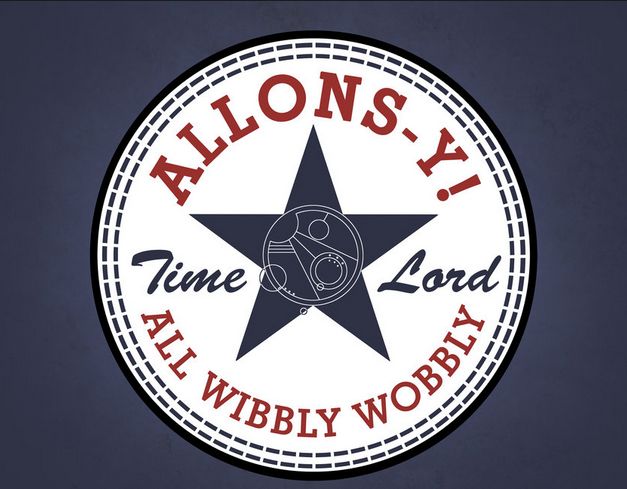
Allons-y has also been immortalized in memes like these:

Screen Shot 2015-07-28 at 10.57.49 AMScreen Shot 2015-07-28 at 11.09.40 AM  Screen Shot 2015-07-28 at 10.56.55 AM

So, using “Allons-y” might not have much purchase if one is going for “French authenticity.” It might even convey something more like “Big (Anglo)Phony.”

But. It still might add something fun to the Philadelphia performance of Slick Macarons.

Moving on, I thought I would try to zero in on the more paralinguistic aspects of being “The Frenchman” and found this video on “Ten Ways to be Parisian with (“Chanel Muse”) Caroline De Maigret.”

10 ways to be Parisian

On viewing her lovingly hilarious portrait of the Parisian Woman, I thought tip #2, “Look at your phone when it rings but don’t pick it up,” might give my daughter some sense of the physical performance she could enact as The Frenchman in Slick Macarons.

In all, these few minutes of Sociolinguistic Persona Hacking gave us a lot to work with.

Sociolinguistic Persona Hacks may also  suggest a broader lesson about language. Creating a Sociolinguistic Persona ultimately has less to do with “accuracy” or “mastery” of a named language (like French) and more to do with combining languages, attitudes and one’s own personal flair. Learning a language (or to act out a language) is necessarily about learning about languages and their many ways of acting.

Ce n’est pas grave, mon Cheri!

Allons-y!

Have you ever tried your own Sociolinguistic Persona Hacks using languages you are not familiar with? Or, if you are a language teacher, with the languages you teach? Share your secrets—er, stories—below!

A World of Others’ Words

After my last post, some readers took immense issue with my use of the phrase, linguistic gentrification.

I pointed out that sometimes privileged, white people use phrases taken from the life ways of black and brown people without knowing the deeper story of that language.

So I made an analogy to “gentrification.”

I wanted to suggest that, just like neighborhoods, our words have had previous residents.

Screen Shot 2015-06-21 at 7.31.52 AMIronically, and perhaps too late, I realized the word “gentrification” itself has its own vivid history, of which I am only a partial witness. As the literary theorist Mikhail Bakhtin (pictured) has stated, “We live in “a world of other’s words” (1984, 143).   And this certainly became clear when I used the term “gentrification.” Reader responses rolled in:

@grvsmth started an exchange on Twitter:

Sorry, @brymes, I find “gentrification” a really problematic term; applying it to language only muddies the waters

@nelsonlflores came to my defense with this mature formulation:

It seems very different to acknowledge its complexity than to completely dismiss as a viable concept.

But others held fast: @capntransit suggested we simply should not use the word “gentrification”:

The dehumanizing and scapegoating is so woven into the frame, I can’t see how you’d extricate it.

Any word I use, to quote Mikhail Bakhtin again, comes already “populated—overpopulated—with the intentions of others”(1981, 294). And, clearly, I had blithely used the word “gentrification,” not knowing the previous intentions of others using it. I hubristically thought I could, in a 500-word blog post, populate it with my own intentions: A useful analogy for a linguistic process. Not so?

In my own defense, these responses also illustrate the point I was trying to make: I was “gentrifying” the word “gentrification”—attempting to people it with my own intentions, the same way people take over neighborhoods with theirs.

But in that short exchange, we also began illustrating the positive potential in such a process by constructing a new social history for the word “gentrification.” And we began to use it as a way to think about language too.

As a character in Chang-Rae Lee’s novel, Native Speaker puts it (p.46):

No matter how smart you are, no one is smart enough to see the whole world. There’s always a picture too big to see

So what do we do? Do we just stop trying to see it? As Citizen Sociolinguists, we try to assemble a bigger picture than any one person can see by putting those different perspectives together. In the spirit of Citizen Sociolinguistics, to search for more of the “world of others’ words” behind “Gentrification,” I tried a Citizen “Corpus Analysis” by googling the phrase, “Why is Gentrification…” and waiting for the autofill to happen. Here’s what came up:

Screen Shot 2015-06-21 at 7.00.34 AM

According to the Google algorithm, it seems that, in agreement with the Twitter responses, gentrification is a word that people associate with being “bad”—but also “important.”

When I added the word “so,” only one Google search response came up:

Screen Shot 2015-06-21 at 7.00.56 AM

Again, like language, gentrification seems to take on a life of its own. No matter how much we say about it—whether it is good, bad, important or controversial, it is happening. And, like language change, it is hard to stop. We live in a world of others’ words, others’ intentions, and we navigate it. As citizens, and certainly as Citizen Sociolinguists, I urge readers to explore the range of perspectives on it—and that we do it together.

Have you ever had a moment when you realized you live in a “world of others’ words”? What words have you used that – perhaps too late—you have realized are “populated with the intentions of others”? How did you learn about those intentions? Please comment below!

Linguistic Gentrification

Most people recognize the process of neighborhood gentrification: A once affordable neighborhood with character becomes transformed by wealth into a place that the very people who nurtured the character of that place can’t afford to live in anymore (or don’t even want to). With a moment of thought, you can probably think of a few examples of linguistic gentrification too: Everyday, “non-standard,” yet uniquely expressive language gets repackaged as cool, trendy, even standardized—so much so that the original users may no longer want to use it.

Screen Shot 2015-06-16 at 8.49.32 AM

When neighborhood gentrification strikes, features of old run-down structures originally organic to a way of life—like a breezy front stoop or an original ice box—get repurposed as signs of sophistication. Likewise, linguistic gentrification: Features of language originally part of a way of life—and some looked down on in schools or marked as “non-standard”—become markers of sophistication, local knowledge, or social cachet.

Often these gentrified features originally come from speech typified as “African American.” Those very features deemed “non-standard” resurface as expressively powerful, and get used by white people. So, while most English teachers will decry the use of a “double negative” as incorrect, students in an Ivy League University will use the phrase, “Ain’t nobody got time for that!” strategically and to great effect (see previous post, Language Awareness II).

The word “finna” has also gained popularity these days in suburban Honors English classes I’ve been working in. It even appeared in a collective slang word cloud they created last semester:

Screen Shot 2015-06-16 at 11.10.54 AM

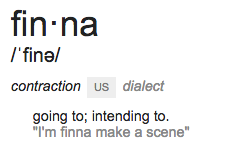
Finna also appears on the Internet in this official looking entry (the very first hit for a google search):

Screen Shot 2015-06-16 at 9.10.28 AM “Shawty,” “salty,” “jawn,” and the ubiquitous, “yo” are other words gentrified by suburban Honors English 11th Graders.

 But when asked about “finna,” “salty,” or “shawty,” few students can provide a sense of the social history of these words, aside from their own personal contact with them. Most assume they just were part of auto-tuned YouTube songs or funny Vine videos that somehow went viral. A few mention Kanye West as a good source of these expressions. In conversation, one student mentioned that “finna” might come from “fixing to,” a “Southern” phrase. But, others had no idea that “finna” might be parsed that way.

 Just as neighborhood gentrifiers vary in their knowledge of the history of the city they occupy, linguistic gentrifiers have varying levels of awareness of the historical foundation for these words, phrases or features of pronunciation. And, newcomers to words and phrases like “salty,” “ain’t nobody got time for that,” or “finna” use them with wide-ranging degrees of finesse. Some gentrifiers—of cities and language—surely recognize underlying character and build on that. Yes! Others might lack that sensitivity, driving away residents and speakers, losing generations of history and life ways that built the original character that drew us to those places and expressions.

Do you recognize linguistic gentrification around you? Do you partake in the process? What are the different types and what are their effects? Please comment!

WAVE! White American Vernacular English

What if we analyzed everyday speech of White Americans as a legitimate, internally consistent system?

Try googling “White American Vernacular English” and guess what you get:

Screen Shot 2015-06-12 at 3.46.16 PM

The Wikipedia entry for “African American Vernacular English.”

Does this mean WAVE does not exist as a legitimate systematic variant of the English language?

WAVE might easily be characterized by a quick internet search for “Grammar Pet Peeves.” Using this definition, my search reveals many possible tokens of WAVE, probably recognizable to most readers. This is a typical Internet circulated list:

Screen Shot 2015-06-12 at 4.04.17 PM

This list (and the countless other similar lists on the Internet) probably contains some words or usages that most white people use frequently.

Sometimes, we have less conscious awareness of WAVE tokens. For example, a few months ago, news surfaced about an individual who had, over several years, changed thousands of instances of a certain “grammar error” on Wikipedia. When I asked people to guess what it might be, many came up with common pet peeves like those on the list above. But the culprit was the phrase “comprised of,” used where the Wikipedia editing maven considered “composed of” the correct choice. “Comprised of” he asserted, simply has no place in the English language.

Many white people, however, use “comprised of” all the time. Even I, a college professor, but a native speaker of WAVE, grew up using “comprised of” in place of “composed of”! Many of my peers don’t think of it as “wrong.” Swiftly, people began to speculate that this Wikipedia correction maven had Obsessive Compulsive Disorder.

Many other people who point out “errors” white people make also, frequently, are taken to task. The errors they are pointing out inevitably are recognized as common (even systematic!) but easy to overlook. The people who have these Pet Peeves sometimes even apologize for being so picky.

And white people generally don’t officially get penalized for saying “literally” in a figurative way, or using “comprised of” instead of “composed of.” In classrooms, teachers say things on these Pet Peeve lists all the time and, unless that teacher has an arch enemy in the class, nobody corrects them.

And nobody collects these words together and calls them WAVE and then says they are appropriate in some situations, but not in others: “Okay, you can say “literally” for emphasis when you are drinking with friends, but never in a job interview.”

Let’s face it: WAVE is not a thing people talk about. AAVE is. And because AAVE is named, sometimes people say it is appropriate here and there, but not over there.   Originally, the christening of a variety of speech with the name AAVE was meant to provide legitimacy. But over time, this good intention has stumbled all over itself by suggesting on the one hand that it is “legitimate” but on the other hand, only in certain (non-white) situations.   WAVE on the other hand, does not need to be labeled because white people speak it. And even though some people have a few mild “pet peeves” about it, WAVE is legitimate in white public spaces (like schools).

Nelson Flores and Jonathan Rosa, in their brilliant article in Harvard Educational Review this month, call this a raciolinguistic ideology. They carefully illustrate how the language of white people is not subject to the same “appropriate” or “not appropriate” critique that the language of Black or Brown students is subjected to in classrooms. Flores and Rosa do not talk about WAVE—because it does not exist as a named entity. And this illustrates their point. White people, by virtue of being white, get to count as using language appropriately.

As long as I am a white person, I can speak the way I grew up speaking. Aside from the occasional article about linguistic Pet Peeves or the (OCD?) programmer who corrected thousands of instances of “Comprised of” on Wikipedia, nobody will correct me. They will understand that I’m just speaking after all, I’m not writing the f***ing Declaration of Independence!

And literally nobody will sympathetically identify me as a native speaker of WAVE, but kindly advise that my speech is not appropriate in school.

Are you a speaker of WAVE? Do people sometimes tell you it is not appropriate for certain situations? Do you repeatedly get critiqued for speaking the way you grew up speaking in your home? Do you see other evidence of raciolinguistic ideologies around you?

Making a Scene: Get thee to YouTube

Screen Shot 2015-05-09 at 9.44.39 PMI just saw Shakespeare’s Hamlet off Broadway at the Classic Stage Company. The production features Peter Sarsgaard as a hipster Hamlet, drinking, sniffing coke (meth?) and lackadaisically moping around, while delivering his lines in a way that uncannily grabbed my attention. His perfectly laid-back, but pained delivery turned the super-familiar, “To be or not to be…”, “Oh that this too too solid flesh would melt…”, “Alas poor Yorick, I knew him…” into brand-new-seeming phrases.

Hearing these lines again also made me think of the modern Internet meme-like quality of much of Shakespeare. How different is “To be or not to be” from President Obama’s “Yes we can!” or Sweet Brown’s “Ain’t nobody got time for that.”? Why do we keep watching and performing these phrases again and again? One reason might be that each time we hear these recognizable words in new contexts, we experience something different (See also, modern day poetics post). How would this work with Shakespeare?

I decided to choose one meme-like phrase of the play and focus on that, and Sarsgaard’s performance struck me most during the “Get thee to a nunnery” scene. I had remembered this scene as one of an angry Hamlet ranting at Ophelia (his girlfriend) telling her, “Get thee to  a nunnery!”, shoving her around crazily. But in Sarsgaard’s version, Hamlet and Ophelia (played by Lisa Joyce) seemed not really to be talking to each other at all. Hamlet wasn’t ever yelling and rarely even directing his speech at Ophelia, but musing to himself about the pointlessness of marriage, the fickle nature of all women. He closed the scene in angst, leaving the stage without looking at Ophelia:

I say, we will have no more marriages:

Those that are married already, all but one, shall live;

The rest shall keep as they are. To a nunnery, go.

Throughout the scene, Hamlet came off as depressed and disillusioned with all womanhood and humanity. Ophelia seemed heartbroken, for losing Hamlet, and for Hamlet losing his mind. Each seemed not to be talking to, or even addressing each other. The scene, as played by Skarsgaard and Joyce seemed about painful and isolating misunderstanding. It seemed deeper and sadder than I had ever remembered.

I turned to YouTube: How do others make meaning out of these words?

First, I found the Mel Gibson (1990) movie version:

GibsonNunnery

Though this scene takes a long time, Gibson cuts nearly half of the text. He never even says “get thee to a nunnery,” “make thy way to a nunnery” or even, the final, “to a nunnery go!” Instead, he yells a lot and pushes Ophelia around.

Next, I looked to the more elegant Kenneth Branagh & Kate Winslet (1996) movie version. Here Branagh includes all of Shakespeare’s text, including “Get thee to a nunnery.” And he delivers it directly to Ophelia’s face.

BrannaghNunnery

Branagh, like Gibson, but not to such a degree, yells a lot while storming around a huge castle atrium.

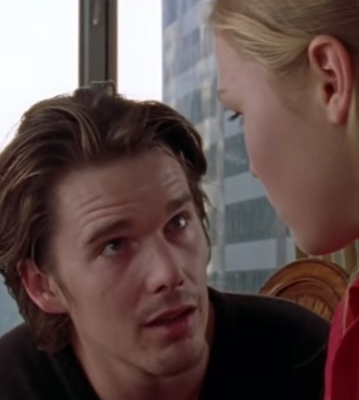
Ethan Hawke (2000) takes a different approach. He is a modern guy, involved in business dealings in New York, up in a high rise, holding a beer (Carlsberg). But, like Gibson & Branagh, in the nunnery scene, he emotes directly to Ophelia. He is massaging her shoulders as he delivers his “Get thee to a Nunnery” line, and oddly pleading with her when he tells her why she should go, “We are errant knaves all; believe none of us”:

HawkeNunnery

One YouTube commenter (the only one) suggests a possible problem with this performance:

HawkeComment

As Georgian Wolf’s comment hints, Hawke’s engaged stance toward Ophelia seems strange considering the harsh, yet almost stream-of-consciousness content of his lines.

Big Stars are not the only ones performing Shakespeare on YouTube. So, I started looking at non-professional versions performed by students in English classes. My favorite was an unlikely performance by “Hong Kong students”:

HongKongStudentsNunnery

This version came closest to the painful sense of detachment and loneliness I got from Sarsgaard’s performance. Hamlet is staring off into space for the “get thee to a nunnery” line. And, many of the other lines cut to imagined, dreamlike spaces (and distinctly non-Denmark like settings):

MarryaFool

This HK Students’ version might speak more to other high school age students (especially in Hong Kong) than any of the professional productions do. And, collectively, this small set of YouTube scenes (and there are many more) illuminate the potential range of interpretations of a single scene, even a single line, of Shakespeare—including the potential to mock Mao Zedong!

Still, many High School English students seek out the “Spark Notes” website rather than YouTube to try to figure out what is going on in Shakespeare. How does Spark Notes represent the Nunnery scene?

Hamlet is very nasty to Ophelia and tells her to become a nun.

After seeing a YouTube repository of Shakespeare scenes, performed in dozens of new ways, this bare bones description disappoints. Unlike a Spark Notes synopsis, YouTube performances of classics don’t attempt to generically summarize THE meaning of a scene. They collectively communicate the huge range of potential meanings behind not only Shakespeare, but all our language. Also, inevitably, some performances work, some don’t. Why? What comes together to make a scene? How could centuries-old drama make sense in our world? Why do some performances speak more to certain people than others? To explore these kinds of questions, get thee to YouTube!

Have you encountered YouTube versions of “classics”? Have you any favorite versions? Can YouTube help students connect to literature and understand language in this way? Please comment below!

New Uses for Old (Linguistic) Tools

rakefornecklacesDIYGoogle “Old Tools, New Users” and you will find a host of innovative ideas for how to recycle old rakes, hammers, screwdrivers, clamps and even the toolboxes that once held some of those things you no longer use. These sites offer new life for our favorite old (but now unused) implements by giving them updated roles in our updated lives. I don’t need this old (but cool-looking) rake but I do need someplace to hang my scarves and necklaces. Voilà! Problem solved. I don’t need these extra hammers, but they could do a great job holding up my i-Pad.ipadDIY

Just like old rakes, hammers, and pitchforks, old linguistic tools have been repurposed by DIY adventurers, and their new uses have multiplied on the web. For example, a dialect survey created in 1930’s by the linguist Hans Kurath has become widely known via internet-mediated social circles. This survey includes two parts: a list of words to read aloud, to illustrate how you say them (including Water, Crayon, Caramel, Syrup, Pecan & New Orleans), and a list of prompts to elicit what locals call certain items (For example, “How do you address a group of people?”). The original purpose of this survey was to gather data that could be used to construct Regional Linguistic Atlases. And Kurath created several of these, in multiple volumes, using his survey and careful statistical mapping to characterize local dialects of the United States.

Just over a year ago, a version of Kurath’s survey reappeared as a modified and internet-ready “Dialect quiz” in the New York Times, How Y’all, Youse, and You Guys Talk.

Rather than using this quiz to create regional dialect maps, the NYTimes quiz offered to indicate “where you’re from.” Many people I know took the New York Times quiz at least one time, and declared astonishment as to its accuracy. But others also took it several times, playing the part of people from places they had lived at some point in their life. Others laughed at its extreme inaccuracy–like an Australian friend who was identified as from Yonkers. People were using the tool and relishing it, but instead of using it to pinpoint regional variety, the new use seemed to foment talk about mobility. Discussions like, “When I lived in Atlanta… but in Chicago…”

Another re-tooled version of Kurath’s dialect survey surfaced before the NYT “Dialect Quiz,” and circulated through Tumblr and YouTube as the “Accent Challenge” or “Accent Tag.” There are now thousands of Accent Challenge videos posted on YouTube. These performances illuminate features of English in today’s world that could never have been predicted by Kurath as he and his research assistants traversed the States with their trusty notebooks and gigantic recording devices.

English that Includes Korean: One accent challenger, featuring what she calls a “Konglish” approach, reads through word list and prompts twice: Once, as she would say things when she is with her Korean friends and again, as she would talk with her American friends (see previous Post).

English Around the World: The accent challenge videos go far beyond Kurath’s boundaries of the United States, including Jamaica, Australia, New Zealand, and dozens of finely divided regions of Ireland, Scotland, and England.

English and Exchange Students: Some accent challengers have even used the survey as a way to compare the different varieties of foreign accented English—and comparisons of the differences between Swiss, German, and Italian speakers.

Stories of Language Use: Almost all accent challengers take their time with the survey, prefacing the reading of the list with long stories of how they grew up speaking certain ways and with whom, and interrupting their survey with asides that add to their story.

All of these Accent Challengers (and there are many more varieties) display an awareness of their own and others’ speech that Kurath could never have fathomed or welcomed, as he set out to document the unmonitored, regional speech of rural folk.

Now, working with teens in high school English classes, I’ve had them develop their own New and Improved Accent Challenge, to explore language around them. They’ve devised new word lists and prompts that depart from the standardized goals of Kurath, to ask peers, parents and locals about more contemporary local language distinctions. Instead of asking “What do you call a small bug that rolls into a ball when touched?” for example, they’ll ask “What do you call the dairy dessert that comes from a machine?” since the distinction between those who say “soft serve” and “custard” appeals more to them (as citizen researchers) than the name of a roly-poly.

Most old tools probably did their job well. Rustically beautiful rakes and hammers remind us of simpler times, while lending a hand in our modern homes. The new role of linguistic tools can also bring to mind a simpler communicative time and simultaneously illuminate some features of our updated communicative world. Repurposed and in the hands of citizen sociolinguists, Kurath’s old survey does not lead to several more pounds-worth of bound volumes of linguistic detail, but instead, it builds awareness and sparks dialog about complex forms of linguistic diversity. The conversations brought on by oldtoolboxthese repurposed linguistic tools go beyond “roly-poly” or “custard” and “soft-serve,” building awareness of linguistic difference, how quickly it changes, how it separates us, or can draw us together.

Have you made new discoveries by using old linguistic tools like the “Dialect Quiz” or the “Accent Challenge”? What other old linguistic tools are you aware of that might take on new uses today?


Untranslatable and Multilingual Words

pochemuchkaAbout two years ago, a blog listing 11 “Untranslatable words from other cultures” became unexpectedly popular.This list includes beautiful illustrations and words that describe situations or states of mind that we all might recognize, but may not have a single word for, like the Spanish word for post-meal conversation:

Sobremesa: the time after lunch or dinner you spend talking with the people you shared the meal with.

Or the Russian description of a potentially annoying type of person:

Pochemuchka: Someone who asks a lot of questions. In fact, probably too many.

The “pochemuchka” description also includes the aside, “we all know a few of these,” suggesting that, though the word is distinctly Russian, the sentiment may be familiar cross-linguistically.

The voluminous comments following the 11-word list reveal a general recognition of the social arrangement or emotion described by each entry, but also the special added zing that these sentiments take on when a specific word gets attached to them. As one commenter wrote:

Tine • What a lovely post! It gives me great joy to hear about other people’s perceptions and how they cherish it enough to give it its own word.

The subsequent proliferation of sites with “untranslatable words” like this suggests that many people like Tine, above, are drawn to words from afar that name subtle, yet recognizable, feelings, perceptions, situations, or social nuance. (Try googling “untranslatable words” and you will find dozens of lists, videos, and essays). Paradoxically, these “untranslatable” words seem to translate well to readers, as insinuated by at least one commenter on a YouTube video illustrating “8 Untranslatable words” (https://www.youtube.com/watch?v=sPHJp25u7Tw):

Qichin 8 Untranslatable words … and their translations.

If there are words that exist in one language but have widely recognized meanings, could there also be words that exist in many languages (or “cultures”) but have different meanings? Is there a flipside to “untranslatable words?” I call these multilingual words. They exist. But this type of word seems harder to find.   Googling “multilingual words,” yields no entries describing this possibility–only multilingual word lists featuring supremely translatable words like Hello, Goodbye, Thank you and You’re Welcome, or simply definitions of the word “multilingual.” Googling “words that exist in multiple languages” yields the same lists of “untranslatable words” described above.

Still, words that look the same and sound the same in different languages but have different definitions in each of those languages do, of course, exist. The recent guest post about Google my Bulbul, a popular YouTube video, provides at least one example. The word “Bulbul” draws a few comments that suggest different definitions:

Insan hor  ‘Bulbul’ means ‘Penis’ in Egyptian.

Yzeed Az no it means beautiful bird 😛

Business Andbusiness is is bird with melodious voice

SillyDodo  Uhh.. bulbul in hebrew is a word for penis..

 These are not subtle sentiments or distinctions. “Bulbul” is not “untranslatable.”  People just disagree on the translation. They also disagree on what language it comes from.  Therefore, in the face of this comment controversy, the best way to understand what “bulbul” means is to see how the video-maker, Funzoa, uses the word in his video. The Bollywood style of the entire video points to the more romantic “beautiful bird” definition. And, Funzoa, perhaps to disambiguate as clearly as possible, illustrates his otherwise whimsical “Google my Bulbul” with a very dictionary-illustration-like bird:

Bulbul bird

Finally, in the comment thread about the meaning of “bulbul,” Fuzoa explicitly disambiguates:

Funzoa It means a beautiful bird in india. Ao either way google bulbul works. Hehe

With this example of a “multilingual word” in mind, I went back to the “untranslatable” words to refine the distinction. Do people disagree about the meaning of these untranslatable words the way they do about multilingual words? I found numerous claims to new “untranslatable” words in dozens of world languages. But all these words seemed isolated to the language claiming them, and most comments agreed on each meaning.

In some cases, commenters argued about the linguistic uniqueness of the word. So, while Brazilians may want to claim “saudade” as uniquely untranslatable, others name new words to describe it. “Saudade” is to Portugese as “dor” is to Romanian as “stesk” is to Czech as “tesknota” is to Polish as “sehnsuchst” is to German. Similarly, “hygge” is to Danish as “cozy” is to English as “gezelligheid” is to Dutch, and so on.

The comments largely confirm that the “untranslatable” words, while new, are readily understood by readers of different languages as distinctive, and descriptive of feelings we generally understand.

But, finally, one comment thread on the 8 Untranslatable words YouTube video posed this challenge:

Jolly Infidel  Good stuff… But i was hoping for a english word that has no foreign translation.!

And the response came:

ThePolocatfan276 I think that’s called “slang”

Is “slang” so special as to be “untranslatable?” Could it be elevated to the level of “saudade” and “hygge”? Or is it more “multilingual,” like “bulbul”?

Recalling my recent discussions with teens, who love to talk about “slang,” several possibilities for each type of word came to mind. Take this current phrase, for example (with definition approximated from multiple 11th grade discussions).

Eyebrows on fleek: When someone is perfectly coifed, eyebrows smooth and plucked, looking supremely socially confident.

Like “saudaje” or “pochemuchka,” “fleek” seems to be an “untranslatable” word. We recognize the feeling of the expression, “Hey, I’m ready to go to the party! Eyebrows on fleek!” but we might not use that phrase in our own “culture.”

GucciThe following words seem more like the multilingual word, “bulbul.”

Drawin’ (drawing a picture or being annoying?)

Gucci (designer brand name or good—as in “it’s all Gucci”?)

Turning up (showing-up or getting-really-excited-for-a-social-event?)

Even though these words are in English, they act like multilingual words because they mean differently across different groups of people. Teens recognize one meaning, older adults another. Rather than naming a feeling we all recognize, with a new and special word (on fleek!), these words are the same words we all recognize. But, they are infused with new, youth-culture meaning (That’s Gucci!). So here we have it:

Untranslatable words show how naming something brings meaning to a widely recognizable aspect of our social or natural world.

Multilingual words show how our social connections bring new meanings to our words.

Assuming this view on multilingual words, we may be speaking many languages even when we think we are only speaking one. And, being lost in translation may not only apply to named languages like Russian or Spanish or Portuguese. It may also happen when we use words that apparently belong to the same language.

As the linguists Sinfree Makoni and Alastair Pennycook wrote in 2006, in their book Disinventing and reconstituting language (p. 36):

All communication involves translation.

This translation involves not only the typical act of one language being translated into another, but also, and more substantively, the act of people talking to each other and trying to make meaning out of each others’ words. Both untranslatable and multilingual words have the potential to open up different kinds of worlds: Those we recognize but haven’t yet named, and those we have yet to know about.

What “untranslatable” or “multilingual words” do you know? How do you use them? Where, when and with whom? Have you every felt lost in translation in your own language? Please comment!