Google Translate Hacks

How do you translate talk and text? For many, Google Translate, the on-line translation robot, comes into play. But Google Translate makes mistakes, so ingenious humans have figured out nuanced ways of using it in not exactly the way it was intended: Google Translate hacks.

Hack #1: The Stereotype Detector

In this post on Google Translate one blogger asked “Is Google Translate Sexist?” and then suggested that, indeed, it is. He showed this by running tests in German, in which, for example, the word “teacher” in the phrase “Cooking teacher” translates as “Lehrerin” (feminine) while in “Math teacher” it translates as “Lehrer” (masculine).

I tested this myself, with Spanish: Sure enough, a “Cooking teacher” is a “professora” (feminine), while a “Math teacher” is a “professor” (Masculine).

cookingteacher

mathteacher

This does not necessarily mean Google Translate is sexist. Instead, this “sexist” translation illustrates Google Translate’s strength as a potential stereotype detector. Some words collect in gendered ways. We recognize these stereotypes—in concert with Google Translate.

Hack #2: The Bilingual Expertise Detector

In the transcript below, from Meredith Byrnes’ research on bilingual family literacy, a bilingual mother is explaining to her two boys (ages five and six) how she translates the English idiom, “school of fish”:

¡Porque aquí dice school of fish y abajo dice banco de pescado. Pero si fuera- si como dice arriba school of fish seria escuela de pescado!


(Because here it says school of fish and down here it says bank of fish. But if it was- if it says school of fish it would be school of fish!)

Bilingual people like this mom have special knowledge. The boys will not be able to simply use word by word translation or  a dictionary or even Google Translate for an idiom, because it does not translate literally:

schooloffish

Nope! Google Translate doesn’t get it. But this “mistake” reveals how Google Translate can work well as a Citizen Sociolinguistic tool. In its dumb errors (or “sexist” oversteps) Google Translate can reveal the nuanced knowledge of human beings, like this bilingual mom.

Hack #3: The Bilingual Collective Expertise Detector

Flash forward 10 years in the life of a bilingual family. Often, bilingualism is distributed across a family, parents having expertise in one language, children in another.   Robert LeBlanc’s research on multilingual literacy among teens who attend a massively multilingual Catholic Church (services offered in English, Spanish, Vietnamese, and Tagalog) illustrates this point.  And, he learned about this Google Translate hack one family developed there.

Teens who attend this church regularly use Google Translate as just one of several translation steps to read scripture publically. One teen, who doesn’t speak much Vietnamese, or read any, manages to recite scripture aloud in church. These are his basic steps:

  1. Types bible passage into Google Translate
  2. Prints out Vietnamese text from Google Translate
  3. Asks mother (who speaks and writes in Vietnamese, but not English) to edit, smoothing over the inevitable Google Translate errors.
  4. Records mother reading the passage aloud, using his phone.
  5. Listens to audio from phone during spare moments and repeats it until it is committed to memory.
  6. Recites memorized Vietnamese bible passage in church.

With this hack, Google Translate, which seems impersonal and error-prone, has the potential to function as an intimate medium, forcing at least one teen to engage deeply on a multilingual task with his mother.
2003-LOST-IN-TRANSLATION-007

Lost and Found in Google Translation

Because Google Translate is imperfect, much is lost in translation. But when we use Google Translate as Citizen Sociolinguists, in concert with multilingual acquaintances, friends, or family members, much more can be found. How do you use Google Translate? What Google Translate hacks do you know?  Please share and comment below!
 

Language Diversity at the Oscars

The lack of racial diversity in the “Academy” (of Motion Pictures) was well publicized long before Oscar night. It even gave writers enough time to come up with Neil Patrick Harris’ quip about “the best and the whitest– oops brightest” to kick off the show. And, with #OSCARSSOWHITE cresting as a popular twitter hashtag, white homogeneity was in the spotlight.

But how did language diversity fare? There is no #OSCARSSOSTANDARDENGLISH or #OSCARSNOLANGUAGEDIVERSITY2015 to track on twitter. How inclusive is the Academy when it comes to different ways of speaking?

As Citizen Sociolinguists, we have the tools to investigate. First step, we can look at what people were saying then and there, at the Oscars, about language. Then we can ask our social networks: What memorable moments of language talk could people recall the next day?

People I’ve talked to immediately recalled two primary ultra-awkward moments of talk about language (and these seem to have been underlined in real time Twitter feeds too).

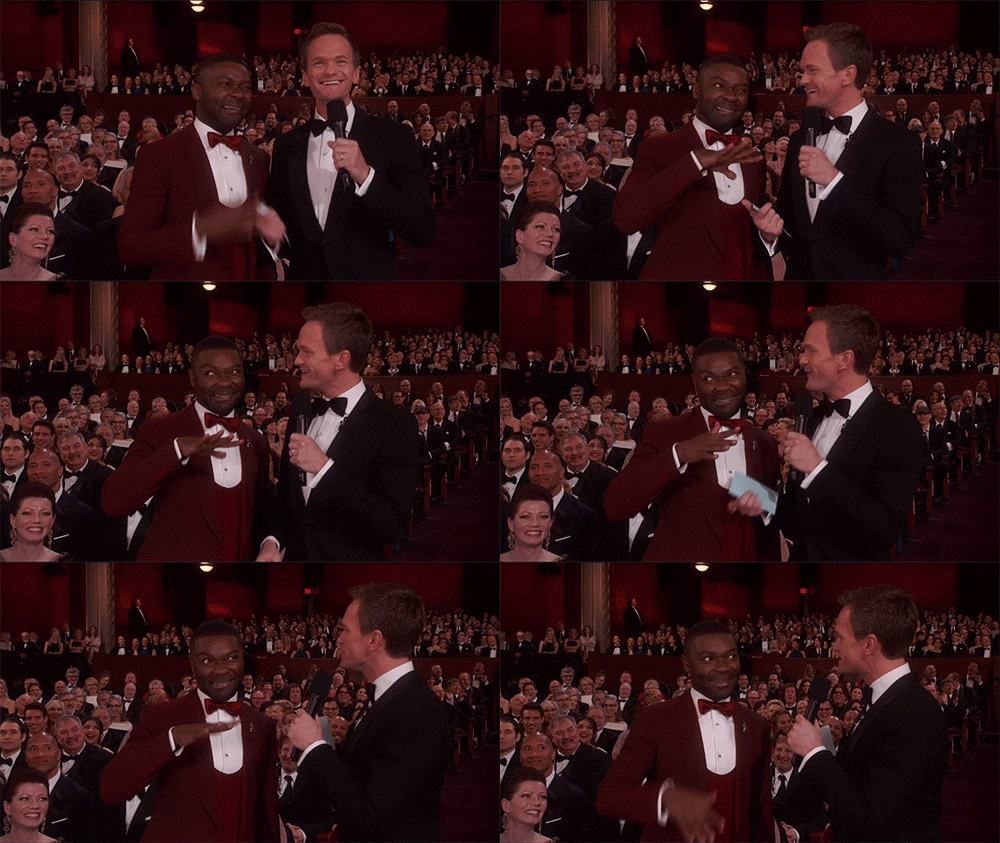
The first of these two key language awareness moments was Neil Patrick Harris’ attempt to talk about the “British Accent” with David Oyelowo, best actor nominee for his role as Martin Luther King, Jr. in Selma. Neil Patrick Harris jokes, “Help me prove that everything sounds better in a British Accent. I’m going to do this setup for a joke and then I’ll give you the punch line.” The joke and the punch line are not worth repeating—only barely funny, clearly tasteless. Simply the expressions on the faces of the audience were enough to indicate the sourness of this routine. And on the web, Oyelowo’s gif-immortalized gesture echoed this impression. Even British English couldn’t patch things up:

Oyelowo

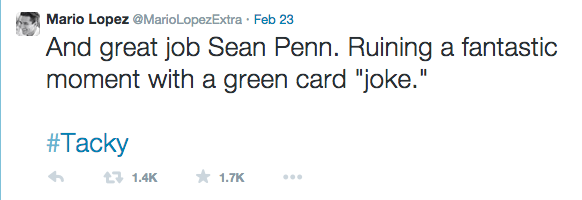
The second memorable language awareness moment began when Sean Penn announced the winner of Best Picture, for Birdman, directed by Alejandro González Iñárritu. After the usual pregnant pause and before he announced the winner, Penn’s off-the-cuff “green card” comment—alluding to Iñárritu being Mexican—met with immediate revulsion on Twitter. As exemplified here:

Screen Shot 2015-02-25 at 12.11.46 PM

A few glum faces, even among the best picture winners, gave hints that this humor didn’t fly with everyone in the room either. Iñárritu then brilliantly stepped on stage with the cast of Birdman and took the microphone. Self-deprecatingly, he described his own English accent:

Oh my god, they want me to talk because I am the worst English-speaking guy here.

Then he proceeded to put to shame the evening’s countless scripted and non-scripted attempts at language artistry. He spoke up for Mexico and for Mexicans’ contributions in the United States, and he implicitly punched back at Sean Penn’s joke:

Finally, I just want to take one second. I want to take the opportunity to dedicate this award for my fellow Mexicans. The ones who live in Mexico. I pray that we can find and build a government that we deserve. And the ones that live in this country, who are part of the latest generation of immigrants in this country. I just pray they can be treated with the same dignity and respect of the ones who came before and build this INCREDIBLE. IMMIGRANT. NATION. Thank you very much.

If that is the “worst English-speaking guy” in the room, what might we call some of the other English speakers present that evening? And how well does the Academy seem to recognize the verbal artistry involved in language diversity?

What moments of talk about language did you hear at the Oscars? What do your social networks have to say about language diversity that night?

Leave your comments below!

Sociolinguistic Outtakes: Footnotes, Epilogues, Anecdotes and Asides

Have you ever indulged in a movie… outtake? The DVD ends and scenes flash beside the credits, featuring the very same movie actors you just watched–breaking character. They swear or burp or burst into belly laughs, when they are supposed to be exuding wisdom or dying or committing a felony.

 FellowshipOuttake“I’m sorry I cannot get up these god damned steps smoothly” (Ian McKellen outtake from The Fellowship of the Ring)

Even animated movies have outtakes. Toy Story outtakes, for example, proliferate on the web—as if the anthropomorphized toys are so real that they, like human movie actors, sometimes break character and burp or giggle at the wrong times.

BuzzBurp Buzz Lightyear after burping in his packaging (Toy Story outtake)

Outtakes were once perhaps simple teasers to make people keep watching during the credits after the movie ended. Now they are specially produced and sought out on the web for their own, unique merits (one Toy Story compilation on YouTube has over six million hits). Why? What makes outtakes interesting to people?

Outtakes show that actors—even the toy Pixar characters?—have lives beyond the artifice of the movie set piece. They react to situations and interact with each other in a huge variety of ways, some of which may be familiar to us, or idiosyncratic and new (like the way Seth Rogan giggles). Also, they make us feel like Hollywood insiders. Movie making isn’t as elite and exclusive a process as we may have thought. Outtakes reveal the process. They also suggest the joy in it. Maybe making the movie was even more fun than watching it.

Now, how does this citizen enjoyment of movie outtakes relate to Citizen Sociolinguistics? Think of the “research article” in place of the “movie.” The article, conference address, or book, like a Hollywood production, emerges from careful editing–the squeezing of countless interviews, observations, field notes, recordings, videos, into the professional medium of a journal article. As with moviemaking, quite a bit ends up on the cutting room floor.

But, language researchers seem to delight in resurrecting those bits that didn’t fit their professional storytelling venture (or research methodology). Just as movie producers (and viewers) delight in replaying Ian McKellen swearing about his robes in The Fellowship of the Ring, language researchers (and readers) relish the unexpected stories that emerge inevitably when doing research with our fellow humans.

It seems that the more rigidly traditional the research parameters, the more delightful the cutting room scraps. William Labov, for example, in a write up of a study that focused on five phonological features and their stylistic variation across five domains of use in New York City, honors his readers with dozens of asides and footnotes that call attention to idiosyncratic features of the humans involved. For example, the research subject Steve K draws these anecdotal descriptions from the staunchly quantitative researcher:

He studied philosophy for four years at Brooklyn College, but left without graduating; he had turned away from the academic point of view, and as an intense student of Wilhelm Reich, sought self-fulfillment in awareness of himself as a sexual person. (p. 104-5)

While Labov includes these descriptions of his subjects (and this one continues in a footnote), he concludes that they play no part in the focus of his research on stylistic variation. Yet these Steve K sorts of descriptions remain a hallmark and entertaining highlight of all Labov’s research.

Linguistic anthropologists, like sociolinguists, also indulge in the anecdote and aside. I still recall clearly the story one of my anthropology professors relayed about a white (Caucasian) anthropologist’s fieldwork. In a discrete epilogue to his book length ethnography, he revealed that, during his entire time living as a participant-observer in remote Indonesia, the community thought he was a ghost.

In the spontaneous moment of an introduction or over wine at the post-talk reception, a researcher might share something about the connection of their work to their own life. Last month, for example, an esteemed, senior sociolinguist gave a talk here at Penn, and introduced his quantitative, fine-grained analysis with a story about his own experience as a graduate student with a stigmatized North Philadelphia accent. Long after he had finished his PhD and had begun to emerge as a leader in the field, his mentor/professor confessed: From the way you sounded in class, I never thought you would really make it through.

These research outtakes reveal the artifice of the research project and even the research training process, throwing what we might have ignored into the public’s view.

What we thought was marginalia may be what drives the work.

These days, sociolinguistic outtakes need not drift into the obscurity of footnotes, or asides during the post-talk reception. The structure of social media, the networked arrangement of the Internet, digital media that hyperlinks footnotes and other information, all make asides as easily accessible as the main research article. And those who are “subjects” in that article may be reading or listening to those asides. What if they joined the conversation?

What if we focused on the outtakes? That’s a Citizen Sociolinguistic approach. Now with social media and hyperlinks to even the most obscure trivia, the institutionally sanctioned research question can easily fall to the background, and the footnote can become focal. As the Cowgirl from Toy Story says in a blooper when she accidentally pulls off part of Buzz Lightyear: Should we put this in the movie now?

OutTakeToyStoryMaybe we should put more sociolinguistic outtakes into the official research. We may discover that the new post-globalization, post-Internet language diversity (or “super-diversity”), has been here all along, in the outtakes.

What “asides” become central to you? Do they take you off-track, or show you a new perspective, something you never knew about before? Please comment below!

The Language Experts

Who are the Language Experts?

When you have a question about language, who (whom!) do you ask?

Sometimes it may seem the experts are those language bullies or “grammandos” who peevishly correct grammar no-nos. If you are not sure of the difference between “comprised of” and “composed of” (and care), the man who has spent years combing through Wikipedia “correcting” those phrases over 47,000 times may seem like the best person to explain it to you.

But what if you have a question about less rule-bound ways that people use language?boutaweekago

For example, who provides expertise on these questions about speaking English in Philadelphia?:

  • What does “Salty” (or “sawdy”) mean when used by Philadelphia second graders?
  • Who says “Ac-A-Me” instead of “Acme” when referring to the Acme grocery store?
  • Why do some teenagers start rapping and dancing whenever they hear the phrase “bout a week ago”?

Moving beyond Philadelphia, suppose you have a question about a phrase you’ve heard in Spanish. What if someone called you a “fresa” and you had no idea what that meant? Would you consult a dictionary? That couldn’t tell you, like my friend from El Paso could, that “fresa” is a word often used for slightly spoiled, entitled girls from Mexico.

What expert on language could you consult if you encountered this English/Chinese phrase:

Hold住

A language purist might despise it, a Chinese Dictionary might translate it, but a Chinese 20-something could probably provide a more robust explanation for this phrase, (which translates into something like “hang in there!” or “deal with it!”), how commonly it is used, and its connection to a certain TV character.

This phrase might lead you to questions about other Asian World Englishes. How do Koreans, Chinese, Thai, Taiwanese, and Japanese use English differently? Who holds the expertise on this massive variety? I would suggest you start by asking someone who immigrated to Singapore for High School. They might be able to explain the intricacies and irreverence of accent parodies like this one:

https://www.youtube.com/watch?v=2OiDvo_XtV4

These are all cases where non-professional-experts, that is, average everyday people who are not linguists or English teachers—Citizen Sociolinguists—have expert knowledge. These everyday citizens have the know-how they need to navigate the daily intricacies of language and communication that make up their lives. And, usually, they are happy to share it.

Your very own friends and acquaintances can often answer your language questions with the precise type of expertise you want. Students and children can also be prime language experts in this regard. Or, Internet sources might guide you. Look up “grammando,” “bout a week ago,” or “salty” and you’ll get some approximations of the meanings of these phrases and their social value. Google “Asian Accents” or a “Mexican fresa” and you may find some video explanations, ranging across degrees of accuracy and offense. These are building blocks to understanding; Your ever-expanding circle of Citizen Sociolinguistics experts can continue to build on them.

Language has interest and connections to social life and human relationships far more wide-ranging than could be contained in one expert’s view. Fortunately, since the survival of life-as-we-know-it depends on it, the grammando will never have the last word on language. As David Weinberger has written in Too Big to Know, when it comes to language or any sort of networked knowledge,

…the measure of one’s strength as an expert is not that you have the final word on some topic, but that you have the first word (p. 68).

When words and communication confuse you, who (whom!) do you call on as your language expert? Your children? Your students? Your parents or friends? Urban Dictionary? YouTube? Google Translate? Others? A combination of all? Post your comments here!

Beoseu or Bus? How do you say it?

KoreanBusWhat’s bigger than a Croissant? A Beoseu!

Before I get on that bus (Beoseu), a brief croissant recap: The last post on “Croissant” generated a lot of commentary—including some new ideas about the reasons for the spread of the Frenchish KwuSAHN pronunciation among the moms of my friends and students. One croissant lover on Facebook posted:

I wonder if Julia Child was an influence?

Certainly Julia Child’s presence in the homes of millions must have had an influence on the spread of “kwuh sahn” as the go-to pronunciation for so many moms of my friends. They may be speaking “Julia Child” as much as they are speaking “French.”

Others, like this Reddit comment from alaricus, pulled us back to The French Language:

I’m a Canadian, and so a little biased, but I happen to think that the relationship between French and English is close enough that most French loan words should be pronounced in the French way.

And some others suggested regional difference:

inigo_montoya cruhSAHNT – from US northeast and Midwest

EDFTON Kwason – London

Another Canadian—reporting from Twitter—asked his mom about “croissant,” and she delicately raised the issue of social class:

You mean that bun thing rich people eat?

Other Facebook friends also hinted at the class-connotations of kwu SAHN and kruh SANT, bringing Pillsbury into the picture:

How about crescent rolls?

Still others mentioned, it really depends on the situation:

I use both! When I’m at Miel Patisserie, I’ll say kwu SAHN, but probably not at Trader Joes. Trader Joes is strictly a kruh SANT place.

A couple International graduate students mentioned that they have had odd experiences when they used what they thought was the authentic French pronunciation. For example,

When ordering a ‘Western kwu SAHN’ it was clear the waiter had no idea what I was saying. I immediately switched to ‘Western kruh SANT and everything cleared up

Overall, I noticed two emerging trends:

  1. Everyone is familiar with multiple pronunciations (though they may not use them all); and
  2. Many people express awareness of the varying social value of those different croissant pronunciations.

So, we are flexible users of a range of Croissant usages. Why should we care?

Because this type language awareness is much bigger than Croissant. We are talking about new ways of making meaning and using words—not capital L languages, proper pronunciations, or even simple “word borrowing.”

Croissant-like pronunciation issues surround us. Some of them seem obvious. Most of us would never say the Frenchish kwu-SAHN at Trader Joes, when asking for a cheap, yet buttery, 3-pack. But, other words with croissant-like pronunciation issues may skirt our awareness.

To illustrate, lets move on to bigger things. Like the word bus. Not controversial, right? But what if you are in Korea? Like Croissant, Bus is considered a “loanword” in Korean. So, if you like GRE analogies, Croissant is to the United States as Bus is to Korea:

Croissant:United States::Bus: Korea

But if you say “Bus” in Korea, you might say it more like this:

버스 or “beoseu”

Of course, American travelers sometimes miss this nuance. As a transnational US/Korean graduate student told me yesterday:

Many Americans in Korea see that “Bus” is an “English” word and use American pronunciation. Most people in Korea wouldn’t understand them.

So, to use the word “bus” effectively in Korea, it seems you must pronounce this word as “beoseu.” Let’s revisit that analogy! Now, KruhSANT is to kwu SAHN as beoseu is to bus.

Kruh SANT: kwu SAHN::Beoseu:Bus

Even if you are an amazing English speaker who knows Korean, to be a competent communicator, you need to use the beoseu pronunciation. So I had to ask the student, as a Fluent speaker of English and Korean, as someone born in the U.S., but whose childhood was split between the United States and Korea, how do you say “bus” in Korea?

I say Beoseu—even when speaking English. If I said “bus,” people would probably think I was showing off or being pretentious.

Sound familiar? In the United States, Croissant becomes KruhSANT (not pretentious), In Korea, Bus becomes Beoseu (not pretentious). Why, you might ask, is this not simple “borrowing” of a “loan word”?

As these examples, show, and I hope to see more, when we say a word a particular way, we enact a unique identity, imply a social background, or attempt to spark a certain type of relationship with the person we are talking to. Thank goodness there are different ways to say “croissant”! This means there are more possibilities for expression:

What if one wanted to get silly with the ironic Trader Joe’s types? Use “Kwuh-Sahn”:

Do you have any more kwu-SAHN 3-packs?

Or, what if someone wanted to enact an ironically cosmopolitan Korean? Maybe they could use “Bus”:

Where does this train/bus go? 

i bus-neun eodi-ro gamnikka?

We are not simply “borrowing” words from another language and struggling to pronounce them in some original or authentic way. Each new word expands our repertoire—the fact that it is layered with a history in another country, place, or social milieu adds to the possibilities for both communicative brilliance and breakdown. Life remains interesting.

Are you a speaker of multiple languages? A master of mixture? Please comment or add your examples below!


Croissant: How Do You Say It?

How do you say CROISSANT?

Do you use a special-sounding French pronunciation? Like kwu SAHN ?

Or, do you use a more American pronunciation, like kruh SANT?

Do you go with the super-American, CREscent?

Or even, CROIscent?

What is the best choice?

Given my previous posts, it might be obvious that how you say this word depends on what kind of impression you want to give, where you are, what sort of event you are participating in, and how flexibly aware of language you are. But how might one gain the awareness to use this word and its myriad possible pronunciations effectively?

In Citizen Sociolinguistic fashion, we can start by turning to the Internet:

A question to Google like, “How should I pronounce ‘Croissant’?” leads to a few possibilities. One woman from RachelsEnglish.com confidently explains that if you are speaking American English, you must say kruh SANT:

Croissant

Another YouTube video features this same pronunciation, a simple picture of the typed word, and a cold and lonely wind blowing in the background for 16 sad seconds:

But other Internet posts carefully explain the truly French way to say this word.

For example, this response, from Karma Chameleon, to the question “How is ‘Croissant’ pronounced?” (posted under the “ethnic food” category on Yahoo answers) was designated  the “Asker’s Favorite”:

Phonetically – ‘ Kwar-sor’ -spoken fast.. Haha, best way I can describe a French accent in type!

So, both the “American” kruh SANT, and the “French” kwu SAHN (or kwar-sor) have proponents (no sites seemed to condone “CREscent” or “CROIsent”).

Narrowing it down: kruh SANT or kwu SAHN?

Continuing my Citizen investigations, I talked to a few students and friends, and a common answer I got when I asked them about “croissant” was: I say “kruh SANT.” But my mom uses “kwu SAHN” no matter what the context. So, one mom from Long Island might say something like this (rough replication of her daughter’s rendition):

Greab me a cup a cawfee and a kwu SAHN

Another Mom (from Boston) would say something like this:

 I’ll take heam and cheese on a kwu SAHN. And a cup a cawfee, skim milk, two sweetnuhs.

Now why do American moms say this one way, but the YouTube teachers of “American English” insist on kruh SANT? What does this tell us about language?

Finally, I happened to ask an Ivy League French Instructor: What do you think when an American says, in the midst of a Ham and Cheese type sentence, Kwu SAHN ? She smiled:

I think it sounds cute.

This expert on The French Language did not choose to say “exquisite” or “correct.” But, smilingly, “cute”! And, when my friends discussed their mothers’ pronunciation of the word, I sensed them also glowing with sentiment for this lovable feature of their mom’s repertoire.

So, as usual, Citizen Sociolinguistics reveals the nuance of ways with a word, but no absolutes about how we must say it or what counts as “American” or “English” or even “French.” Instead, we forge on, learning new ways, and new understandings of languages in conversation with each other, with one another.

What do you think of Kwu SAHN? How does your mom say this word? What does this type of pronunciation conundrum tell us about language these days? Weigh in here and comment below!

Language Awareness or Linguistic Insecurity?

Do you change the way you speak depending on the situation and the person you are addressing?

Screen Shot 2015-01-30 at 2.43.37 PM

May I venture… Of course you do!

Does this mean you are linguistically insecure? Or does it mean that you are a sensitive speaker with finely tuned language awareness?   Let’s consider the difference.

The ominous phrase Linguistic Insecurity probably makes intuitive sense to most people. But it is also a technical term defined in the ‘60s by William Labov as “hypersensitivity to stigmatized features which [speakers] themselves use.” For example, a linguistically insecure New Yorker who casually says they love that delicious, cocoa-bean-derived treat, “chaaaaahklit” would, in formal circumstances, pronounce this very carefully as “chocolate.”

Labov’s research indicated that, specifically (1966, p. 93):

 Lower middle class speakers show the greatest Linguistic Insecurity.

That is, in his study of people in New York City in the 1960’s, these “lower middle class” people were the most likely to alter the way they spoke (away from casual speech) when reading passages or word lists to a linguist. People of “low” and “lower class” did not show this kind of stylistic range.

Nor did “upper middle class” people. In fact, “lower middle class” people became even more “hypercorrect” (Labov’s term) than upper middle class people when speaking in very controlled formal reading situations.

Now one might chortle knowingly at the concept of Linguistic Insecurity, feeling confident that one uses language properly (though not hypercorrectly) and does not partake in such callow language performances. But: Labov made another point about this group of “lower middle class” people who exhibited linguistic insecurity. They also had the widest stylistic range of any other group. That is, they had a way of speaking very casually and a way of speaking mildly casually, a way of speaking somewhat formally, and a way of speaking very controlled English that were all distinct from one another. And they used these ways of speaking in distinct situations.

This ability to call on such a wide repertoire could be a crucial tool for someone who wants to (who needs to!) strategically, intelligently and creatively use language. Shifting one’s language from situation to situation according to perceived social value of different ways of speaking could suggest “linguist insecurity” but it might also suggest an impressive level of Language Awareness.

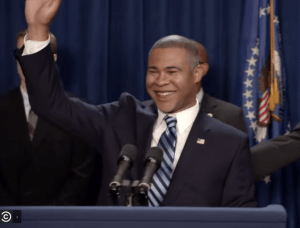
Today, President Barack Obama, for example, has become a model of linguistic flexibility and language awareness—even leading to a parody of his stylistic shifts by the comedians Key and Peele (an extremely language-aware duo) (https://www.youtube.com/watch?v=nopWOC4SRm4).

So, what distinguishes the awareness and flexibility of a contemporary language user like President Obama who wields a vast communicative repertoire and uses it strategically in different situations from those “lower middle class” people of the 1960’s whom Labov referred to as “linguistically insecure”? How do we explore this question as Citizen Sociolinguists?

I have a few tentative answers:

Most obviously, we can ask people about the language they use. Instead of drawing conclusions about insecurity or hypercorrectness, we can listen to what people say about their own language.

We can watch people. Take a look at a few linguistic self-portraits posted on the Internet. Countless people record themselves these days, illustrating (or instructing about) precisely the shifts in ways of speaking that Labov was examining in others. (See for example previous post on the Konglish Accent Tag).

Or, we can scratch the cultural surface and see how creative people like novelists, comedians, and screenwriters use different ways of speaking to build portraits of stupidity, snobbishness, insanity, or brilliance. Creative productions, including parodies like Key and Peele’s, illustrate flexible use of language that illustrates not linguistic insecurity, but language awareness. These portraits and parodies also have the potential to productively expand our awareness of social nuance and distinction.

How do you distinguish between Language Awareness and Linguistic Insecurity? What exemplifies this difference for you? Is it a useful distinction? Please comment below!

Modern Day Poetics: Internet Memes

Ain’t nobody got time for that.

Eyebrows on fleek

All your base are belong to us

I’ll get you my pretty…and your little dog too

One does not simply…walk into Mordor

Do you recognize any of these phrases? Do images come to mind when you hear them?

My guess is that most readers can identify these as common Internet memes:  Phrases that drop from seemingly nowhere and are suddenly said everywhere.  (If you don’t recognize them, google a few and you will soon discover a new world.)

Why do these exist?  You may be thinking now, “who knows?”  “who cares?” or perhaps even:

onedoesnotsimplyhavetime

I would like to humbly suggest that all these phrases build a common culture, a shared poetics, capable of spreading ideas, laughter, joy, idiocy, wisdom, and general being-together-ness, the same way adages (“A stitch in time saves nine”  “Early to bed…” “Haste makes waste”), poetry, folktales, or fables provide a medium for sharing ideas among a social group.

Why call it “Poetics”?   Isn’t this elevating the super-mundane to the arch and sublime?

Like poetry, memes lose their thrust when paraphrased or translated literally word for word. Memes get meaning not from individual words, but from the way words (and images, fonts, sound, music) are put together. As an astute student of mine pointed out, the expressive power of “Ain’t nobody got time for that” does not come through in a translation like, “Nobody has sufficient time to do that.”

And why does this matter?

Memes provide us a new way of thinking about how language works.  A way that is not homogenizing or reliant on a standardized set of rules or definitions.  To the contrary, memes often accumulate their meaning by combining ways of speaking that we don’t typically think of going together.  The arid diction of “One simply does not walk into Mordor” and the earthy “Aint nobody got time for that” combined give us joy!  The fantastical “I’ll get you my pretty” from Wizard of Oz lends an extra hint of evil when it is layered onto a more contemporary political rivalry:

I'llgetyoumyprettyevilbush

Now, take this view of memes and modern day poetics and think of everyday communication: Expressing ourselves can be more effective, creative, joyous and communicative when we combine words/languages/gestures and images so freely;  When “Aint nobody got time for that” can be used in the same sentence as “the quadradic equation”;  Or when phrases from Spanish, French, Tagalog, and English can rally one another in new, yet recognizable, combinations.So, memes, while functional as poetic chunks, also take on meaning in these creative combinations.  They provide the medium for continued snowballing of expression.

What role do Internet memes play in your life?  Do they facilitate communication?  Thinking? By analogy, do combinations of ways of speaking make communicating more facile? Do you know any multilingual memes? Add your comments, memes, examples here!

Language Awareness Part II: I didn’t do nothing! Ain’t nobody got time for that!

By far the most shock and awe was generated last week by responses to this Language Awareness Survey question (#4):

True or False:

In English, the sentence “I didn’t do nothing” means “I did do something.”

Nearly half (46 people out of 99) responded that this is “true.”

The comments (on Facebook and under the blog post) generally matched my own curious feelings:

 What’s with the answer to question 4???!?!?

and

#4’s divided answered really shocked me!!

Friends I saw face-to-face also expressed surprise of the same general nature: What in the world is going on with question 4?

My surprise continued when commentary specifically addressed the reasons for the vast quantity of “true” responses. Some people noted that this is a colloquial or vernacular or AAVE (African American Vernacular English) expression.

Interesting to see that the toughest question was about the colloquial “didn’t do nothing”.

and

“I didn’t do nothing.” Okay, we know what it means in the current vernacular.

and

If one reads this with an AAVE pronunciation, one would recognize the meaning of this construction in that variety of English as a negative construction.

And, even before I tabulated the results, one responder had commented:

 When you say “English” does it mean English language proper or does it mean our American English which is so flexible?

This suggests that if the question had inserted “Colloquially” or “In Flexible American English” rather than, “In English” people may have answered differently.

What if the question had been worded this way instead: Try it!

Commenters also mentioned a different issue: Someone could use this statement with a certain emphasis on the word nothing and that would yield the (non-colloquial) meaning, I did do something:

 I’ve definitely used the phrase “I didn’t do nothing; I finally figured X out!” when I came home from a writing session with nothing written, for example.

So, maybe this was just an inacurrate representation of a certain way of speaking English?

What if the question used a quote that was a more commonly recognized representation of the colloquialism/vernacular/ethnic variety that is being hinted at in the question? Consider, for example, if we re-asked #4 this way, keeping “In English,” but changing the quotation (take the poll!):

The elusive question #4 not only presents a stilted version of some mysterious “vernacular” but also insinuates that some pure, unitary form of “English” is relevant when making a meaningful judgment.

But, problems aside, the nearly 50/50 answer split opened a discussion and raised our awareness: What’s the difference between (to use the descriptions of one Facebook commenter) “Our Flexible American English” and “English Proper”? What kinds of “double negatives” do you use? What kinds are you aware of? What counts as a good/fun/interesting/smart/illuminating example of a double negative? Post your comments here!

Language Awareness: Who Has It?

An important premise of Citizen Sociolinguistics is that people have significant awareness of language and how they use it. People demonstrate this on the Internet by posting detailed definitions on Urban Dictionary (See previous post on UD.), making lengthy side-comments on YouTube about their own “accent” during Accent Challenge videos (See previous post on Konglish.), or just in conversation, talking about new words they’ve learned while traveling or meeting new people (See previous post on “Weg.”).

All this Internet and face-to-face banter about and with language, suggests to me that people have become increasingly liberal in their attitudes about language and more aware about how language can be used flexibly. But “seems” isn’t always “so.” Could it be that these super-aware language users are just a minute sliver of people representing the unique and tiny world I live in? Or, am I deluding myself about their “super-awareness”?

I decided to test the waters of language awareness by sending out a brief “Language Awareness Survey” to my Facebook friends. It consists of six T/F questions, extracted from an ancient revolutionary textbook called Language and Reality, written by Neil Postman in 1966. Here is my much-abridged version of his quiz:

Directions: Answer True (T) or False (F) for each of the statements which follow.

“T”= So far as I know, this statement is more true than false.

“F”= So far as I know, this statement is more false than true.

  1. ________ The English language has only six major vowel sounds: a, e, i, o, u, and y.
  2. ________ Correct grammar is grammar that is logical.
  3. ________ Generally, educated people do not use a dialect when speaking.
  4. ________ In English, the sentence, “I didn’t do nothing” means “I did do something.”
  5. ________ Regardless of how many people use the word “irregardless,” it is still not a word in English.
  6. ________ The more meanings a word has, the less useful it is.

Survey Monkey nicely tabulated the responses from the first 100 Facebook responders before asking for money (apologies to those friends who replied later whose responses I couldn’t use or even see!).

Given that Facebook responders are officially designated my “friends,” I assumed we would all have pretty much the same (“correct”) responses to these questions. My own humble responses would be False, False, False, False, False and, False!

A very smart Facebook responder must have had the same assumption (and shared my answers) because he commented,

“Advice on survey construction, don’t frame all or most questions so they have the same answer or same negation structure.”

Not only did I construct the survey poorly, but, as the results below illustrate, nobody paid much heed to this huge hint as to the “correct” answers when responding:

Question True False
1.     The English language has only six major vowel sounds: a, e, i, o, u, and y. 30 68
2.     Correct grammar is grammar that is logical. 19 79
3.     Generally, educated people do not use a dialect when speaking. 7 93
4.     In English, the sentence, “I didn’t do nothing” means “I did do something.” 46 53
5.     Regardless of how many people use the word “irregardless,”it is still not a word in English. 56 40
6.     The more meanings a word has, the less useful it is. 9 85


My first impression was shock and delight! My Facebook friends and I have more divergent views about language than I would have predicted. But I do have some possible (and potentially exciting) explanations, which I will delve into in my next post. In the meantime, send your comments. Do these results surprise you too? Why do you think the responses were so wide-ranging? If you would (or did) post answers other than F, F, F, F, F, F, why?