Gelati and ChatGPT

As citizen sociolinguists, as humans, we listen and learn from the language around us.  Inevitably, over a lifetime of living among multiple communities and generations, traveling here and there, raising a family, and having a career or two, our communicative repertoire will be more expansive and powerful than the sum of all the language we learn in schools, the vocabulary represented in the dictionary, or prose spouted as superior by ChatGPT or Claude or your AI robot of choice.  

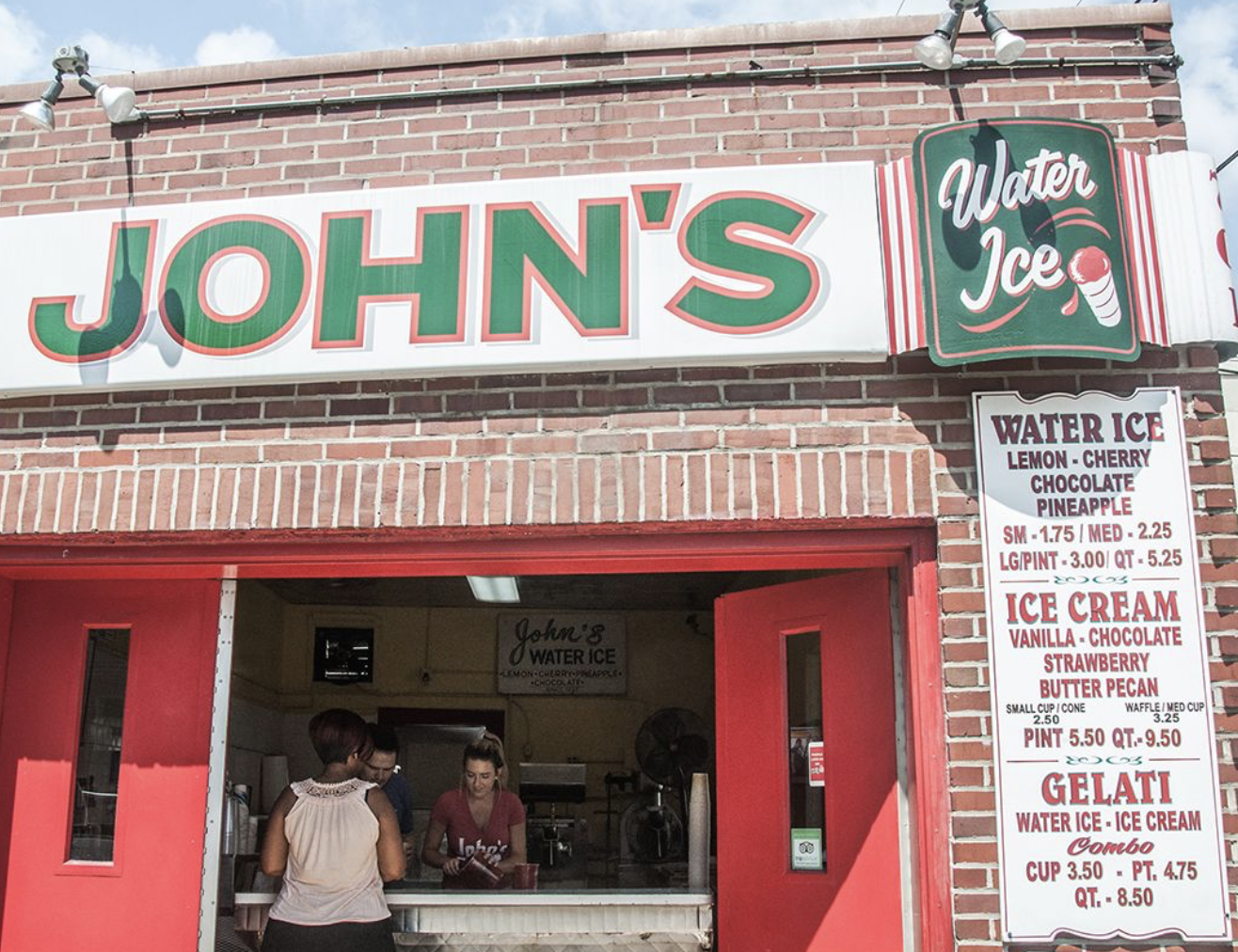
This became clear in a very specific way last week when I asked my students to look at this picture of John’s Water Ice and tell me what the word “Gelati” means.  John’s Water Ice is a special neighborhood spot—the type that politicians like to drop by for photo ops, illustrating their connection to the community, and their love of local delicacies.  At the time this picture was taken (2011), President Obama was on the campaign trail with our Pennsylvania Senator Bob Casey.  I learned later that President Obama ordered a lemon, my personal favorite. John’s Water Ice is delicious!  

But if you’re not from Philadelphia, like most of my students, you might be wondering, what is water ice? And even if you have a guess about what water ice is, you might really be stumped by “Gelati.”  When I asked my students (not allowing those from Philadelphia to respond), they were stumped.  So, of course, they asked AI.  ChatGPT came up with this:
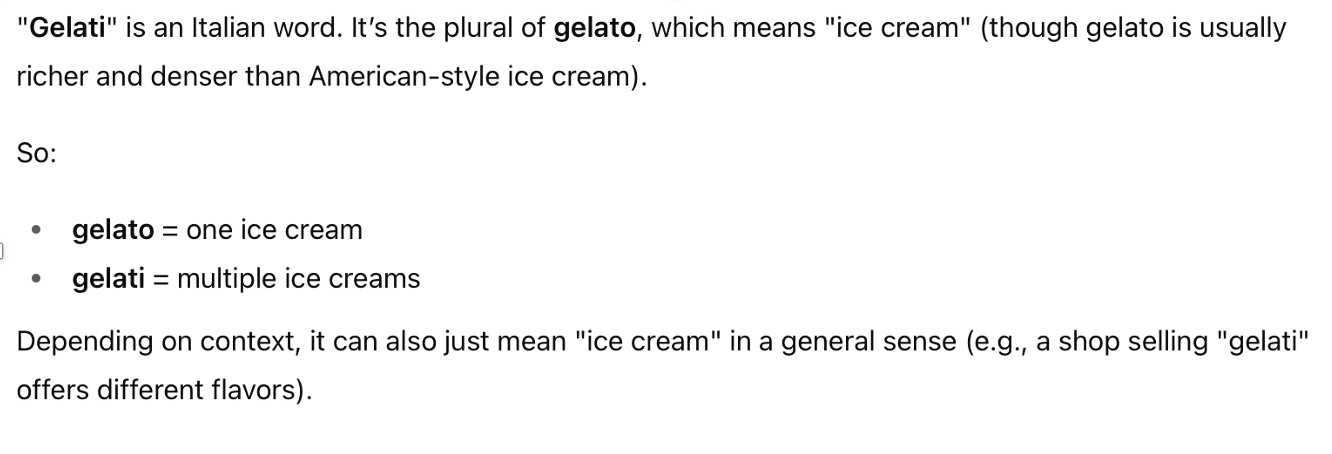
I turned to the Philadelphians in the room.  Is that what “gelati” means in this illustration? No. 

But meanwhile, ChatGPT asked:

This sounds like ChatGPT might be catching on to the John’s Water Ice meaning of gelati.  Was it?  Here’s what followed: 

None of these examples come anywhere near the description of a gelati (a gelati, singular!) in Philadelphia. This is AI pomposity at its finest (and most embarrassing: “summer gelati vibes”?). Would you like ChatGPT to “break down the difference between gelato and regular ice cream.”  No! 

Here in Philadelphia, as the locals in my class began to explain, a gelati (singular) is like a parfait: A bottom layer of ice-cream (or “custard”), followed by a layer of water ice (flavored ice of the most sublime, slushy texture), followed by another layer of ice cream, and topped with one more colorful dollop of water ice (ideally pronounced “wooder ice”).  This, my phriends, is a gelati.  

Now, if you will look back at the picture of Obama and Casey, you’ll see it, plain as day: 

GELATI

WATER ICE * ICE CREAM

Combo

Knowledge this delicious comes from humans and experience in the world!  It expands one’s communicative repertoire in useful and wonderful ways.  Do you know local language that only humans and experience could illuminate?  Of course you do!  Please share your citizen sociolinguistic expertise below (or with a friend, in real life). 
AI’s Eternal Present: The Hollywood Basement

What is a “Hollywood Basement”? How would you define it?

This week I was reading through an interview recorded by Marcyliena Morgan and discussed in her book, Language, Discourse and Power in African American Culture (Cambridge, 2002). In this interview with lively older women who had lived through the Great Migration and were discussing their experiences living in Chicago at that time, one of them mentioned her apartment, describing it as a “Hollywood basement”:

“My landlord had discovered that I was pregnant—had given me a, like a Hollywood basement instead of the fifth floor where I originally was living.”  (Morgan, p. 105)

When I read this phrase, something clicked in my own memory.  I faintly recalled my father, who grew up in Milwaukee, using that phrase, Hollywood basement, to describe those apartments whose windows were only half above sidewalk level, offering a nice view of pedestrians’ feet walking by on city streets.  It struck me as a midwestern expression, a landlord’s euphemism for dark and sunken basement living quarters.  But I wanted to learn more, so, of course, I googled it.  

What then followed was the most unsatisfying google search I’ve ever experienced: page after page of links to one and only one instance of “Hollywood basement” use: the lyrics of the Red Hot Chili Peppers’ song, “Californication”:

The term “Hollywood basement,” which up to this point had seemed like a quaint term from a previous generation, one which I wanted to know more about, now seemed locked in the eternal present of an Internet-circulated feedback loop.  

I was horrified: From now on, will the Internet no longer be a place where we can investigate language history and current (often passionate) language debates?  Where we unearth arcane connections between forms of life and ways of using language? Instead, will the internet now ensure that we only see the same meanings over and over?  Are we doomed, now, to only thinking about the phrase “Hollywood basement” in the context of Californication, since that is where the internet will guide us?  

Does this mean the information age has ended?  We used to worry that there is so much information out there that we won’t be able to distinguish what matters and what doesn’t.  But now, we seem to have a more troubling problem.  According to Google’s AI, to whom I humbly inquired, “Is this the end of the information age?”, we are now in the “Age of Intelligence”:  

According to AI, this intelligence focuses on “analyzing, understanding, and applying it effectively through advanced data processing and artificial intelligence.” 

Does that mean anything?  Is this type of “intelligence” what leads to one and only one understanding of the phrase “Hollywood Basement”? 

Often, critical educators who strive to create a thoughtful and informed generation to lead us into the future, focus on the question, “What counts as knowledge?”  This question can help teachers think critically about their own practice, their curriculum, and their sources of expertise.  Language is always changing, so what counts as language knowledge in our classrooms is always changing too. What counts as an accurate definition or correct usage varies across context.  For that reason, critically aware, relevant teaching relies on being responsive to change.  In contrast, the type of synthetic process (“advanced data processing” ) described by AI as heralding in the Age of Intelligence, seems to freeze language change and the processes that give language meaning.   This type of “Intelligence,” and the self-referential circle it leads to (Let’s call it the “Hollywood basement” type of intelligence) might count as knowledge—but of a very limited sort. 

Limiting our world to what people post online has always seemed existentially threatening to me. Googling does not count as “research,” and I still want to live life in some kind of “real world.”  At least the Internet used to seem like an immense and ever-expanding world. So much information! Such rich, immersive environments! But with AI as a driver of content we see, what used to seem like a limitless world might only, increasingly, refer to itself. As quickly as the “information superhighway” took off, it might now be turning back on itself,   like a snake eating its tail.  This was the visceral experience I had when I looked up “Hollywood basement” and faced nothing but page after page of “Californication” links. What does anything mean anymore? 

Readers, help! Have you experienced the phrase “Hollywood Basement” in contexts other than the Red Hot Chili Peppers’ song “Californication”?  If so, what does it mean to you?

Have you experienced a similar existential internet search problem—looking for a definition and finding one and only one, somewhat limited answer? Please share your experiences below!