Ugh! How do you pronounce UGG™? 

You may think pronouncing UGG is as easy as saying “AHH” when you slip your foot into the cushy sheepskin lined interior of an UGG boot. It is!  But, in happy citizen sociolinguistic fashion, there is more than one way to do it.  

I discovered this recently when a student pointed out (literally spelled out) that she was wearing some cozy “U-G-G” boots, treating UGG as an initialism, like UCLA or FBI.  My citizen sociolinguistic senses were tingling, so I had to ask the class: Do you all say U-G-G, not “Ugh”?  The Chinese speakers in the class nodded, and one provided an explanation: The word “Ugh” is difficult to say for Chinese speakers.  U-G-G is much easier.  

Another student explained that the sound “ugh” had a meaning in Chinese so saying U-G-G instead circumvents any confusion. (This explanation was not whole-heartedly endorsed by other Chinese speakers in the class).  

I was curious what Internet AI would say. My computer’s “AI Overview” had a very firm anti-U-G-G stance: UGG is pronounced like “hug” without the h.

AI OVERVIEW: You say “Ugg” like the word “hug,” but without the ‘h’ sound at the beginning; it’s a single syllable, rhyming with “bug” or “mug,” often pronounced closer to “uh-g” or even “ag” in Australia, the boot’s origin. It’s pronounced as one sound, not “U-G-G”.

Consistent with this “overview” there are many YouTube videos demonstrating how to pronounce UGG “in English.” Most go with “ugh” and a few illustrate the Australian pronunciation (“ag,” as in “agriculture”) also mentioned in the AI Overview. I found no demos of “U-G-G.”  

But apparently someone else was UGG-curious eight years ago and posted this question on Quora, “Why do Chinese spell “U-G-G-S” instead of just saying “Uggs”?”  The lone responder wrote, “Because they assume it’s an abbreviation like NBA.”  (Who’s assuming now?!). After assuming this rationale, the lone responder continued: “The funny thing is, they stick to this pronunciation, even when you tell them the ‘correct’ way. What’s funnier is that the Australian customs officers have got used to saying ‘U-G-G’ to make sense to the Chinese visitors.”

This anecdote endears me to these pragmatic Australian customs officers/citizen sociolinguists!  But it seems a bit dismissive of the U-G-G pronunciation (as funnily persistent “even when you tell them the ‘correct’ way”) and it fails to mention my Chinese-speaking students’ explanation about the difficulty and possible weirdness of saying “ugh” instead of U-G-G. 

I encountered a new take when I came across a TikTok post, “How do French people pronounce “UGG”?  This is nothing like “hug without an h”—it’s more like something you might say when looking out from your Parisian garret at a glittering Eiffel Tower and popping a bottle of the best Champagne. “Oo Jey Jey!”

Click on this link to hear for yourself this fabulous UGG pronunciation:https://www.tiktok.com/@masha_in_paris/video/7172919774341614853

Let’s sum up: Chinese speakers seem to favor “U-G-G.” French speakers, “oo-jey-jey”.  Aussies say “ag”.  Internet AI and most YouTube tutorials say “Ugh.” Are all these pronunciations okay?  I think so. UGG is not an “English” word—it’s a brand name!  So, give yourself this holiday gift: Enjoy your favorite pronunciation as you would your favorite Aussie sheepskin slipper. From this point forward I will be luxuriating in my own imaginary pair of Oo Jey Jeys.  Oolala! 

Have you encountered any surprisingly wonderful new pronunciations lately?  Please share below! 

Gelati and ChatGPT

As citizen sociolinguists, as humans, we listen and learn from the language around us.  Inevitably, over a lifetime of living among multiple communities and generations, traveling here and there, raising a family, and having a career or two, our communicative repertoire will be more expansive and powerful than the sum of all the language we learn in schools, the vocabulary represented in the dictionary, or prose spouted as superior by ChatGPT or Claude or your AI robot of choice.  

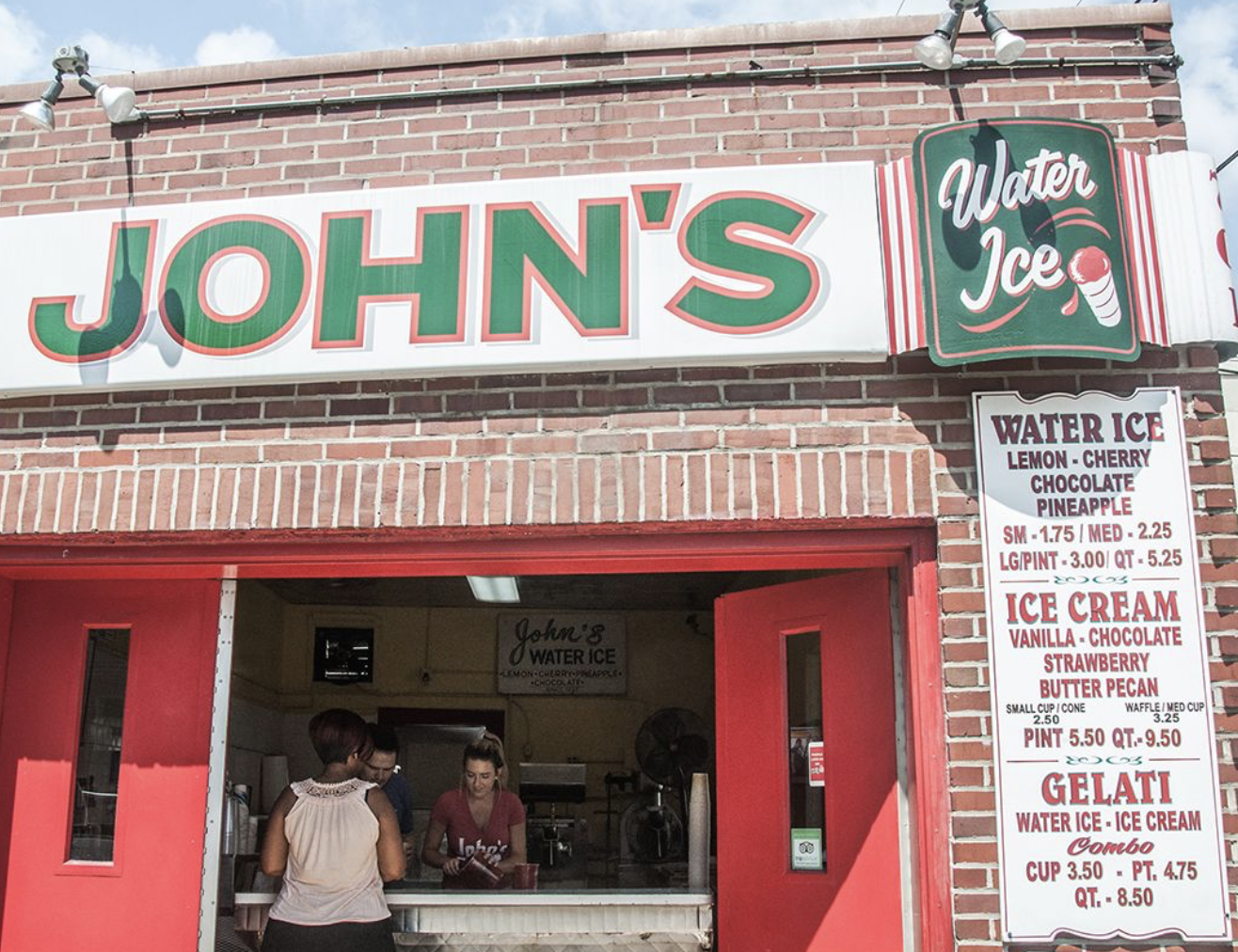
This became clear in a very specific way last week when I asked my students to look at this picture of John’s Water Ice and tell me what the word “Gelati” means.  John’s Water Ice is a special neighborhood spot—the type that politicians like to drop by for photo ops, illustrating their connection to the community, and their love of local delicacies.  At the time this picture was taken (2011), President Obama was on the campaign trail with our Pennsylvania Senator Bob Casey.  I learned later that President Obama ordered a lemon, my personal favorite. John’s Water Ice is delicious!  

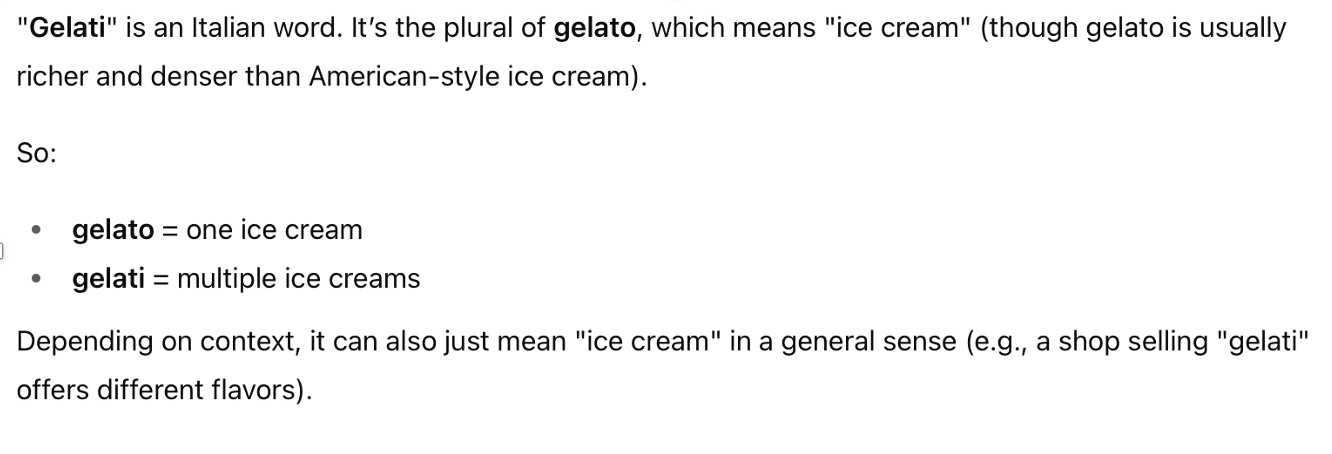
But if you’re not from Philadelphia, like most of my students, you might be wondering, what is water ice? And even if you have a guess about what water ice is, you might really be stumped by “Gelati.”  When I asked my students (not allowing those from Philadelphia to respond), they were stumped.  So, of course, they asked AI.  ChatGPT came up with this:

I turned to the Philadelphians in the room.  Is that what “gelati” means in this illustration? No. 

But meanwhile, ChatGPT asked:

This sounds like ChatGPT might be catching on to the John’s Water Ice meaning of gelati.  Was it?  Here’s what followed: 

None of these examples come anywhere near the description of a gelati (a gelati, singular!) in Philadelphia. This is AI pomposity at its finest (and most embarrassing: “summer gelati vibes”?). Would you like ChatGPT to “break down the difference between gelato and regular ice cream.”  No! 

Here in Philadelphia, as the locals in my class began to explain, a gelati (singular) is like a parfait: A bottom layer of ice-cream (or “custard”), followed by a layer of water ice (flavored ice of the most sublime, slushy texture), followed by another layer of ice cream, and topped with one more colorful dollop of water ice (ideally pronounced “wooder ice”).  This, my phriends, is a gelati.  

Now, if you will look back at the picture of Obama and Casey, you’ll see it, plain as day: 

GELATI

WATER ICE * ICE CREAM

Combo

Knowledge this delicious comes from humans and experience in the world!  It expands one’s communicative repertoire in useful and wonderful ways.  Do you know local language that only humans and experience could illuminate?  Of course you do!  Please share your citizen sociolinguistic expertise below (or with a friend, in real life). 

Multilingual Mondegreens

Mondegreen is a wonderfully useful word for the misheard version of a well-known phrase or song lyric. Often these are funny and a little irreverent.  Many famous mondegreens come from classic rock lyrics, like Jimi Hendrix’s “’Scuse me while I kiss the sky” (misheard as the mondegreen, “’Scuse me while I kiss this guy”) and Creedence Clearwater Revival’s “There’s a bad moon on the rise” (“There’s a bathroom on the right.”).  For years I naively thought Eric Clapton’s seductive, rhetorical question, “C’mon baby do you do more than dance?” was the information-seeking, “C’mon baby, do you do modern dance?” All of these mondegreens are in English obviously, but I’ve recently become aware of a few multilingual mondegreens (a well-known phrase or song lyric misheard in a different language) and I started to wonder if these tend to have the same entertainingly absurd dynamic to them.  So far, the answer seems to be yes, and so much more.

My students recently alerted me to a viral YouTube video, apparently circulated many years ago, a perfect multilingual mondegreen that seems as silly and enjoyable as those I’ve mentioned in English. The video version depicts only audio with sub-titles in English: a Spanish-speaking individual calls in to a Spanish-speaking DJ on a pop radio station and asks if the DJ could play a favorite song: “Eso son Reebok o son Nike.” The DJ wonders aloud for a bit, and then seems to have an “aha” moment, and plays the correct song, “This is the Rhythm of the Night.”

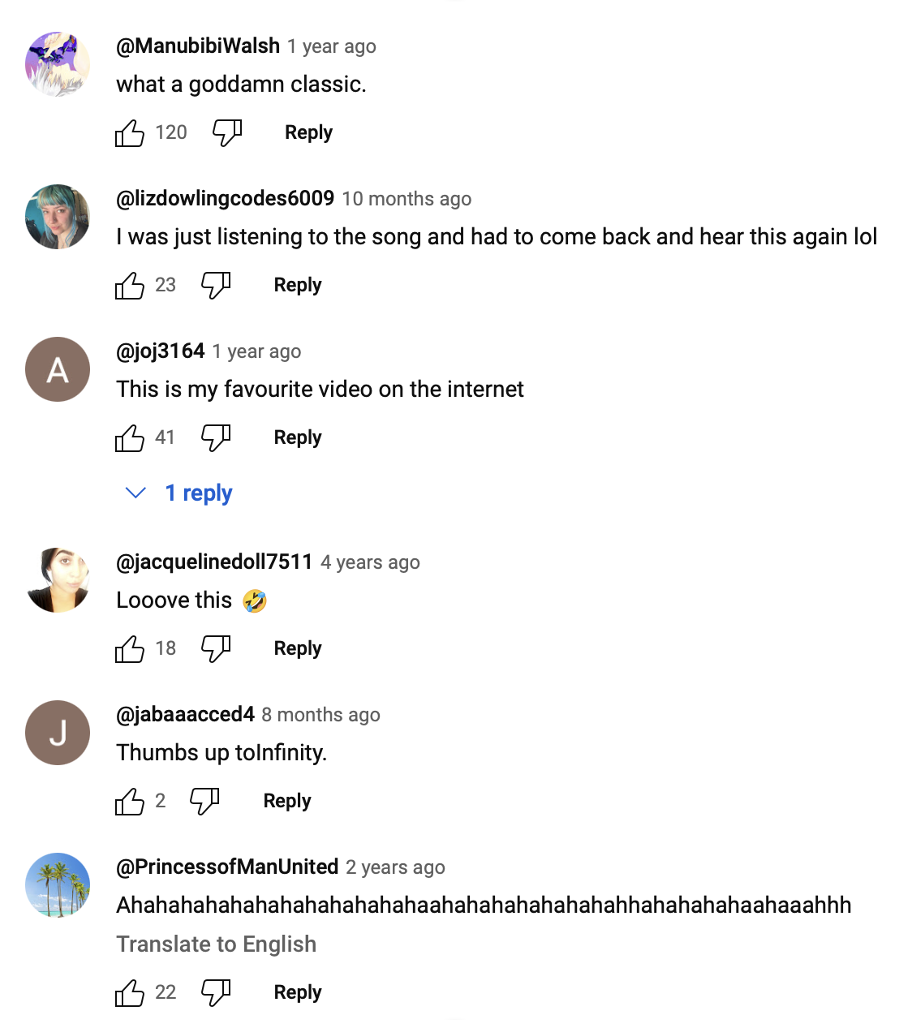
“Eso son Reebok o son Nike” is as a great example not only of a multilingual mondegreen, but also of how important it can be to give someone the benefit of the doubt when you are trying to figure out what they are saying. This DJ is such a generous listener. And he very satisfyingly guesses that the caller is requesting “This is the Rhythm of the Night.” Does this have the same absurd joyfulness as the monolingual Classic Rock mondegreen examples above? Judging by the reaction of the DJ, who ends up laughing spontaneously through the second half of the video, yes! And my students also expressed love for this example. Under the English translated YouTube version, the comments echo this enthusiasm: 

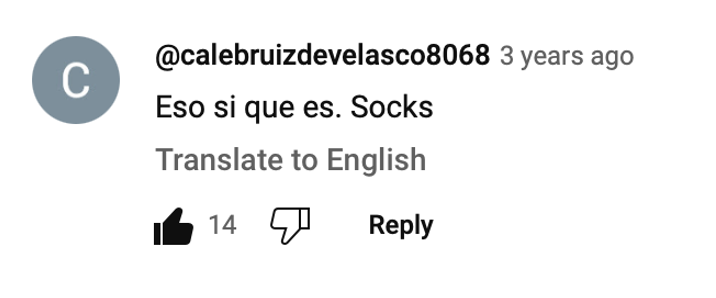
One commenter even added another multilingual pun in their response:

So, it seems that at least this Spanish/English multilingual mondegreen has the same effect as those old classic rock mondegreens.  Joyful absurdity! Plus more—a little revelry in multilingual punning.

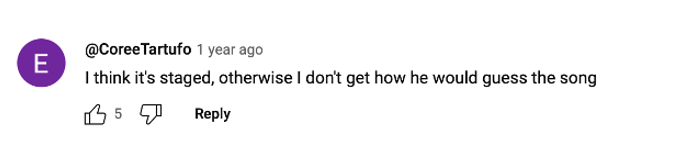
Still, one commenter suggested that this was all a staged performance. At first they couldn’t believe that this DJ could get to the bottom of this multilingual mondegreen.  

But multiple people reply, explaining how, as bilinguals themselves, they see how this could realistically be deciphered by the DJ: 

Importantly, one of these replies also mentions another, all-English, mondegreen (“We like papaya” for “Relight my fire”) to illustrate that this type of mishearing is common.  Collectively, these commenters convince the skeptic.

But there are other multilingual mondegreens that are not nearly so popular, nor so generously deciphered.  When the misheard words immediately seem offensive in another language, people don’t work as hard as that DJ to get to the bottom of the multilingual mondegreen mystery—that is, to match the misheard word to the original song lyric.  Most infamously, K-pop lyrics that contain the word “Nega,” which some speakers hear as the offensive and racist English language “N-word,” have led some artists to issue trigger warnings before live performances of songs that prominently feature that word. This is another multilingual mondegreen, but one that seems less innocent.  

I recently heard from my students about a similar problematic mondegreen of a viral Chinese pop song (“Nae Ni**a”) that foregrounds, again, a word that sounds very much like the “n-word” in English.  (https://www.youtube.com/watch?v=NjD0H4eBfng):

How do listeners interpret this potentially racist multilingual mondegreen?

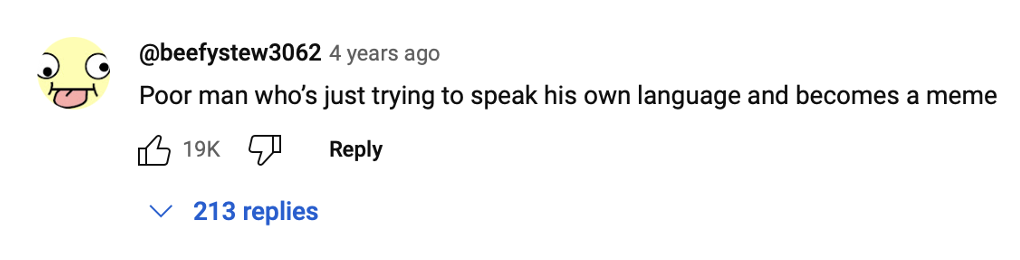
Some insist the original lyric and its literal translation render it innocent (the video accompanying it, including a rainbow unicorn and dozens of teens dancing in tuxedo suits, seems to underline that interpretation):

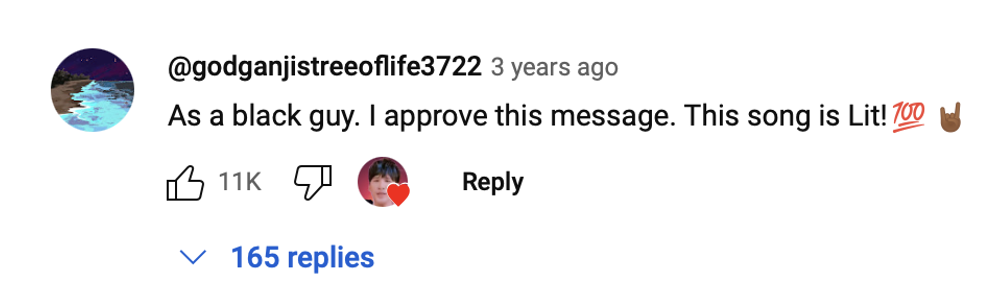
But the awareness of the potential for offense is still there, since more than one fan also points out their Black identity as they express their appreciation: 

And other comments point out that this song is in Chinese—even though some might hear the words as English (the essence of a multilingual mondegreen):

But the existence of the potential for multiple racist interpretations seems to act as a lightening rod for more toxic comments, not to be repeated here.  And, I get the sense that people may be using this song as an excuse to, in other contexts, use the n-word in offensive ways, without being held accountable. Several comments mention the possibility of getting an “n-word pass” because of this song. 

All of these mondegreens highlight how we stretch our ears to hear things in new ways when multiple languages are involved, and how misunderstanding arises even among massively homogenous groups like monolingual classic rock fans in the United States. Mondegreens, both the hilariously absurd, and the interculturally awkward, can make us pay attention to lyrics (and their translations) and help us appreciate them.  They also highlight the ever so human possibility for mishearing in any language, and the exponentially greater possibility of miscommunication when multiple languages are involved.  

The DJ who impressively deciphered “Eso son Reebok o son Nike” illustrates the interactional rewards that follow from generous listening: Very little in life is as sweet as a laugh shared at nobody’s expense! Rather than refusing to understand, that DJ stretched his ears, puzzled a bit, then found “The Rhythm of the Night,” to lasting and entertaining effect.  In our complex multilingual world, multilingual mondegreens help us to recognize the crazy ways our varieties of communication will overlap and near-miss, and that, if we empathically listen to each other, we might be rewarded by learning a little about each other’s languages, and even, if we’re lucky, share a hilarious “aha” moment that brings us a little bit closer together. 

What are your favorite and least favorite mondegreens, multilingual or otherwise? What kind of impact do they have?  Please comment below! 

Citizen Sociolinguistics and AI-Assisted Writing

This semester I have been receiving a lot of bizarrely polished essays from my students.  They aren’t plagiarized or even straight-up usages of ChatGPT.   I haven’t seen one grammatical mistake, not one spelling mistake, but these essays don’t read like they’ve merely been through spell-check and grammar-check. There are many oddly elaborate, yet somehow simultaneously formulaic word choices.  For example, phrases like these:

  • “The diverse tapestry of linguistic diversity”
  • “profound implications”
  • “a catalyst for positive change”
  • “In essence…”

Or entire sentences like these:

  • “Let us be mindful of the role we play in shaping a more inclusive and equitable world.”
  • “While this ideology may masquerade as a beacon of clarity, it often acts as a restrictive force.”
  • “We not only advocate for diverse linguistic forms but also honor the deep cultural narratives they embody.”

What is going on here? 

Taking a citizen sociolinguistic approach, I talked to several “authors” of such phrases and essays to try to answer that question. I tried to remain curious, not judgmental:  What is their process? What tools are they using to help with their writing.  And, why?

Several different strategies emerged in our conversations. Examples include, from most to least complicated:

  • Writing an essay in Chinese, then getting three translation options from GoogleTranslate, choosing the “more academic” seeming version, then running that paragraph-by-paragraph through Grammarly, selecting the “professional” setting. 
  • Writing an essay in English, then using ChatGPT to review and edit, specifically directing it to adjust “phrasing” and “coherence.”
  • Writing an essay in English, then running each paragraph through Grammarly, using the “professional” option. 

Most students avoided mentioning the highly stigmatized ChatGPT, and some even declared that they hate ChatGPT, but a couple did mention it as a useful tool for “brainstorming,” (if not for editing as mentioned by one).  

Why use these tools?  These strategies seem time-intensive, and the results highly variable: In the best case, a mediocre paper, in the worst, a practice punishable as academically dishonest.  Students presented similar backstories to make sense of their AI practices.  As both undergrads and graduate students, in the United States as well as China and Canada, students have been told by professors and teaching assistants to improve their writing, often receiving advice like the following:

  • “Your words are too simple.”
  • “Your writing is too personal.” 
  • “You need more transitional phrases.”
  • “You need more professional words.”

Some professors even allow the use of AI tools, if the students acknowledge their use. So, the students have developed strategies that directly address the writing advice they’ve received: They run an essay through Grammarly, selecting the “professional” output setting, they choose a Google-translated option that seems to have fewer “simple” words, they make explicit requests for transitional phrases (see “In essence,” “Let us be mindful,” “We not only advocate…but also honor” above).   

This seems legitimate, since, the students say, these essays still contain their own original ideas.  But after one runs an essay through the AI wringer, ideas can be hard for a reader to detect anymore.  Originality? Lost. 

Despite my sincere efforts to remain a curious explorer and not judge these writing strategies through the lens of Aging Professor, I find them disturbing.  A few analogies to the AI takeover of student writing began to simmer in my brain:  

The first may be a bit obvious: Frankenstein’s Monster.  We have created a monster (AI writing tools) that we can no longer control.  When something written by a human individual goes through Grammarly and comes out radically different, that human individual loses their voice.  And, if Grammarly has chosen vocabulary unfamiliar to that human individual, the original writer doesn’t know what they are saying anymore. If that human happens to be a university student, they no longer know how their writing might sound to a professor or teaching assistant—or whether their original ideas remain original.  The essay becomes like Frankenstein’s monster, out of the hands of its author, doing things that author no longer has any control over.  Ultimately, that monster turns on humanity and must be killed. 

Another ominous analogy, less rooted in Victorian fiction: A Self-Driving Car.  I’ve asked several people if they would be willing to completely cede control to a self-driving car, spending their mornings in the car reading the paper, preparing for class, talking with their kids, and letting the Artificial Intelligence handle the driving. Everybody has balked at that idea—some intuitively uneasy with giving so much control to a complex activity like an urban commute during rush hour, others citing YouTube videos that illustrate the kinds of disasters such negligence has already wreaked.  Like AI writing assistance, a self-driving car simply doesn’t have a sense of the complex context of its activity—or the very sensitive nature of human beings.  My dad also pointed out that “Driving is fun!” Why let an AI-tool do all the fun part? I hope some readers see writing this way as well.  Writing is fun!  Like driving, it potentially gives us a sense of freedom—we can say anything! But both AI driving and AI cyborgian writing, seem overly concerned with standardization, which inevitably eliminates both the fun and the humanity involved with either of these activities. 

The mention of “fun” also brings me to my third analogy:  The Drum Track.  Many songs get along just fine with a non-human drum track.  But take a listen to a song recorded with a human drummer, or go to a live concert.  Listen to that drummer: Do they play the same pattern again and again? Or, do they surprise you with a jump on the established rhythm, or a withheld beat?  How does this affect your experience of the song?  While it may sometimes be fun and useful for musicians to use a drum machine to provide a driving beat, it’s nothing like the actions of a live drummer—even if that drummer makes mistakes now and then.  Like creating music, writing involves establishing your own rhythm, your own voice, and that can’t be achieved with tools like Grammarly and ChatGPT, the writer’s equivalent of a monotonous drum track.    Rather than turning to standardizing tools to shape an individual’s writing voice, one might instead focus on reading works by talented writers, engaging more fully with writing that does *not* read like a monotonous drum track. As students and professors, we should build our own writing (and writing advice) on those models we most admire, not the most pedestrian standardized versions pumped out by AI.  

By now, my opinion may be all too painfully clear.  The monster must be killed, or ultimately, it will kill us, or at least take a very large bite out of the humanity and joy of writing.  Thus, my suggestion to students: Don’t use these tools! To Professors: Try to refrain from encouraging students to engage with them, even in a cyborgian compromise.  Consider what you sacrifice in the long run, consider the purpose of education.  

Readers may have alternative opinions, and more practical suggestions.  Please share your comments below! Or have ChatGPT express an opinion—I’m curious to see what it might “say.”  

Speak Good Singlish: A Form of Citizen Sociolinguistics

Screen Shot 2016-05-24 at 12.52.27 PMLast week, the New York Times published an opinion essay  by Mr. Gwee Li Sui.  In it, he suggested the Singapore govenment’s “war on Singlish,” had some problems. Singlish (Singapore English), he argued, represents Singapore well, bringing together many of the languages of that nation. Mr. G even asserted that Singlish has the power to “connect speakers across ethnic and socioeconomic divides like no other tongue could.”

He included a short glossary, illuminating Singlish’s internal variety (see sidebar).

Mr. G also pointed out that the more restrictions placed on Singlish, the more it seems to flourish: “In the eyes of the young, continued criticism by the state made it the language of cool.”

And, as his essay illustrated, individuals needn’t choose between Singlish or Standard English, as many people are aware of both (and other languages) and fluently switch between the two.

A few days later, the New York times published a letter from Li Lin Chang, press secretary to Prime Minister Lee Hsien Loong of Singapore.

This letter emphasized that the type of creative language use that Mr.G praised was only the purview of highly educated people, not everyday people in Singapore who need “standard English” to get ahead:

Not everyone has a Ph.D. in English Literature like Mr. Gwee, who can code-switch effortlessly between Singlish and standard English.

This statement piqued my curiosity.  Using Singlish does seem complicated—as it combines so many languages and grammatical systems. But I know many code-switchers in the United States who do not have PhDs—even some toddlers! Is code-switching between Singlish and Standard English different? Something only PhD educated people can handle?

In Citizen Sociolinguistic mode, I started searching the Internet to see who (in addition to Mr G, PhD) was facile with this type of “code-switching”.  It appears there are many non-PhDs who, like Mr. G, capably code-switch between Singlish and other forms of English, as illustrated (and discussed) in this YouTube Video :

Screen Shot 2016-05-24 at 2.12.08 PM

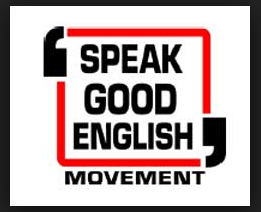
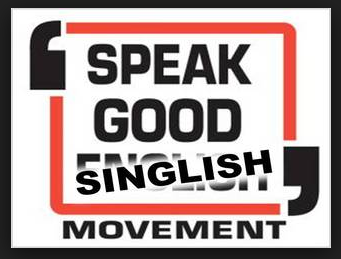
In about ten minutes’ more poking through the Internet, I also learned about the “Speak Good English” campaign in Singapore and spied this logo:

Screen Shot 2016-05-24 at 1.34.40 PMThe Speak Good English movement also includes  post-it note style signs like this, emphasizing the edits needed to “get it right”:Screen Shot 2016-05-24 at 1.08.27 PMI also started finding quite a few signs suggesting an underground “Speak Good Singlish” movement, and even a counter logo:Screen Shot 2016-05-24 at 1.33.55 PM
This movement also counters the official post-it notes with deftly edited signs translating “Standard English” into “Singlish”. Here are a few Pinterest posts to illustrate:

Screen Shot 2016-05-24 at 1.15.16 PM

This Pinterest user seems to have a good grasp of “code-switching” between Standard and Singlish.

A Google image search illustrated many more playful post-it style notes like the following English/Singlish translations:

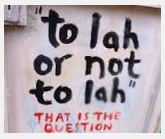
And this sign even merges Singlish with Shakespearean diction (lah!):

Screen Shot 2016-05-24 at 1.39.43 PM

“Lah” seems important:

Screen Shot 2016-05-24 at 1.38.41 PM

Long before Mr. G wrote his New York Times editorial, the Speak Good Singlish movement seems to have grasped the import of Singlish for Singaporean Citizens.

Who was behind this “Speak Good Singlish” counter-punch?  Does their language awareness and ability to code-switch entail PhDs?

No. They are Citizen Sociolinguists, illustrating—with humor and creativity—how language connects to social value in everyday lives.  In the process, they are building everyone’s repertoire, rather than holding up one “standard” as the only functional way to succeed.

Of course, some readers may still feel that proud Singlish speaking citizen sociolinguists are missing out on something that a more rigid “Speak Good English” regime might provide them. What’s your opinion on Singlish? Or the “Speak Good Si/English” movement? Please add your comment below!!!


Retweet! and Other I-Agree Signals

“Retweet!”

Screen Shot 2016-02-23 at 9.35.05 AM

This week, listening in on a heated high school discussion, I heard someone shout out “Retweet” from across the room. I wasn’t sure what was going on. Was our conversation being tweeted about?

Later, in another class, while gathering lists of words (using pencil and paper) for our semester-by-semester slang tracking, the word “retweet” appeared on someone’s list.

I had to ask, “Do people actually say that?”

Sure.  It means “I agree with you,” or “I feel the same way,” or “I TOTALLY AGREE!”

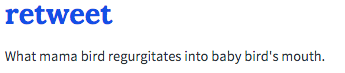
These kids had some pin-pointed expertise:  I couldn’t even find this definition of “retweet” on Urban Dictionary, where the only definitions offered are the literally literal

Screen Shot 2016-02-23 at 9.52.49 AM

and the facetious (?)

Screen Shot 2016-02-23 at 9.53.04 AM

Yuck!

So… here’s the scoop:  Certain teenagers say “retweet!” out loud—in the same place other people might say, “thumbs up!” “here-here!” “right on!” or even “I concur.”

Why so many expressions for “I agree”?

Slang expressions tend to proliferate around taboo topics like sex and drugs, or insulting remarks about men, women, race, ethnicity, religion, nationality.  We as a species seem to have an unlimited capacity to make new words for the skeezy, forbidden, or embarrassing. And it makes sense that we would want to be more creative (or secretive) about how we talk about them.

Less obvious:  Our species-wide love of agreement and new ways to do it!

Just as ways to talk about being “wasted/lit/turnt/smashed/etc” proliferate like crazy, so do ways of expressing the fact that “I feel the same way.”

Screen Shot 2016-02-23 at 9.32.51 AM Look around you and you will see all kinds of evidence that people like to agree!
Many of these, just like many other new words, are boring and sheep-like (think thumbs ups, viral videos, proliferations of exclamation points!!!). But others tip toward the profound, or at least show that how we agree may be a powerful glue holding us together.

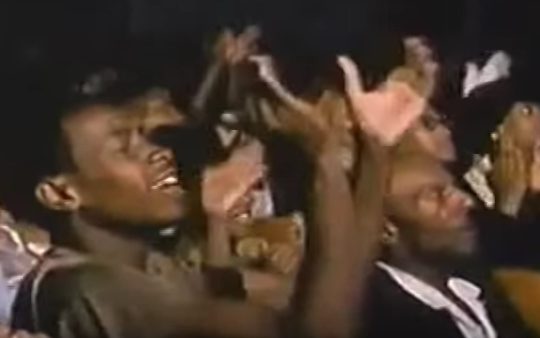
Call and Response is one of the most moving forms of “retweet!” Listen to all the buzzing agreement, for example, during Dr. Martin Luther King, Jr.’s “I have been to the Mountaintop” speech:

Screen Shot 2016-02-23 at 11.07.33 AM

MLK: “Somewhere I read of the freedom of speech”

Audience: “YEAH!”

MLK: Somewhere I read of the freedom of press”

Audience: YEAH!

MLK:  Somewhere I read that the greatness of America is the right to protest FOR right.

Audience:  YEAH! ((Clapping and screaming in agreement))

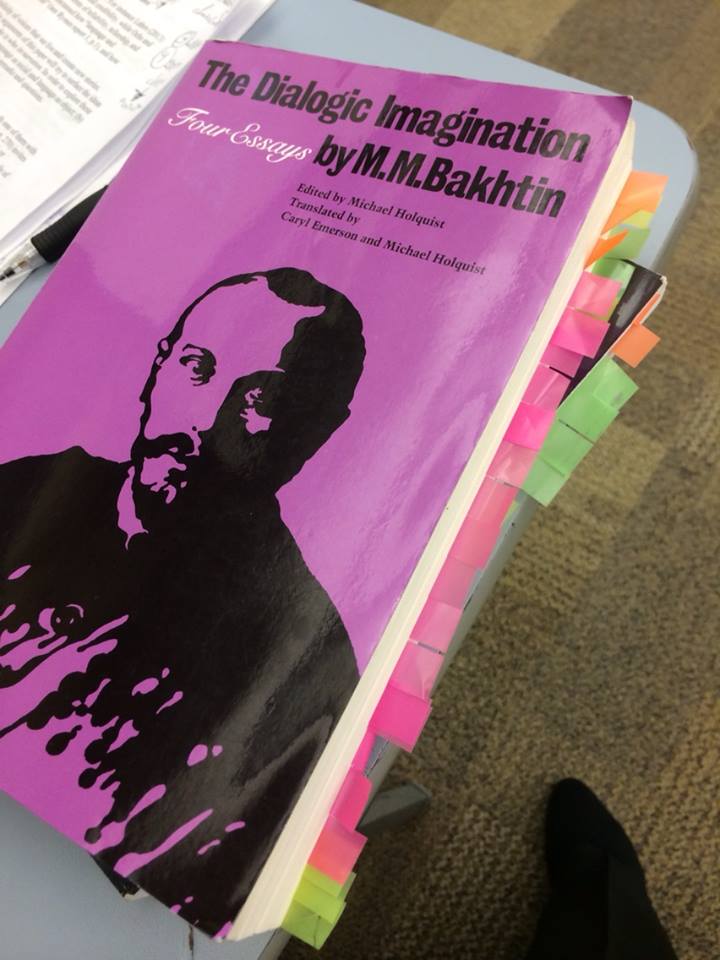
Enthusiastic agreement happens when reading too. Look through a book that someone appreciated:  Underlining!  Highlighting!  Post it notes!lovingpostits

I happily notice when students show up with books like this in class.  So many post-it notes can’t simply be superficial display.  This student found a connection with Mr. Bakhtin.

Teachers also recognize when there is a buzz of agreement in a class.  When faces light up, I’ll sometimes stop and ask, “You’re smiling.  Do you agree?” Yes—and the discussion gets better.

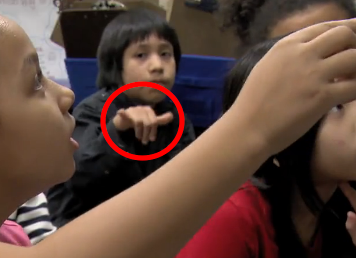
Some teachers even use silent hand-signs for agreement.  At this website about “talk moves,” one teacher illustrates how she embeds this agreement sign in her discussions, apparently with some success:

Screen Shot 2016-02-23 at 10.25.02 AM

Comments on this video also enthusiastically agree that the “I agree” sign improves classroom discussions:

Screen Shot 2016-02-23 at 10.30.16 AM

Piling on, readers of the comments that agree with the “I agree” sign also receive “I found this helpful” agreement award symbols.Screen Shot 2016-02-23 at 10.32.01 AM

People seem driven to express agreement and we keep finding new ways to do it.

As the “talk moves” teacher explains, the “I agree” sign is a way to “encourage discourse in the classroom.”  Agreement signals involvement. Humans learn and develop through interaction. But we also want to keep it real and display our unique identities: Different groups, different media, different attitudes, different styles require different agreement expressions.  I may agree with much of class discussion—but  I doubt I’ll ever say “retweet!” to express that agreement. I have my ways.  You probably have yours.  And the conversation continues…

How do you express agreement?  When, where and why? What are the effects?  Please comment here!


Is This Realistic? Citizen Sociolinguistics and The Movies

A question I often ask when I’m watching a movie’s depiction of local speech, a stigmatized dialect or mock-worthy speech act is, “Is this realistic?”

How could one possibly answer that question?

Would you find a “real” speaker of that local or stigmatized variety or notable swatch of talk and check with them?

Who might that be?  And who am I to label that variety “local,” “stigmatized,” or “mock-worthy” anyway?

From a Citizen Sociolinguistics perspective, one route to go is to look at the comments on-line.  Take a look at a stretch of movie dialogue on YouTube—inevitably you will find an example—and see what commenters say.

Here are a couple examples to illustrate:

Example 1:  Akeela and the Bee. 

This movie is about Spelling Bee competitions and an unlikely competitor, Akeela, who comes from a predominantly African American neighborhood in Los Angeles.  The movie makes a big deal about ways of speaking, as illustrated in this clip, where a Professor criticizes Akeela for her use of “ain’t”:

I like this depiction of Akeela’s snappy retort to the obviously lonely and socially awkward professor.  As the movie proceeded, I kept wondering how this clash of language attitudes and lifestyles would unfold.

Then, in another pivotal scene, Akeela’s brother tries to weasel out of helping her learn spelling words, but is peer-pressured (by an older and cooler guy from the neighborhood) to help her.  The scene seems almost goofily Hollywoodish, as it depicts, in a heartwarming way, the neighborhood rallying around Akeela to help her learn crazy-hard words like staphylococci.   

Screen Shot 2016-01-29 at 7.16.44 PM

After I see this, the “is this realistic?” question kicks in big time.  Here’s when I start scanning the comments.  And the commenters seem to answer, “yes!”  While some chime in simply criticizing (“Fuck this wake ass shit”[sic]) or loving it (“Love this Movir so bad”[sic]), the more specific comments remark on its authenticity:

Screen Shot 2016-01-29 at 6.20.25 PM

Screen Shot 2016-01-29 at 6.21.37 PM

These commenters rally around the positive depiction of Akeela as a flexible speaker of both a local African American variety in Los Angeles and Akeela’s prowess as a spelling hero for the community.

Example 2:  Ferris Bueller’s Day Off

Straying far from Akeela and the Bee territory, Ferris Bueller’s Day Off throws intense shade on anything having to do with school.  In one of its most quoted and widely circulated scenes, an Economics teacher (played by Ben Stein) bores the class with his “discussion” of The Great Depression, tariffs, and supply-side economics (aka voodoo economics).  In this clip, his “Anyone? Anyone?” refrain is featured as a non-question, a feeble bid to get students talking:

https://www.youtube.com/watch?v=uhiCFdWeQfA

Screen Shot 2016-01-25 at 2.33.13 PM

This clip, like the Akeela clips, while entertaining, smacks of Hollywood overkill.  Teachers aren’t really THIS BAD are they?  And again, I find myself asking the question, “Is this realistic?”  It does seem to illustrate a recognizable and much-mocked speech act, often referred to in educational research circles as the “guess what I’m thinking” question.  But does this really happen in schools anymore?

To answer that question, I turned again, as is the Citizen Sociolinguistic way, to the comments.  Of course, many commenters recognize and appreciate simply the hilarity of Ben Stein’s performance.  But, additionial comments pile up in painful recognition of the “Anyone? Anyone?” speech act:

Screen Shot 2016-01-29 at 6.38.41 PM

Screen Shot 2016-01-29 at 6.38.58 PM

Screen Shot 2016-01-29 at 6.39.23 PM

Screen Shot 2016-01-29 at 6.39.36 PM

Screen Shot 2016-01-29 at 6.39.43 PM.png

Screen Shot 2016-01-29 at 6.40.31 PM.png

Screen Shot 2016-01-29 at 6.40.50 PM

Screen Shot 2016-01-29 at 6.41.10 PM

For these viewers, Ben Stein’s performance smacks of today’s dysfunctional classrooms.  Part of the hilarity of his performance, I suspect, comes from its pinpointed realism.

Some of you astute readers might be questioning this Citizen Sociolinguistic method of gathering evidence of the “realistic” quality of these Hollywood performances.  Why grant any credence to YouTube commenters?  Why even believe what they say?  They might even be being ironic!  Yes—and perhaps some readers will interpret these comments this way.  And yet, even the existence of these comments (ironic or not!)  illustrates that these ideas are circulating out there in the real world.  And, as soon as they get put down in YouTube, they continue to circulate.  The comment regarding Ben Stein’s performance, “This never gets old.  I still have classes like that,” for example, has (so far) received 45 likes.  Viewers seem to identify with this perspective.  This performance of “teacher” seems to be a recognizable prototype; his much-maligned questioning style is one that students out there recognize and loathe.

And Akeela’s neighborhood peers, rallying behind her spelling training, seem to also be illustrating recognizable attitudes about ways of speaking and studying language.

These performances resonate.  That’s why they are up on YouTube.  That’s why they garner comments and why those comments garner thumbs ups (in some cases, many thumbs ups).  Those comments and thumbs ups perpetuate an understanding of these as recognizable ways of speaking—and attitudes about those ways.  Is something realistic? It never starts out so.  It becomes realistic in how people, subsequently, display their answers to that question.

What movie depictions of speech have you wondered about?  Do Citizen Sociolinguistic investigations shed light on those wonderings?  Please comment below!

Crossposting—Dumb or Delightful?

Screen Shot 2015-11-20 at 8.07.40 PMHave you ever tried crossposting?

Most literally, crossposting is the practice of posting the same message on two or more of your social media accounts.

For a while, this was happening to me by accident when, unbeknownst to me, my Twitter account was linked to my Facebook account. It was dumb—and delightful at the same time.

Dumb—because suddenly all my nerdy language tweets, focused on an audience of students and colleagues were now posted to my family and friends from across the myriad phases of my life.

But also delightful! Suddenly unlikely friends from high school started tagging me on language related posts on Facebook, or sending me breaking news about the Word of the Year, or drawing on my expertise (“What is dabbin’?”).

Eventually, I figured out how to unlink the two, and I unlinked them, probably saving the majority of my Facebook friends from a lot of spam.

Through this accidental experiment, the value of crossposting came through to me. Not only did I discover Facebook friends who cared about language like I did—I also became more careful about the kinds of language posts I was making on Twitter. Would my mother be offended by this post? As long I was crossposting to Facebook and Twitter, that question always had to be in the back of my mind.

But this got me thinking about communication and social boundaries Screen Shot 2015-11-20 at 8.08.53 PMmore generally. Crossposting—and its ramifications—as a metaphor for communication seems worth considering. What happens when you “crosspost” across the various social groups you are part of? Being completely oblivious of the participants and audience in each of these groups seems socially naïve—at best. And, this seems to be what happened at Yale last month, when professor Erika Christakis notoriously posted, to a college house e-mail listserve, the idea that Halloween is a chance to be “a little bit obnoxious,” countering the campus-wide e-mail suggesting students be sensitive about Halloween costumes (and, for example, avoid blackface). Bringing up the value of obnoxious Halloween costumes might be a nice debate on one of prof. Christakis’ “social media platforms”—say dinner with like-minded colleagues—but, as it turns out, it may be a dumb thing to crosspost to hundreds of Yale freshmen.

These days, social media may be making us more aware of the ramifications of crossposting in real life. People who use Facebook, Twitter, Instagram, Snapchat, etc., tend to mindfully tailor their messages to whomever they imagine is listening/reading/over-hearing on one of those apps.

Highschool students I work with, for example, know a lot about mindfully crossposting. As a way of exploring language in their lives, we have had them represent the various sectors of their lives as pie charts (see previous post on language diversity pies) and talk about the language they use differently in each of those sections. Many students list a dozen or more sections in their pie, making fine-grained distinctions, for example, between language used with one’s own parents, other adults, and one’s girlfriend’s parents. They include “slang” in some sections and not in others. Sometimes they include named languages in certain sections, including separate spots for “Chinese,” “Chinglish” and “English.” They seem intuitively aware that certain ways of speaking work well in some slices of their daily language pie, but that it would be very dumb to speak that way in others.

But, this does not mean students don’t engage in some forms of delightful “crossposting.” These same high school students have also mentioned that, sometimes, the most fun people are the ones who don’t keep their language rigidly aligned with a certain slice of their language pie–instead, mixing slang with formality, French with English, or purposely mispronouncing certain words.

Still, students also admit, part of the joy of this kind of language crossposting is the inherent risk involved. The danger of overstepping remains—crossposting might be dumb or delightful. It might be offensive and even incite mass protest (as in the unfortunate case at Yale). It might be hilarious and spark new ways of thinking (think Key and Peele style humor). In either case, “crossposting” reveals the borders we cross repeatedly in our everyday lives. When we start crossing those borders, we are taking risks. But they may be worth it.

Apparently, the Christakis professors are now encouraging Yale students to join them in further discussion. And, already, the general public has been made more aware of a variety of student voices on Yale’s campus. Let’s hope this leads to more crossposting across social groups there and even some new discoveries about each other. I would hate for it to lead to “delinking” our social circles permanently.

What social media do you crosspost too? How selective are you about what you post to which platform? In which sections of your life have you done more radical crossposting? What have been the effects? Please comment below!


The Linguistic Color Line

Screen Shot 2015-08-25 at 9.19.18 AMW.E.B. DuBois has asserted that “The problem of the Twentieth Century is the problem of the color line.” What is the color line? Was this true all over the U.S.? And what about the 21st Century? Have we overcome the problem of the color line?

For the early part of the 20th Century, in the South, Jim Crow laws made the color line very explicit: Blacks were excluded from white public spaces: drinking fountains, sections of the bus, etc .

But these explicit laws permeated the North as well. There were “White’s Only” clubs, like The Cotton Club, even in Harlem.

What about the 21st Century? Does a color line remain? Of course. While there may no longer be Jim Crow laws on the books, there are still implicit ways in which an individual’s race is monitored in public. One key mechanism for this monitoring is what I call the linguistic color line.

Everyday, individuals in the United States modify the way they act and talk when they are in the presence of white people. This is not simply a matter of being “polite” or adjusting one’s talk to fit into certain social situations. Sometimes, it is a matter of “Talk like white people or you will be brutalized.”

This was depicted recently in a brilliant satire of a police stop, performed by Larry Wilmore as commentary on Sandra Bland’s arrest in Texas.

At point 4:16, of the clip linked below, Wilmore identifies precisely the linguistic color line that Sandra Bland was being asked to toe:

http://www.cc.com/video-clips/yjv4ys/the-nightly-show-with-larry-wilmore-mess-within-texas—sandra-bland-s-arrest

WILMORE: I mean, it’s easy to say, “Black people, why aren’t you acting like the Dowager Countess when a cop pulls you over?”, right?

WILMORE (Channeling Dowager Countess in English Accent): Oh, hello, officer. I’m so pleased you’ve unexpectedly dropped in on me. Would you like some tea I brewed in my glove compartment here?

Apparently Sandra Bland was not allowed to act and talk certain ways in her own car when addressing a police officer.

As Wilmore sums up, “We live in a world where black people have to strategize so they’re not brutalized by police.”

And, much of this strategizing involves modifying one’s language.

The linguists Nicole HollidayRachel Burdin, and Joseph Tyler, in their detailed and revealing blog post on the linguistic nuance of this encounter, have, with irony, labeled Sandra Bland’s crime, “Talking While Black.”

As the Sandra Bland encounter illustrates, while we may have fewer explicit laws about where black and white people can congregate, we continue to have tacit rules about ways black people are allowed to talk and act in certain spaces.

This, lately, has been dramatically illustrated in the case of police encounters. But it is often also the case in schools, where certain (white) ways of talking and acting are expected from all children—even (especially?) when most or all of them are not white. Schools have been legally desegregated, Jim Crow laws have been abolished, yet, as soon as any student steps across the threshold of a public school, they are expected to talk and act in certain ways that match white notions of polite and proper.

This is the linguistic color line. Enforcing that color line in classrooms may not be so dramatic as the Sandra Bland encounter, but it can, for children, be silencing.

Have you encountered the linguistic color line? Have you witnessed it being enforced? In institutions? In schools? In service encounters? In social activities? Is it time to lift what W.E.B. DuBois called “The Veil” and let people speak?

Please comment!

A World of Others’ Words

After my last post, some readers took immense issue with my use of the phrase, linguistic gentrification.

I pointed out that sometimes privileged, white people use phrases taken from the life ways of black and brown people without knowing the deeper story of that language.

So I made an analogy to “gentrification.”

I wanted to suggest that, just like neighborhoods, our words have had previous residents.

Screen Shot 2015-06-21 at 7.31.52 AMIronically, and perhaps too late, I realized the word “gentrification” itself has its own vivid history, of which I am only a partial witness. As the literary theorist Mikhail Bakhtin (pictured) has stated, “We live in “a world of other’s words” (1984, 143).   And this certainly became clear when I used the term “gentrification.” Reader responses rolled in:

@grvsmth started an exchange on Twitter:

Sorry, @brymes, I find “gentrification” a really problematic term; applying it to language only muddies the waters

@nelsonlflores came to my defense with this mature formulation:

It seems very different to acknowledge its complexity than to completely dismiss as a viable concept.

But others held fast: @capntransit suggested we simply should not use the word “gentrification”:

The dehumanizing and scapegoating is so woven into the frame, I can’t see how you’d extricate it.

Any word I use, to quote Mikhail Bakhtin again, comes already “populated—overpopulated—with the intentions of others”(1981, 294). And, clearly, I had blithely used the word “gentrification,” not knowing the previous intentions of others using it. I hubristically thought I could, in a 500-word blog post, populate it with my own intentions: A useful analogy for a linguistic process. Not so?

In my own defense, these responses also illustrate the point I was trying to make: I was “gentrifying” the word “gentrification”—attempting to people it with my own intentions, the same way people take over neighborhoods with theirs.

But in that short exchange, we also began illustrating the positive potential in such a process by constructing a new social history for the word “gentrification.” And we began to use it as a way to think about language too.

As a character in Chang-Rae Lee’s novel, Native Speaker puts it (p.46):

No matter how smart you are, no one is smart enough to see the whole world. There’s always a picture too big to see

So what do we do? Do we just stop trying to see it? As Citizen Sociolinguists, we try to assemble a bigger picture than any one person can see by putting those different perspectives together. In the spirit of Citizen Sociolinguistics, to search for more of the “world of others’ words” behind “Gentrification,” I tried a Citizen “Corpus Analysis” by googling the phrase, “Why is Gentrification…” and waiting for the autofill to happen. Here’s what came up:

Screen Shot 2015-06-21 at 7.00.34 AM

According to the Google algorithm, it seems that, in agreement with the Twitter responses, gentrification is a word that people associate with being “bad”—but also “important.”

When I added the word “so,” only one Google search response came up:

Screen Shot 2015-06-21 at 7.00.56 AM

Again, like language, gentrification seems to take on a life of its own. No matter how much we say about it—whether it is good, bad, important or controversial, it is happening. And, like language change, it is hard to stop. We live in a world of others’ words, others’ intentions, and we navigate it. As citizens, and certainly as Citizen Sociolinguists, I urge readers to explore the range of perspectives on it—and that we do it together.

Have you ever had a moment when you realized you live in a “world of others’ words”? What words have you used that – perhaps too late—you have realized are “populated with the intentions of others”? How did you learn about those intentions? Please comment below!