Google Translate Hacks

How do you translate talk and text? For many, Google Translate, the on-line translation robot, comes into play. But Google Translate makes mistakes, so ingenious humans have figured out nuanced ways of using it in not exactly the way it was intended: Google Translate hacks.

Hack #1: The Stereotype Detector

In this post on Google Translate one blogger asked “Is Google Translate Sexist?” and then suggested that, indeed, it is. He showed this by running tests in German, in which, for example, the word “teacher” in the phrase “Cooking teacher” translates as “Lehrerin” (feminine) while in “Math teacher” it translates as “Lehrer” (masculine).

I tested this myself, with Spanish: Sure enough, a “Cooking teacher” is a “professora” (feminine), while a “Math teacher” is a “professor” (Masculine).

cookingteacher

mathteacher

This does not necessarily mean Google Translate is sexist. Instead, this “sexist” translation illustrates Google Translate’s strength as a potential stereotype detector. Some words collect in gendered ways. We recognize these stereotypes—in concert with Google Translate.

Hack #2: The Bilingual Expertise Detector

In the transcript below, from Meredith Byrnes’ research on bilingual family literacy, a bilingual mother is explaining to her two boys (ages five and six) how she translates the English idiom, “school of fish”:

¡Porque aquí dice school of fish y abajo dice banco de pescado. Pero si fuera- si como dice arriba school of fish seria escuela de pescado!


(Because here it says school of fish and down here it says bank of fish. But if it was- if it says school of fish it would be school of fish!)

Bilingual people like this mom have special knowledge. The boys will not be able to simply use word by word translation or  a dictionary or even Google Translate for an idiom, because it does not translate literally:

schooloffish

Nope! Google Translate doesn’t get it. But this “mistake” reveals how Google Translate can work well as a Citizen Sociolinguistic tool. In its dumb errors (or “sexist” oversteps) Google Translate can reveal the nuanced knowledge of human beings, like this bilingual mom.

Hack #3: The Bilingual Collective Expertise Detector

Flash forward 10 years in the life of a bilingual family. Often, bilingualism is distributed across a family, parents having expertise in one language, children in another.   Robert LeBlanc’s research on multilingual literacy among teens who attend a massively multilingual Catholic Church (services offered in English, Spanish, Vietnamese, and Tagalog) illustrates this point.  And, he learned about this Google Translate hack one family developed there.

Teens who attend this church regularly use Google Translate as just one of several translation steps to read scripture publically. One teen, who doesn’t speak much Vietnamese, or read any, manages to recite scripture aloud in church. These are his basic steps:

  1. Types bible passage into Google Translate
  2. Prints out Vietnamese text from Google Translate
  3. Asks mother (who speaks and writes in Vietnamese, but not English) to edit, smoothing over the inevitable Google Translate errors.
  4. Records mother reading the passage aloud, using his phone.
  5. Listens to audio from phone during spare moments and repeats it until it is committed to memory.
  6. Recites memorized Vietnamese bible passage in church.

With this hack, Google Translate, which seems impersonal and error-prone, has the potential to function as an intimate medium, forcing at least one teen to engage deeply on a multilingual task with his mother.
2003-LOST-IN-TRANSLATION-007

Lost and Found in Google Translation

Because Google Translate is imperfect, much is lost in translation. But when we use Google Translate as Citizen Sociolinguists, in concert with multilingual acquaintances, friends, or family members, much more can be found. How do you use Google Translate? What Google Translate hacks do you know?  Please share and comment below!
 

Language Diversity at the Oscars

The lack of racial diversity in the “Academy” (of Motion Pictures) was well publicized long before Oscar night. It even gave writers enough time to come up with Neil Patrick Harris’ quip about “the best and the whitest– oops brightest” to kick off the show. And, with #OSCARSSOWHITE cresting as a popular twitter hashtag, white homogeneity was in the spotlight.

But how did language diversity fare? There is no #OSCARSSOSTANDARDENGLISH or #OSCARSNOLANGUAGEDIVERSITY2015 to track on twitter. How inclusive is the Academy when it comes to different ways of speaking?

As Citizen Sociolinguists, we have the tools to investigate. First step, we can look at what people were saying then and there, at the Oscars, about language. Then we can ask our social networks: What memorable moments of language talk could people recall the next day?

People I’ve talked to immediately recalled two primary ultra-awkward moments of talk about language (and these seem to have been underlined in real time Twitter feeds too).

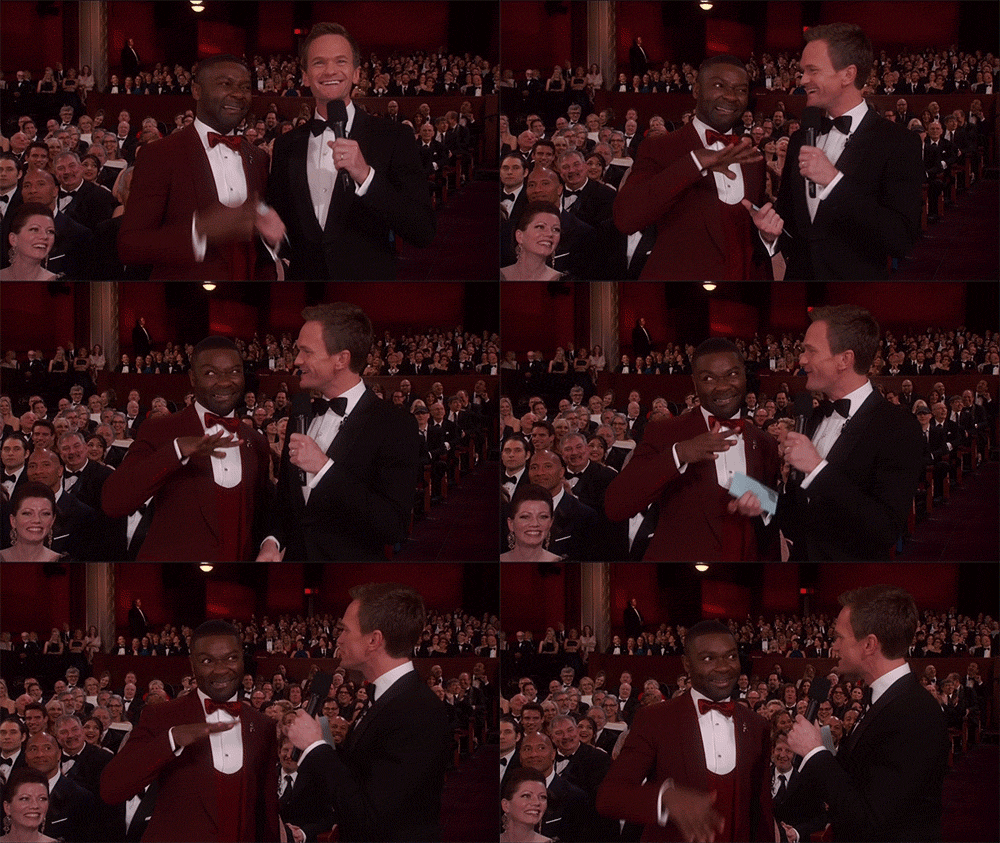
The first of these two key language awareness moments was Neil Patrick Harris’ attempt to talk about the “British Accent” with David Oyelowo, best actor nominee for his role as Martin Luther King, Jr. in Selma. Neil Patrick Harris jokes, “Help me prove that everything sounds better in a British Accent. I’m going to do this setup for a joke and then I’ll give you the punch line.” The joke and the punch line are not worth repeating—only barely funny, clearly tasteless. Simply the expressions on the faces of the audience were enough to indicate the sourness of this routine. And on the web, Oyelowo’s gif-immortalized gesture echoed this impression. Even British English couldn’t patch things up:

Oyelowo

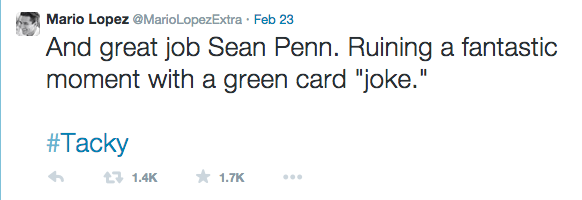
The second memorable language awareness moment began when Sean Penn announced the winner of Best Picture, for Birdman, directed by Alejandro González Iñárritu. After the usual pregnant pause and before he announced the winner, Penn’s off-the-cuff “green card” comment—alluding to Iñárritu being Mexican—met with immediate revulsion on Twitter. As exemplified here:

Screen Shot 2015-02-25 at 12.11.46 PM

A few glum faces, even among the best picture winners, gave hints that this humor didn’t fly with everyone in the room either. Iñárritu then brilliantly stepped on stage with the cast of Birdman and took the microphone. Self-deprecatingly, he described his own English accent:

Oh my god, they want me to talk because I am the worst English-speaking guy here.

Then he proceeded to put to shame the evening’s countless scripted and non-scripted attempts at language artistry. He spoke up for Mexico and for Mexicans’ contributions in the United States, and he implicitly punched back at Sean Penn’s joke:

Finally, I just want to take one second. I want to take the opportunity to dedicate this award for my fellow Mexicans. The ones who live in Mexico. I pray that we can find and build a government that we deserve. And the ones that live in this country, who are part of the latest generation of immigrants in this country. I just pray they can be treated with the same dignity and respect of the ones who came before and build this INCREDIBLE. IMMIGRANT. NATION. Thank you very much.

If that is the “worst English-speaking guy” in the room, what might we call some of the other English speakers present that evening? And how well does the Academy seem to recognize the verbal artistry involved in language diversity?

What moments of talk about language did you hear at the Oscars? What do your social networks have to say about language diversity that night?

Leave your comments below!

Sociolinguistic Outtakes: Footnotes, Epilogues, Anecdotes and Asides

Have you ever indulged in a movie… outtake? The DVD ends and scenes flash beside the credits, featuring the very same movie actors you just watched–breaking character. They swear or burp or burst into belly laughs, when they are supposed to be exuding wisdom or dying or committing a felony.

 FellowshipOuttake“I’m sorry I cannot get up these god damned steps smoothly” (Ian McKellen outtake from The Fellowship of the Ring)

Even animated movies have outtakes. Toy Story outtakes, for example, proliferate on the web—as if the anthropomorphized toys are so real that they, like human movie actors, sometimes break character and burp or giggle at the wrong times.

BuzzBurp Buzz Lightyear after burping in his packaging (Toy Story outtake)

Outtakes were once perhaps simple teasers to make people keep watching during the credits after the movie ended. Now they are specially produced and sought out on the web for their own, unique merits (one Toy Story compilation on YouTube has over six million hits). Why? What makes outtakes interesting to people?

Outtakes show that actors—even the toy Pixar characters?—have lives beyond the artifice of the movie set piece. They react to situations and interact with each other in a huge variety of ways, some of which may be familiar to us, or idiosyncratic and new (like the way Seth Rogan giggles). Also, they make us feel like Hollywood insiders. Movie making isn’t as elite and exclusive a process as we may have thought. Outtakes reveal the process. They also suggest the joy in it. Maybe making the movie was even more fun than watching it.

Now, how does this citizen enjoyment of movie outtakes relate to Citizen Sociolinguistics? Think of the “research article” in place of the “movie.” The article, conference address, or book, like a Hollywood production, emerges from careful editing–the squeezing of countless interviews, observations, field notes, recordings, videos, into the professional medium of a journal article. As with moviemaking, quite a bit ends up on the cutting room floor.

But, language researchers seem to delight in resurrecting those bits that didn’t fit their professional storytelling venture (or research methodology). Just as movie producers (and viewers) delight in replaying Ian McKellen swearing about his robes in The Fellowship of the Ring, language researchers (and readers) relish the unexpected stories that emerge inevitably when doing research with our fellow humans.

It seems that the more rigidly traditional the research parameters, the more delightful the cutting room scraps. William Labov, for example, in a write up of a study that focused on five phonological features and their stylistic variation across five domains of use in New York City, honors his readers with dozens of asides and footnotes that call attention to idiosyncratic features of the humans involved. For example, the research subject Steve K draws these anecdotal descriptions from the staunchly quantitative researcher:

He studied philosophy for four years at Brooklyn College, but left without graduating; he had turned away from the academic point of view, and as an intense student of Wilhelm Reich, sought self-fulfillment in awareness of himself as a sexual person. (p. 104-5)

While Labov includes these descriptions of his subjects (and this one continues in a footnote), he concludes that they play no part in the focus of his research on stylistic variation. Yet these Steve K sorts of descriptions remain a hallmark and entertaining highlight of all Labov’s research.

Linguistic anthropologists, like sociolinguists, also indulge in the anecdote and aside. I still recall clearly the story one of my anthropology professors relayed about a white (Caucasian) anthropologist’s fieldwork. In a discrete epilogue to his book length ethnography, he revealed that, during his entire time living as a participant-observer in remote Indonesia, the community thought he was a ghost.

In the spontaneous moment of an introduction or over wine at the post-talk reception, a researcher might share something about the connection of their work to their own life. Last month, for example, an esteemed, senior sociolinguist gave a talk here at Penn, and introduced his quantitative, fine-grained analysis with a story about his own experience as a graduate student with a stigmatized North Philadelphia accent. Long after he had finished his PhD and had begun to emerge as a leader in the field, his mentor/professor confessed: From the way you sounded in class, I never thought you would really make it through.

These research outtakes reveal the artifice of the research project and even the research training process, throwing what we might have ignored into the public’s view.

What we thought was marginalia may be what drives the work.

These days, sociolinguistic outtakes need not drift into the obscurity of footnotes, or asides during the post-talk reception. The structure of social media, the networked arrangement of the Internet, digital media that hyperlinks footnotes and other information, all make asides as easily accessible as the main research article. And those who are “subjects” in that article may be reading or listening to those asides. What if they joined the conversation?

What if we focused on the outtakes? That’s a Citizen Sociolinguistic approach. Now with social media and hyperlinks to even the most obscure trivia, the institutionally sanctioned research question can easily fall to the background, and the footnote can become focal. As the Cowgirl from Toy Story says in a blooper when she accidentally pulls off part of Buzz Lightyear: Should we put this in the movie now?

OutTakeToyStoryMaybe we should put more sociolinguistic outtakes into the official research. We may discover that the new post-globalization, post-Internet language diversity (or “super-diversity”), has been here all along, in the outtakes.

What “asides” become central to you? Do they take you off-track, or show you a new perspective, something you never knew about before? Please comment below!