You may think pronouncing UGG is as easy as saying “AHH” when you slip your foot into the cushy sheepskin lined interior of an UGG boot. It is! But, in happy citizen sociolinguistic fashion, there is more than one way to do it.
I discovered this recently when a student pointed out (literally spelled out) that she was wearing some cozy “U-G-G” boots, treating UGG as an initialism, like UCLA or FBI. My citizen sociolinguistic senses were tingling, so I had to ask the class: Do you all say U-G-G, not “Ugh”? The Chinese speakers in the class nodded, and one provided an explanation: The word “Ugh” is difficult to say for Chinese speakers. U-G-G is much easier.
Another student explained that the sound “ugh” had a meaning in Chinese so saying U-G-G instead circumvents any confusion. (This explanation was not whole-heartedly endorsed by other Chinese speakers in the class).
I was curious what Internet AI would say. My computer’s “AI Overview” had a very firm anti-U-G-G stance: UGG is pronounced like “hug” without the h.
AI OVERVIEW: You say “Ugg” like the word “hug,” but without the ‘h’ sound at the beginning; it’s a single syllable, rhyming with “bug” or “mug,” often pronounced closer to “uh-g” or even “ag” in Australia, the boot’s origin. It’s pronounced as one sound, not “U-G-G”.
Consistent with this “overview” there are many YouTube videos demonstrating how to pronounce UGG “in English.” Most go with “ugh” and a few illustrate the Australian pronunciation (“ag,” as in “agriculture”) also mentioned in the AI Overview. I found no demos of “U-G-G.”
But apparently someone else was UGG-curious eight years ago and posted this question on Quora, “Why do Chinese spell “U-G-G-S” instead of just saying “Uggs”?” The lone responder wrote, “Because they assume it’s an abbreviation like NBA.” (Who’s assuming now?!). After assuming this rationale, the lone responder continued: “The funny thing is, they stick to this pronunciation, even when you tell them the ‘correct’ way. What’s funnier is that the Australian customs officers have got used to saying ‘U-G-G’ to make sense to the Chinese visitors.”
This anecdote endears me to these pragmatic Australian customs officers/citizen sociolinguists! But it seems a bit dismissive of the U-G-G pronunciation (as funnily persistent “even when you tell them the ‘correct’ way”) and it fails to mention my Chinese-speaking students’ explanation about the difficulty and possible weirdness of saying “ugh” instead of U-G-G.
I encountered a new take when I came across a TikTok post, “How do French people pronounce “UGG”? This is nothing like “hug without an h”—it’s more like something you might say when looking out from your Parisian garret at a glittering Eiffel Tower and popping a bottle of the best Champagne. “Oo Jey Jey!”
Let’s sum up: Chinese speakers seem to favor “U-G-G.” French speakers, “oo-jey-jey”. Aussies say “ag”. Internet AI and most YouTube tutorials say “Ugh.” Are all these pronunciations okay? I think so. UGG is not an “English” word—it’s a brand name! So, give yourself this holiday gift: Enjoy your favorite pronunciation as you would your favorite Aussie sheepskin slipper. From this point forward I will be luxuriating in my own imaginary pair of Oo Jey Jeys. Oolala!
Have you encountered any surprisingly wonderful new pronunciations lately? Please share below!
As citizen sociolinguists, as humans, we listen and learn from the language around us. Inevitably, over a lifetime of living among multiple communities and generations, traveling here and there, raising a family, and having a career or two, our communicative repertoire will be more expansive and powerful than the sum of all the language we learn in schools, the vocabulary represented in the dictionary, or prose spouted as superior by ChatGPT or Claude or your AI robot of choice.
This became clear in a very specific way last week when I asked my students to look at this picture of John’s Water Ice and tell me what the word “Gelati” means. John’s Water Ice is a special neighborhood spot—the type that politicians like to drop by for photo ops, illustrating their connection to the community, and their love of local delicacies. At the time this picture was taken (2011), President Obama was on the campaign trail with our Pennsylvania Senator Bob Casey. I learned later that President Obama ordered a lemon, my personal favorite. John’s Water Ice is delicious!
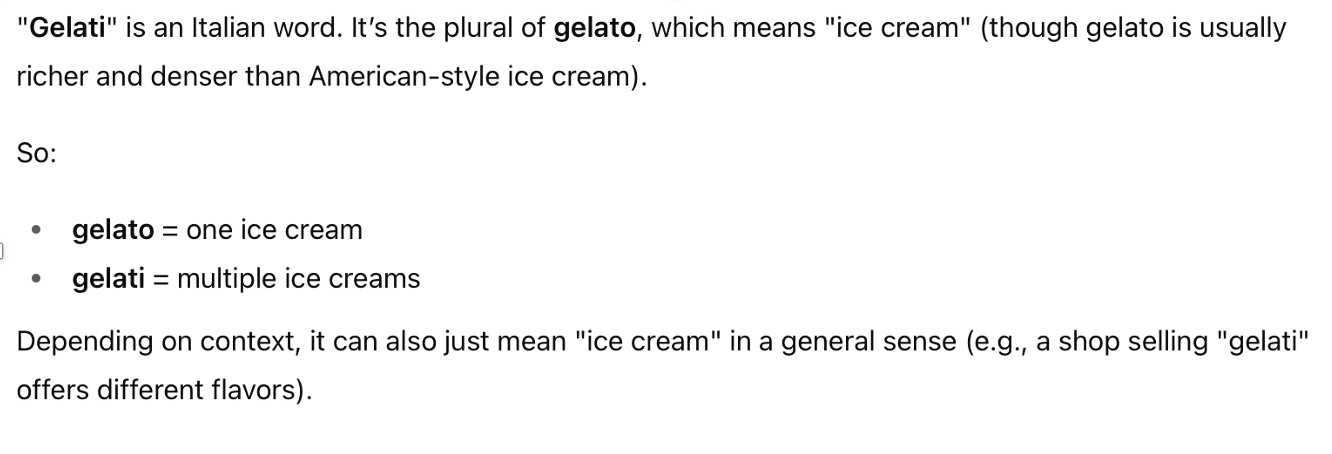
But if you’re not from Philadelphia, like most of my students, you might be wondering, what is water ice? And even if you have a guess about what water ice is, you might really be stumped by “Gelati.” When I asked my students (not allowing those from Philadelphia to respond), they were stumped. So, of course, they asked AI. ChatGPT came up with this:
I turned to the Philadelphians in the room. Is that what “gelati” means in this illustration? No.
But meanwhile, ChatGPT asked:
This sounds like ChatGPT might be catching on to the John’s Water Ice meaning of gelati. Was it? Here’s what followed:
None of these examples come anywhere near the description of a gelati (agelati, singular!) in Philadelphia. This is AI pomposity at its finest (and most embarrassing: “summer gelati vibes”?). Would you like ChatGPT to “break down the difference between gelato and regular ice cream.” No!
Here in Philadelphia, as the locals in my class began to explain, a gelati (singular) is like a parfait: A bottom layer of ice-cream (or “custard”), followed by a layer of water ice (flavored ice of the most sublime, slushy texture), followed by another layer of ice cream, and topped with one more colorful dollop of water ice (ideally pronounced “wooder ice”). This, my phriends, is a gelati.
Now, if you will look back at the picture of Obama and Casey, you’ll see it, plain as day:
GELATI
WATER ICE * ICE CREAM
Combo
Knowledge this delicious comes from humans and experience in the world! It expands one’s communicative repertoire in useful and wonderful ways. Do you know local language that only humans and experience could illuminate? Of course you do! Please share your citizen sociolinguistic expertise below (or with a friend, in real life).
What is a “Hollywood Basement”? How would you define it?
This week I was reading through an interview recorded by Marcyliena Morgan and discussed in her book, Language, Discourse and Power in African American Culture (Cambridge, 2002). In this interview with lively older women who had lived through the Great Migration and were discussing their experiences living in Chicago at that time, one of them mentioned her apartment, describing it as a “Hollywood basement”:
“My landlord had discovered that I was pregnant—had given me a, like a Hollywood basement instead of the fifth floor where I originally was living.” (Morgan, p. 105)
When I read this phrase, something clicked in my own memory. I faintly recalled my father, who grew up in Milwaukee, using that phrase, Hollywood basement, to describe those apartments whose windows were only half above sidewalk level, offering a nice view of pedestrians’ feet walking by on city streets. It struck me as a midwestern expression, a landlord’s euphemism for dark and sunken basement living quarters. But I wanted to learn more, so, of course, I googled it.
What then followed was the most unsatisfying google search I’ve ever experienced: page after page of links to one and only one instance of “Hollywood basement” use: the lyrics of the Red Hot Chili Peppers’ song, “Californication”:
The term “Hollywood basement,” which up to this point had seemed like a quaint term from a previous generation, one which I wanted to know more about, now seemed locked in the eternal present of an Internet-circulated feedback loop.
I was horrified: From now on, will the Internet no longer be a place where we can investigate language history and current (often passionate) language debates? Where we unearth arcane connections between forms of life and ways of using language? Instead, will the internet now ensure that we only see the same meanings over and over? Are we doomed, now, to only thinking about the phrase “Hollywood basement” in the context of Californication, since that is where the internet will guide us?
Does this mean the information age has ended? We used to worry that there is so much information out there that we won’t be able to distinguish what matters and what doesn’t. But now, we seem to have a more troubling problem. According to Google’s AI, to whom I humbly inquired, “Is this the end of the information age?”, we are now in the “Age of Intelligence”:
According to AI, this intelligence focuses on “analyzing, understanding, and applying it effectively through advanced data processing and artificial intelligence.”
Does that mean anything? Is this type of “intelligence” what leads to one and only one understanding of the phrase “Hollywood Basement”?
Often, critical educators who strive to create a thoughtful and informed generation to lead us into the future, focus on the question, “What counts as knowledge?” This question can help teachers think critically about their own practice, their curriculum, and their sources of expertise. Language is always changing, so what counts as language knowledge in our classrooms is always changing too. What counts as an accurate definition or correct usage varies across context. For that reason, critically aware, relevant teaching relies on being responsive to change. In contrast, the type of synthetic process (“advanced data processing” ) described by AI as heralding in the Age of Intelligence, seems to freeze language change and the processes that give language meaning. This type of “Intelligence,” and the self-referential circle it leads to (Let’s call it the “Hollywood basement” type of intelligence) might count as knowledge—but of a very limited sort.
Limiting our world to what people post online has always seemed existentially threatening to me. Googling does not count as “research,” and I still want to live life in some kind of “real world.” At least the Internet used to seem like an immense and ever-expanding world. So much information! Such rich, immersive environments! But with AI as a driver of content we see, what used to seem like a limitless world might only, increasingly, refer to itself. As quickly as the “information superhighway” took off, it might now be turning back on itself, like a snake eating its tail. This was the visceral experience I had when I looked up “Hollywood basement” and faced nothing but page after page of “Californication” links. What does anything mean anymore?
Readers, help! Have you experienced the phrase “Hollywood Basement” in contexts other than the Red Hot Chili Peppers’ song “Californication”? If so, what does it mean to you?
Have you experienced a similar existential internet search problem—looking for a definition and finding one and only one, somewhat limited answer? Please share your experiences below!
Mondegreen is a wonderfully useful word for the misheard version of a well-known phrase or song lyric. Often these are funny and a little irreverent. Many famous mondegreens come from classic rock lyrics, like Jimi Hendrix’s “’Scuse me while I kiss the sky” (misheard as the mondegreen, “’Scuse me while I kiss this guy”) and Creedence Clearwater Revival’s “There’s a bad moon on the rise” (“There’s a bathroom on the right.”). For years I naively thought Eric Clapton’s seductive, rhetorical question, “C’mon baby do you do more than dance?” was the information-seeking, “C’mon baby, do you do modern dance?” All of these mondegreens are in English obviously, but I’ve recently become aware of a few multilingual mondegreens (a well-known phrase or song lyric misheard in a different language) and I started to wonder if these tend to have the same entertainingly absurd dynamic to them. So far, the answer seems to be yes, and so much more.
My students recently alerted me to a viral YouTube video, apparently circulated many years ago, a perfect multilingual mondegreen that seems as silly and enjoyable as those I’ve mentioned in English. The video version depicts only audio with sub-titles in English: a Spanish-speaking individual calls in to a Spanish-speaking DJ on a pop radio station and asks if the DJ could play a favorite song: “Eso son Reebok o son Nike.” The DJ wonders aloud for a bit, and then seems to have an “aha” moment, and plays the correct song, “This is the Rhythm of the Night.”
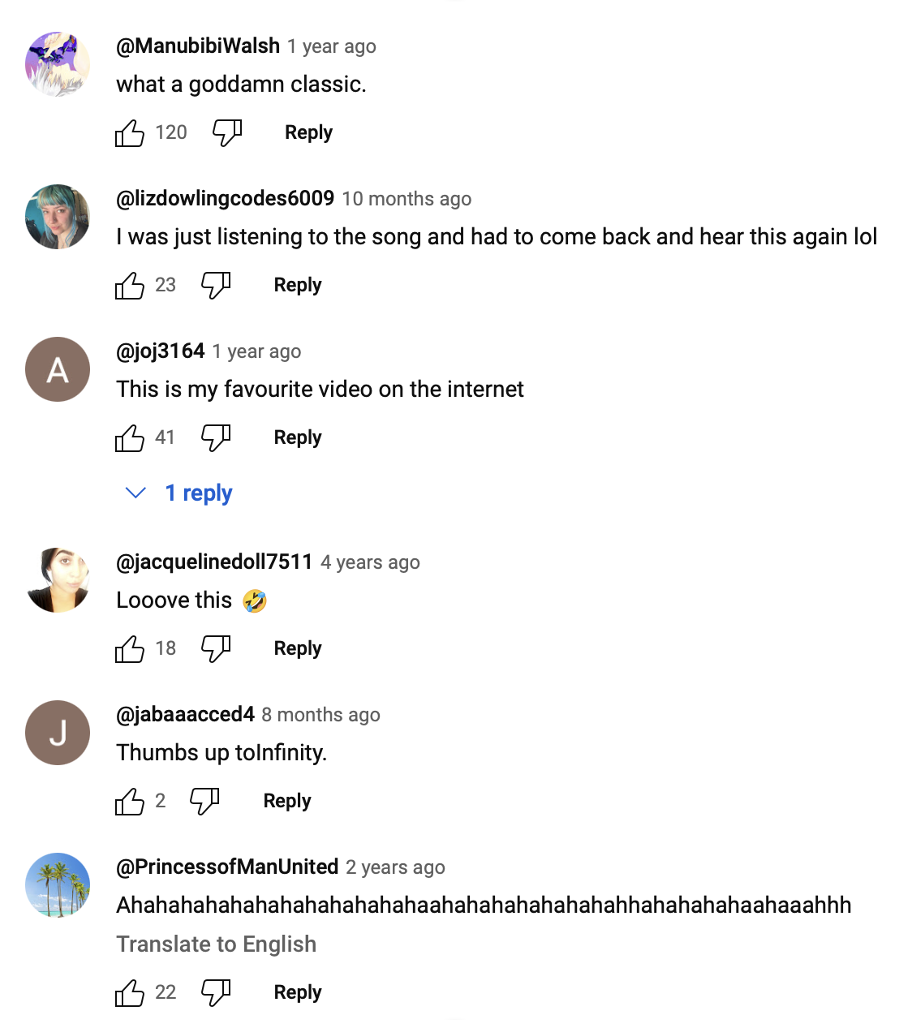
“Eso son Reebok o son Nike” is as a great example not only of a multilingual mondegreen, but also of how important it can be to give someone the benefit of the doubt when you are trying to figure out what they are saying. This DJ is such a generous listener. And he very satisfyingly guesses that the caller is requesting “This is the Rhythm of the Night.” Does this have the same absurd joyfulness as the monolingual Classic Rock mondegreen examples above? Judging by the reaction of the DJ, who ends up laughing spontaneously through the second half of the video, yes! And my students also expressed love for this example. Under the English translated YouTube version, the comments echo this enthusiasm:
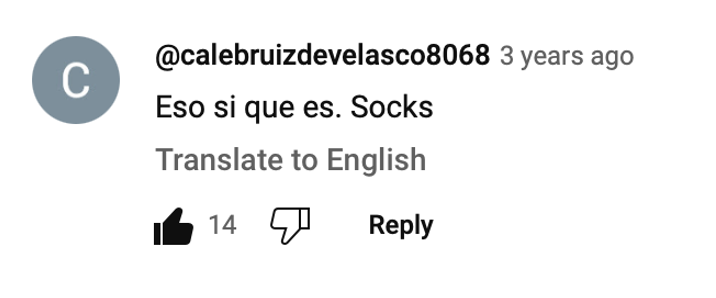
One commenter even added another multilingual pun in their response:
So, it seems that at least this Spanish/English multilingual mondegreen has the same effect as those old classic rock mondegreens. Joyful absurdity! Plus more—a little revelry in multilingual punning.
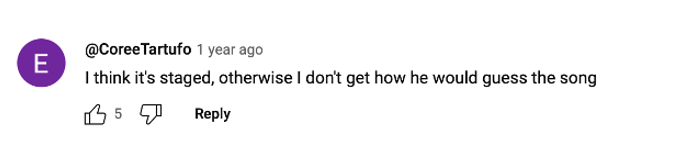
Still, one commenter suggested that this was all a staged performance. At first they couldn’t believe that this DJ could get to the bottom of this multilingual mondegreen.
But multiple people reply, explaining how, as bilinguals themselves, they see how this could realistically be deciphered by the DJ:
Importantly, one of these replies also mentions another, all-English, mondegreen (“We like papaya” for “Relight my fire”) to illustrate that this type of mishearing is common. Collectively, these commenters convince the skeptic.
But there are other multilingual mondegreens that are not nearly so popular, nor so generously deciphered. When the misheard words immediately seem offensive in another language, people don’t work as hard as that DJ to get to the bottom of the multilingual mondegreen mystery—that is, to match the misheard word to the original song lyric. Most infamously, K-pop lyrics that contain the word “Nega,” which some speakers hear as the offensive and racist English language “N-word,” have led some artists to issue trigger warnings before live performances of songs that prominently feature that word. This is another multilingual mondegreen, but one that seems less innocent.
I recently heard from my students about a similar problematic mondegreen of a viral Chinese pop song (“Nae Ni**a”) that foregrounds, again, a word that sounds very much like the “n-word” in English. (https://www.youtube.com/watch?v=NjD0H4eBfng):
How do listeners interpret this potentially racist multilingual mondegreen?
Some insist the original lyric and its literal translation render it innocent (the video accompanying it, including a rainbow unicorn and dozens of teens dancing in tuxedo suits, seems to underline that interpretation):
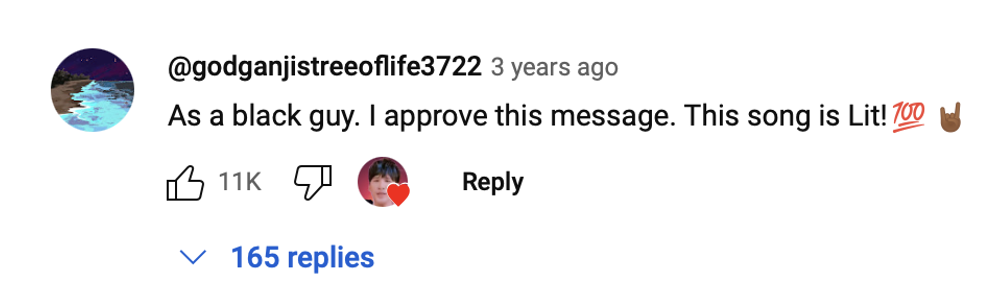
But the awareness of the potential for offense is still there, since more than one fan also points out their Black identity as they express their appreciation:
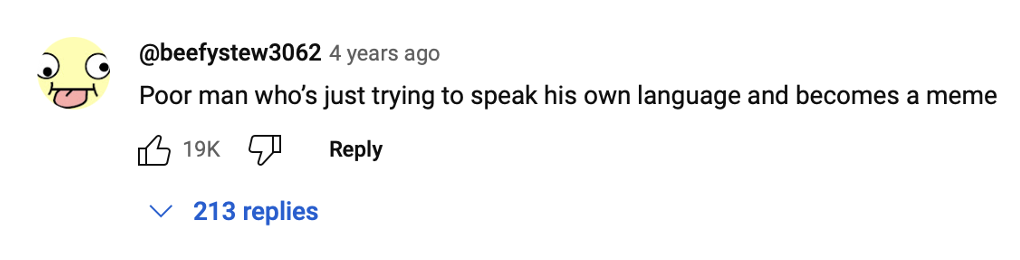
And other comments point out that this song is in Chinese—even though some might hear the words as English (the essence of a multilingual mondegreen):
But the existence of the potential for multiple racist interpretations seems to act as a lightening rod for more toxic comments, not to be repeated here. And, I get the sense that people may be using this song as an excuse to, in other contexts, use the n-word in offensive ways, without being held accountable. Several comments mention the possibility of getting an “n-word pass” because of this song.
All of these mondegreens highlight how we stretch our ears to hear things in new ways when multiple languages are involved, and how misunderstanding arises even among massively homogenous groups like monolingual classic rock fans in the United States. Mondegreens, both the hilariously absurd, and the interculturally awkward, can make us pay attention to lyrics (and their translations) and help us appreciate them. They also highlight the ever so human possibility for mishearing in any language, and the exponentially greater possibility of miscommunication when multiple languages are involved.
The DJ who impressively deciphered “Eso son Reebok o son Nike” illustrates the interactional rewards that follow from generous listening: Very little in life is as sweet as a laugh shared at nobody’s expense! Rather than refusing to understand, that DJ stretched his ears, puzzled a bit, then found “The Rhythm of the Night,” to lasting and entertaining effect. In our complex multilingual world, multilingual mondegreens help us to recognize the crazy ways our varieties of communication will overlap and near-miss, and that, if we empathically listen to each other, we might be rewarded by learning a little about each other’s languages, and even, if we’re lucky, share a hilarious “aha” moment that brings us a little bit closer together.
What are your favorite and least favorite mondegreens, multilingual or otherwise? What kind of impact do they have? Please comment below!
This semester I have been receiving a lot of bizarrely polished essays from my students. They aren’t plagiarized or even straight-up usages of ChatGPT. I haven’t seen one grammatical mistake, not one spelling mistake, but these essays don’t read like they’ve merely been through spell-check and grammar-check. There are many oddly elaborate, yet somehow simultaneously formulaic word choices. For example, phrases like these:
“The diverse tapestry of linguistic diversity”
“profound implications”
“a catalyst for positive change”
“In essence…”
Or entire sentences like these:
“Let us be mindful of the role we play in shaping a more inclusive and equitable world.”
“While this ideology may masquerade as a beacon of clarity, it often acts as a restrictive force.”
“We not only advocate for diverse linguistic forms but also honor the deep cultural narratives they embody.”
What is going on here?
Taking a citizen sociolinguistic approach, I talked to several “authors” of such phrases and essays to try to answer that question. I tried to remain curious, not judgmental: What is their process? What tools are they using to help with their writing. And, why?
Several different strategies emerged in our conversations. Examples include, from most to least complicated:
Writing an essay in Chinese, then getting three translation options from GoogleTranslate, choosing the “more academic” seeming version, then running that paragraph-by-paragraph through Grammarly, selecting the “professional” setting.
Writing an essay in English, then using ChatGPT to review and edit, specifically directing it to adjust “phrasing” and “coherence.”
Writing an essay in English, then running each paragraph through Grammarly, using the “professional” option.
Most students avoided mentioning the highly stigmatized ChatGPT, and some even declared that they hate ChatGPT, but a couple did mention it as a useful tool for “brainstorming,” (if not for editing as mentioned by one).
Why use these tools? These strategies seem time-intensive, and the results highly variable: In the best case, a mediocre paper, in the worst, a practice punishable as academically dishonest. Students presented similar backstories to make sense of their AI practices. As both undergrads and graduate students, in the United States as well as China and Canada, students have been told by professors and teaching assistants to improve their writing, often receiving advice like the following:
“Your words are too simple.”
“Your writing is too personal.”
“You need more transitional phrases.”
“You need more professional words.”
Some professors even allow the use of AI tools, if the students acknowledge their use. So, the students have developed strategies that directly address the writing advice they’ve received: They run an essay through Grammarly, selecting the “professional” output setting, they choose a Google-translated option that seems to have fewer “simple” words, they make explicit requests for transitional phrases (see “In essence,” “Let us be mindful,” “We not only advocate…but also honor” above).
This seems legitimate, since, the students say, these essays still contain their own original ideas. But after one runs an essay through the AI wringer, ideas can be hard for a reader to detect anymore. Originality? Lost.
Despite my sincere efforts to remain a curious explorer and not judge these writing strategies through the lens of Aging Professor, I find them disturbing. A few analogies to the AI takeover of student writing began to simmer in my brain:
The first may be a bit obvious: Frankenstein’s Monster. We have created a monster (AI writing tools) that we can no longer control. When something written by a human individual goes through Grammarly and comes out radically different, that human individual loses their voice. And, if Grammarly has chosen vocabulary unfamiliar to that human individual, the original writer doesn’t know what they are saying anymore. If that human happens to be a university student, they no longer know how their writing might sound to a professor or teaching assistant—or whether their original ideas remain original. The essay becomes like Frankenstein’s monster, out of the hands of its author, doing things that author no longer has any control over. Ultimately, that monster turns on humanity and must be killed.
Another ominous analogy, less rooted in Victorian fiction: A Self-Driving Car. I’ve asked several people if they would be willing to completely cede control to a self-driving car, spending their mornings in the car reading the paper, preparing for class, talking with their kids, and letting the Artificial Intelligence handle the driving. Everybody has balked at that idea—some intuitively uneasy with giving so much control to a complex activity like an urban commute during rush hour, others citing YouTube videos that illustrate the kinds of disasters such negligence has already wreaked. Like AI writing assistance, a self-driving car simply doesn’t have a sense of the complex context of its activity—or the very sensitive nature of human beings. My dad also pointed out that “Driving is fun!” Why let an AI-tool do all the fun part? I hope some readers see writing this way as well. Writing is fun! Like driving, it potentially gives us a sense of freedom—we can say anything! But both AI driving and AI cyborgian writing, seem overly concerned with standardization, which inevitably eliminates both the fun and the humanity involved with either of these activities.
The mention of “fun” also brings me to my third analogy: The Drum Track. Many songs get along just fine with a non-human drum track. But take a listen to a song recorded with a human drummer, or go to a live concert. Listen to that drummer: Do they play the same pattern again and again? Or, do they surprise you with a jump on the established rhythm, or a withheld beat? How does this affect your experience of the song? While it may sometimes be fun and useful for musicians to use a drum machine to provide a driving beat, it’s nothing like the actions of a live drummer—even if that drummer makes mistakes now and then. Like creating music, writing involves establishing your own rhythm, your own voice, and that can’t be achieved with tools like Grammarly and ChatGPT, the writer’s equivalent of a monotonous drum track. Rather than turning to standardizing tools to shape an individual’s writing voice, one might instead focus on reading works by talented writers, engaging more fully with writing that does *not* read like a monotonous drum track. As students and professors, we should build our own writing (and writing advice) on those models we most admire, not the most pedestrian standardized versions pumped out by AI.
By now, my opinion may be all too painfully clear. The monster must be killed, or ultimately, it will kill us, or at least take a very large bite out of the humanity and joy of writing. Thus, my suggestion to students: Don’t use these tools! To Professors: Try to refrain from encouraging students to engage with them, even in a cyborgian compromise. Consider what you sacrifice in the long run, consider the purpose of education.
Readers may have alternative opinions, and more practical suggestions. Please share your comments below! Or have ChatGPT express an opinion—I’m curious to see what it might “say.”
What is the Ludic Fallacy, what does it have to do with Citizen Sociolinguistics, and why does it matter?
According to Finance Philosopher Nassim Nicholas Taleb, who coined the term in his best seller Black Swan (2007), the Ludic Fallacy is the misapplication of the rules of games to real life situations.
To exemplify the Ludic Fallacy, Taleb contrasts how an imagined Professor of Statistics and an imagined Actual Gambler would act after 99 coin tosses land on “heads”: Asked to predict the 100th toss, the Professor (perpetrator of the Ludic Fallacy) asserts there is still a 50/50 chance that the coin will land on “tails.” The Actual Gambler recognizes a problem with that prediction, concluding (and I paraphrase), “Dude, the coin is loaded, get your head out of your a*s!” Taleb thus suggests that otherwise intelligent finance people ignore statistical aberrations and as a result make mistakes that lose them a lot of money; The Ludic fallacy also helps us avoid some pitfalls of the world of Sociolinguistics by drawing our attention to the knowledge of Actual Language Users, or Citizen Sociolinguists.
To illustrate, let’s bring in an Old School Linguist for the role of Professor from Taleb’s example and an Actual Speaker of Language for the Gambler: The Linguist may have noticed some statistical regularities about language and the distribution of its variations, but the Actual Speaker, who has no knowledge of those regularities, goes about their day by assessing each situation more holistically. The Old School Linguist may predict that an Irish immigrant in New York will speak one way, for example, that he would express, feeling weary, a plan to head to bed “airrly” on “Tursday”. But, more unpredictably, that same Irishman, having lived in New York for 30 years may say “Early Thursday” one moment and “airrly Tursday” another—whether he’s talking to a friend, a customer, the news media, whether he is a bit tipsy, or sleepy, or hungry, or not! Like the Actual Gambler, who may provide the best prediction for the coin toss, based on his experience with gambling, those who know the Irishman well will be able to best predict which pronunciation will emerge in any given condition.
Similarly, an Old School Linguist may predict, based on statistical regularities that have been studied for decades, that an African American child in school will speak a “well-formed” variety of African American English. This may include emblematic features of that variety like the use of double negatives (Ain’t nobody got time for that!), copula deletion (What up?), or characteristic words, like a Philadelphian’s classic use of “Jawn” to refer to a random something (Hand me that jawn over there!). But kids at school in Philadelphia today might be able to predict much more—White kids may also be using these words and turns of phrase, and many Black kids will not! Ain’t nobody got time for the Ludic Fallacy here—instead, people are learning about each other and using language to make their way from classroom to classroom, friend group to friend group, online to offline, home to work, high places and low, and back.
Now throw that Old School Linguist into any given interaction: What up playa? It’s been a minute! How you been? You finna make a couple bucks at that gig? Ask that Old School Linguist, based on some recordings played in his office: Who is talking here? What is their demographic? Age, Gender, Race, Class? Likelihood for success? An approach based on platonic ideals about how our world operates, like those enshrined in statistical models, cannot come anywhere close to modeling the way language works in any real-world encounter or predict how it will work in the future. Speakers gain such understanding through long term experience of language and life.
While Linguists may not be able to have all that experience themselves, they can ask questions and value the experience of those who use language every day, the same way a statistician in Vegas, working out the bottom line, may need to consult with some of the seasoned players in the Casino. If it looks like the dice are loaded, the Actual Gambler will be able to tell you how dice get loaded, who fixes the dice that way, where you get them, and maybe even how you can outsmart that cheater! Similarly, an Actual Language User—aka a Citizen Sociolinguist —can tell you who speaks one way or another, why and when, how and with whom. But they certainly can’t share their insight if nobody includes them in their work or bothers to ask.
Obviously, I’ve overstated the case here—as did Taleb when he exemplified the Ludic fallacy. No Statistician, after witnessing the coin fall the same way 99 times in a row, would be such an idiot as to discount the Gambler’s experience. They might instead start to value that Gambler’s insight; No Sociolinguist would insist that Irish American or African American speech works one way, after hearing new ways of speaking, addressing a range of people, in different contexts, again and again. No sociolinguist would discount that speaker’s own explanation for the speech in their community. Would they?
The Ludic Fallacy illustrates that ignoring those real-world voices leads to a mistaken understanding of the world. In finance, this may mean lost money. In the study of language and society, it can lead to wrong-headed judgements about what people can do.
The Ludic Fallacy also provides a refreshing reminder that an aberration from one perspective, is, from another perspective, an obvious illustration of how the world works. The 99 coin tosses yielding “tails” may be an outlier for a Statistician but may be a normal occurrence of a practice easily recognizable to the real-life Gambler. Similarly, an encounter with always new language in the schools in Philadelphia, may seem like an aberration to an outsider Linguist, but happily ordinary to the students in any given classroom. In any case, the unexpected offers an opportunity to engage more deeply with the language, interactions, and the people who create our world.
The foundation of all citizen sociolinguistics is talking about language. Everybody does it, and, inevitably, though talk and conversation, everybody, collectively creates how we view and think about language around us. Those everyday conversations have been the springboard for most of the posts on this site.
The goal of this citizen sociolinguistics website has been to document varieties of language experience, as I’ve encountered them. I’ve also wanted to go beyond my own perspective. This medium, the blog site, has not been the best for back-and-forth, but I’ve enjoyed reading the comments from people across the globe who’ve added their views on the proper pronunciation of “succinct” or “croissant,” or the problematic overuse of the word “gentrification.” Now I’m hoping for more discussion, more voices, more languages, more controversy, more dialogue.
To that end, I invite you all to join me and many others on a much more interactive site, “The Virtual Linguistic Ethnography Lab: A Place to Talk about Language.” Invite your colleagues, your friends, your students!
The site is now live and waiting for the conversation to begin. Check it out:
Each topic features an interactive bulletin board that allows you to see each others’ posts and comment directly. Take a look and join the conversation! And let’s see what we can discover there together.
The hip hop classic, The Miseducation of Lauryn Hill (1998), is now over 20 years old. The album was recorded before either of my children, now ages 13 and 21 were born. But, during quarantine, I’ve had the pleasure of sharing it and listening anew with my 13-year-old daughter. Musically it’s a masterpiece, but there’s more than music here: One of the most compelling and original parts of the album occurs in snatches of talk between the songs. In these interludes, I’ve noticed my daughter’s attention become more focused. She listens intently as a conversation unfolds between a teacher and some middle-school students about one word: Love. This conversation brilliantly enacts not “miseducation,” (as the title of the album might suggest), but an ideal of pedagogical discussion. Whether you’ll be on zoom or masking up and entering a classroom this coming fall, if you’re planning to talk about language with your students, this discussion of the word love on Lauryn Hill’s classic album provides a potentially powerful model for doing so.
The conversation begins like this:
Teacher: Alright people. I’m going to write something on the board. Let’s spell it. First letter…
Chorus of Kids: L-O-V-E [a couple giggles]
Teacher: What’s that?
Chorus of Kids: LOVE!
Teacher: What?
Chorus of Kids: LOVE!
Teacher: How many of you know any songs about love?
Student: I know a lot about love!
Teacher: Tell me some titles, titles, I want some songs.
Student: Love! [Lots of giggles]
Teacher: There’s a song called love? There’s no song called love! Alright, what is it what is it?
Student: It go “loooooove” [more giggles]
Teacher: Okay. Anybody else…
Student: I will always love you.
Teacher: Okay, any movies about love?
Student: Romeo and Juliet.
Teacher: Ok. Did you know what that was about when you saw it?
The conversation then fades out and Lauryn sings a sad love song, “Ex-factor.” After that song and another, the “classroom” conversation continues:
Teacher: Okay, how many people in here have ever been IN LOVE? I know none of the guys are going to raise their hand. Heh heh. How many of y’all have ever been in love? I know none of the guys been in—we don’t get in love, right? Oh! Let this black man right here tell what his idea of love is. It’s not all the time we hear young black men talking about love. About your personal definition. Don’t tell me what Webster thinks.
Student (boy): You are willing to do everything for that person.
Teacher: Okay, everything like what?
Students: Side mumbling
Teacher: Let him talk, come on. If I asked him to talk about a fancy car, he’d be right on point, but we want to talk about love. You can do it! What do you think? You said you loved somebody, you should know why you love them, right?
Student (boy): The way they act. The way they carry theyself. Stuff like that.
Student (girl 1): They just stand out. It’s like sometimes it don’t even matter what they wear or what they look like. It’s like. It’s like. That one! You know?
Student (girl 2): Yeah [wistfully]
Student (girl 1): You know that you want to talk to him because he stands out. It’s like he got a glow or something.
Student (boy): That’s what I’m talking about.
Teacher: That’s deep. I thought that was a beautiful point. Anybody else want to deal with that?
Student (girl 2): And, sometimes like when they try to act funny in front of their boys and they get around and they say I love you—They can’t love you! Because love is- love don’t do that.
Student (girl 1): Love is not phony.
At that point, Lauryn sings one of her most famous songs, Do Wop (that thing), and then, the conversation resumes:
Teacher: Hey. We got some very intelligent women in here, man. Do you think you’re too young to really love somebody?
Chorus of Kids: NO!!!!!!!
Teacher: Let’s take it from me. I’m an adult. I say wait, you’re too young to be in love. This is silly. You’re infatuated with him. He got nice jeans. He wear fancy adidas.
Chorus of Kids: Laughing!
Teacher: I don’t know! Student (girl): It’s a difference from loving somebody and being in love.
Teacher: Okay! You tell me. What’s the difference?
Student: You could love anybody. But when you in love with somebody, you’re looking at that person like- you’re taking that person for what he or she is, no matter what he or she look like or no matter what he or she do!
Student: You can fall IN love—you can fall OUT of love.
Student: You stop being IN love with them, but you is NOT gonna stop loving that person.
Student: Maybe sometimes they’ve never been loved before, or they never been in love before, or they never- they don’t know what the feeling is to be loved.
Teacher: You killed it. We can end the conversation with that, right?
In these small moments, between songs, this teacher illuminates what a great discussion with kids, about one word, might look like.
Now, you might be thinking—this is an ideal situation, and the conversation may even be scripted ahead of time. No wonder it’s so wonderful! Others have also wondered the same. In an essay in Medium about this Album, on the occasion of its 20th anniversary, Alex Chochoclo writes:
“I always wondered whether the classroom dialogue recordings were scripted or not. I’d like to believe that they weren’t. Somehow, the experience of listening to young men and women talk about their opinions and experiences of love at such an early stage in their lives is endearing. I wonder what those same voices are experiencing of love right now and what they’ve endured over the last twenty years.”
As if in answer to Chochoclo’s essay, the New York Times also published an article that year, after tracking down the original teacher and some of these students (now adults) to follow up on these very same wonderings. The revelations of these individuals, and about the word “love” continue to flow in this multi-media article about what followed.
As the participants remember that day, recalling the conversation, they assure listeners that, while it didn’t take place in a classroom, it was entirely improvised—with the single goal being to have a conversation about the word, “love.” The teacher brought a couple of students he already knew to the recording session (which took place in Lauren Hill’s childhood home in Newark, NJ), and Lauryn’s team rounded up a few more neighborhood kids whom the teacher had never met before.
And who is this “teacher”? The students seem so attentive and forthcoming, eager to answer his questions. I have always wondered, is he also a hip hop star? No! At the time of the recording, he was an elementary school teacher in Newark, and a friend and neighbor of Lauryn Hill. Today, he is the Mayor of Newark, NJ, Ras Baraka.
And the students the Times talked to were—still are, in the Times-recorded interview from 2018—genuinely engaged in this discussion of love. Twenty years after the recording of their “class”, they had distinct memories of the event and of the substance of the conversation. One of them remarked, of the interludes between songs:
“That’s the best part of the CD! It kind of makes you laugh. And gets you thinking!”
One of the women surprised herself, looking back, at the wisdom of her statement about love, in 1998, when she said, “Maybe sometimes they’ve never been loved before, or they never been in love before, or they never- they don’t know what the feeling is to be loved.”
Listening back to the recording from 1998, she told the Times reporter: “I was wise beyond my years!” She was impressed with her own younger self, and the recognition she had then that someone who has never been loved may not be able to feel love for others. As she remarks:
“I honestly was thinking about….I had seen kids my age who didn’t have what I had, which was a loving family. And they would just do things that would be considered bad behavior. But, you know, it just dawned on me when that question was asked: Maybe someone doesn’t know how to love because they’ve never been loved before. They don’t know what it feels to be loved. So how can you possibly expect someone who has never been loved before to know how to love?”
Another participant, one of the boys in the love conversation, talked about how the meaning of the word, “love,” for him has changed over 20 years of his life. Now, he says, as a divorced man, as a man who had recently lost his ex-girlfriend to gang violence, “love” for him is a “gamble.” He then remarked, “1998 to now, which is 20 years—I’ve lost over 100 friends to gang violence.”
This conversation—and the return to it 20 years later—reminds us that words don’t define the world for us. Discussing the word love, did not center on identifying its universal essence, the definition. Instead, it illuminated how people bring meaning to that word through the events of their own lives. The love discussion became a way for all these adults to talk about much more than the meaning of a word, or even their own individual relationship to it. That discussion of whatever we mean by “love,” provided a medium to talk and hear about how others might experience the world—through their own relationships, through observations of families around them, from the experience of violence, and of loss. As one participant remarked:
“For me at the time the only person I loved was my brother and my mother. So I could relate to that and that aspect. But to know that being in love was something totally different and its coming from someone that was my peer. It helped be to understand that as I became older and got into relationships. Other people that I know haven’t even had those kind of conversations at home…”
This simple but surprisingly powerful conversation about a single word was still lively for these participants, 20 years after the original recording. While the “classroom discussion” on Lauryn Hill’s record is set up in her own home, with just a few neighborhood kids, and an obviously gifted communicator as teacher, it’s worth thinking how conversations about single words like this can bring out the collective knowledge in any classroom.
Teachers can start conversations like this anywhere, even on-line. Classrooms benefit from this talk about language—conversations that let a word take its meaning from those who are talking about it. Write a word on the proverbial chalkboard (or flash it on your Zoom screen, or post it in on a discussion board) and start a conversation. The word needn’t be “love.” Any word that matters at the moment, for your students, in your shared world, could launch the dialogue: “love,” “freedom,” “citizenship,” even “research.” The word research has been an illuminating springboard into discussion for my students. What is research? That question may not be as spicy as “what is love?” but it is a compelling question for grad students just embarking on research of their own. And just as it was useful for the kids on Lauryn Hill’s record to hear about love from their peers, students can also gain valuable insight from the experience their peers bring to words like “research.”
These are not discussions in which a teacher tells students a standardized definition. As former teacher and now Mayor Ras Baraka encourages kids, he asks for their “personal definition,” saying explicitly, “Don’t tell me what Webster thinks.” These conversations don’t call for the “proper” usage or recite expert opinion on the topic. Instead, talk about the word “love,” like talk about any single word, encourages students to talk about how the word means for them, in their world. Once students are invited to share their intelligence in this way, students seem to gain a confidence that comes from using words as tools for exploration, rather than displays of standardized knowledge being lectured into their heads. Who knows, 20 years later, our students, like those on Lauryn Hill’s record, may still be thinking about such conversations, reflecting how those words work in their world.
As teachers or students, do you remember conversations about words and what resulted? Please share your memories or other comments below!
We will be as fair as we possibly can. The smaller people will definitely be handled.
–Diane von Furstenberg, on the fate of her vendors during the COVID-19 downsizing of her wrap-dress empire
All of us have probably at one time either called someone out for saying something offensive, or been called on our choice of words. Calling someone out for their words is awkward and takes effort. It’s a social risk. I call these instances, “citizen sociolinguistic arrests,” those moments when someone feels strongly enough to take that social risk and call deliberate attention to another’s words: “Please don’t call us girls, we’re women” or “I’m Asian American. We don’t really use the word Oriental anymore.” Those on the receiving end of a citizen sociolinguist’s arrest might feel a bit defensive—“I was just kidding” or “it’s just a figure or speech!” or “Sorry, I didn’t realize you were so sensitive!”. Despite defensive remarks to the contrary, when people take the trouble to call us out on the way we use our words, something larger is going on.
A Diane von Furstenberg Dress
This brings me to Diane von Furstenberg, and the statement quoted above, and, most specifically, her reference to “the smaller people.” In case you are not familiar with DVF, she is an aging fashion designer who, arguably, invented the “wrap-dress” decades ago. She is apparently, according to a New York Times profile of her published this week, struggling during the COVID-19 pandemic. While she still carries a net worth of over one billion (and is married to another billionaire, Barry Diller), her business has been losing money for years. And now, with coronavirus, “fashion is out of fashion,” and the wrap-dress mogul is doing even worse.
DVF’s “money problems” seem laughable to most of us. Still, those who work for DVF have had to suffer because of her losses. Bad business for DVF has meant much harder struggles for those who have worked for her, and the article mentions she has had trouble paying her vendors. One $20,000 invoice for a flower order, leftover from an event she organized in 2019, has still gone unpaid. Given her downsizing plans, this floral designer and other vendors may go without their pay, the way of many of DVF’s former employees who have been put out of work by the incessantly shrinking demand for DVF’s fashions, and now, the pandemic. When questioned about how business consolidation might affect these empolyees, Diane offered this explanation and reassurance:
“We will be as fair as we possibly can. The smaller people will definitely be handled.“
Hundreds of readers took to the comment section to take issue with nearly everything about DVF’s travails, and citizen sociolinguistic arrests zeroed in on this particularly telling turn of phrase: “the smaller people.”
Tiago from Philadelphia in a comment that received 275 recommendations (NYT does not do ‘thumbs up’) pointed directly to that “smaller people” statement:
Dozens of others directly called out the reference to “smaller people.” A few examples:
One might argue that these comments remain in the realm of simple word choice, just an unfortunate phrase, “smaller people.” These are “just words” after all. DVF may have been speaking off the cuff. Give her a break.
However, other readers made explicit the very real and strained conditions the “smaller people,” as DVF calls them, are living through now, and the consequences of self-interest of the kind DVF is displaying with her “smaller people” word choice. Some commenters explicitly mentioned themselves as objects of the “smaller people” reference. Those who have been most hurt by COVID-19:
Some explicitly name the suffering of the “small people” DVF is selfishly short-changing:
And some comments even came from DVF vendors themselves, literally those people whom DVF referred to as “smaller people,” like Rob Adler, still owed $9,000 which he will probably never see:
Sometimes, people believe that getting called out for our words is just a matter of political correctness. We should instead pay attention to deeds. But, when a billionaire complains about her own personal financial struggles and refers to those she is shafting as “smaller people,” we can see how her words themselves are deeds, creating the unexamined life she lives, a life in which she doesn’t see the people who work for her, who count on her for their living, as equally important humans. These citizen sociolinguistic arresters aren’t just wordsmiths taking issue with the phrase “smaller people.” These are real people commenting on these words because they construct a world where DVF feels little responsibility for others—the florist who was stuck with the $20,000 bill, the printer who will never be paid $9,000 owed him by DVF, and those who will never be paid severance wages owed them.
In their sheer accumulation, these comments become the real news story, bringing the blunt reality of DVF’s way of doing business to light. While the headline of the article reads, “Diane von Furstenberg’s Brand Is Left Exposed by the Pandemic,” nobody in the comment section is lamenting the degradation of the DVF brand. The hundreds of comments nearly unanimously condemn her selfishness in the face of COVID-19. The preponderance of this view is so strong that, rather than raising the same issue again, some comments simply call attention to this accumulation of remarks taking DVF to task:
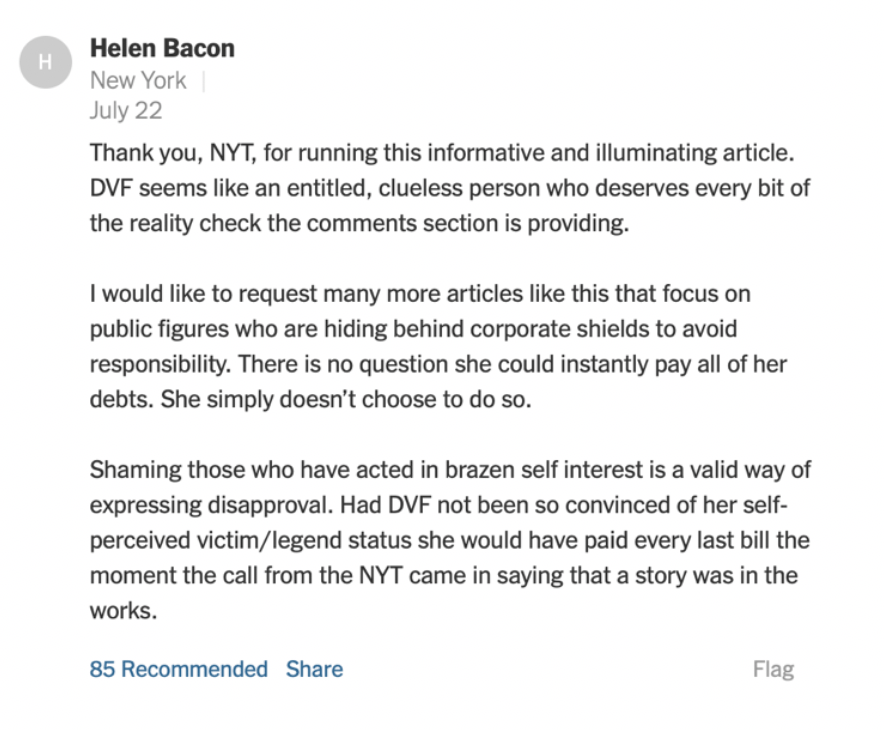
Another response similarly comments on the comments—praising the New York Times for the article, and complementing “the reality check the comments section is providing”:
It’s hard to tell whether this commenter is being sarcastic with their big “thank you” to the NYT. It’s also impossible to say whether the author of the NYT article was intentionally outing DVF as a woman of “brazen self-interest.” That seems unlikely. However, that’s the message this article is delivering—driven home as a result of the contributions of these active readers (and citizen sociolinguists), who have called out DVF’s language and the stance it conveys.
By engaging in these online citizen sociolinguistic arrests, these commenters haven’t just shamed DVF for her use of language. They have shamed her for the entire way of life her language choice conveys and reenacts. Collectively, they ask, “Why, DVF, do you call your vendors, “smaller people”? We know those people, we are those people, and our lives are important, not small.”
Citizen sociolinguists’ arrests may at first strike people as trivially focusing on simple words, but these acts call attention to broader social conditions: Calling some humans “smaller people,” like repeatedly referring to grown women as “girls,” or misguidedly greeting an Asian American who grew up in Ohio with the Chinese language greeting, “ni hao,” are not simply problems with word choice. They both reveal and reproduce unexamined social relationships. The speaker of those words enacts their own unexamined stance again and again through their language choice—until they are faced with a citizen sociolinguistic arrest. A citizen sociolinguist’s arrest has the chance of starting an important conversation, a slim chance of pushing the utterer of each of those poorly chosen words to start speaking differently, and in the process, to start building a different way of seeing and acting in the world. By using words in a new way, one learns something about another person’s perspective, and may even develop compassion for those they don’t know or even understand.
It may be too late for DVF, but her commenters have raised the awareness of the absurdity of profiling her in the NYT. These citizen sociolinguists changed the story from one about the fashion business, to one about people. Comments from those who have been hurt by DVF’s world view, who have experienced hurt from others who share the world view that sees some humans as “smaller people,” may have pushed some readers to think differently about their own stance toward inequality during the COVID-19 pandemic and beyond.
Have you engaged in “citizen sociolinguistic arrests”? Have you been a recipient of one? How did those encounters change your view of the world? How do words display—and produce—compassion or lack thereof? How can we guide each other to become more understanding in how we use words, and in how we show compassion for each other? Do you think we can? Please comment below!
Citizen Sociolinguistics flourishes in those moments when language catches us by surprise and forces us to start talking about it. Consider, for example, the way people alternately marvel or reel in horror at the language of teens. There’s something intriguing going on with teen language that sparks human curiosity. Parents and high-school teachers like to share their stories about the language of teens, and professional linguists like to study and explain it. Non-linguists may judge teen language as right, wrong, or just plain weird (“sick” is a word for something you like?). Linguists tend to describe teen language as playing an important and complex role in language change over time (semantic reversal! Sick!). Now, I would like to consider how teen language changes more than just language, it changes world we live in. To get a bigger picture of what teen language is good for we need to turn to a third view: that of teens themselves.
Everyday Adult Perspectives on Teen Language
First, let’s considerhow everyday adults talk about the language of teens: Sometimes with wonder, but also with trepidation, even revulsion!
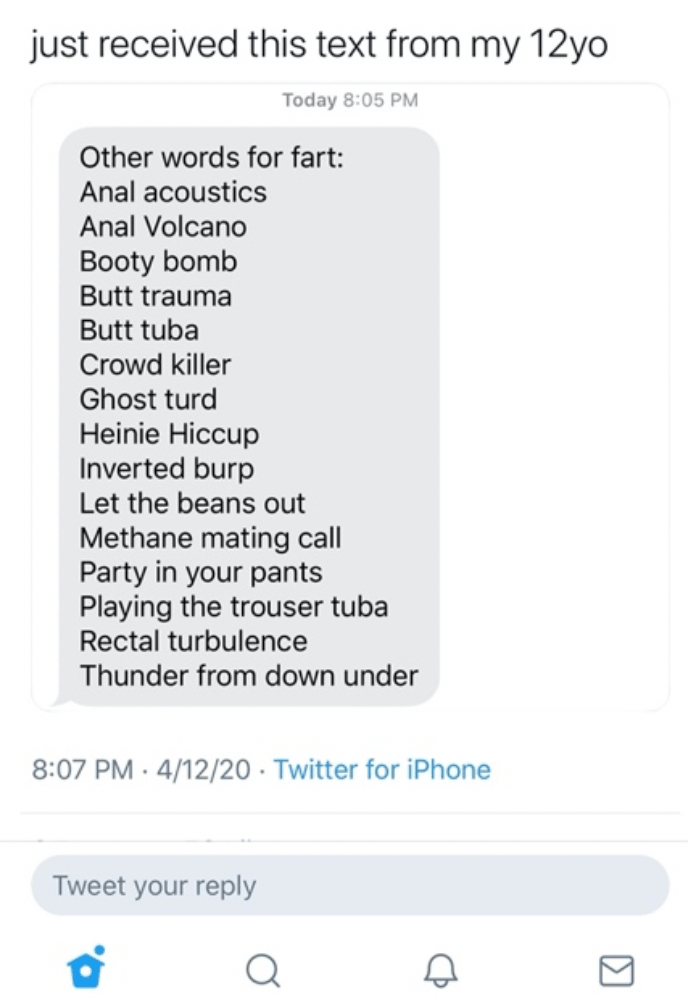
Much of the language of teens seems to crop up out of thin air. During the COVID-19 pandemic, when we have all been at home working, studying, or goofing off together, we may be hearing and seeing more teen language. This post on Twitter, for example, illustrates one working-from-home Mom’s experience with Teen language (or in this case, a 12-year-old):
First of all: Ew! Moving beyond that initial reaction, I showed this tweet to my 13-year-old daughter and she was very impressed! She was also slightly baffled: How did this kid come up with all these different expressions? My daughter and I shared a moment of wonderment (and horror) at this mini fart thesaurus. Sometimes the language feats of teens carry an impressive ‘air’ of mystery and the unknown.
More comprehensive catalogs of teen language or ‘what kids are saying these days’ often lead to this same kind of wonder and disgust. Each semester, for example, my friend Mr. Z, a high-school teacher, has his Language Arts classes compile lists of their favorite “slang,” from which he creates a word cloud. Those words mentioned more often (like “bae” below) show up larger in the cloud, and those less-common words (“sick”) are tiny.
These word clouds have become an impressive tradition over the years, and they’ve begun to function like semester-to-semester time capsules. Each year, the teacher and I, and the crops of new students in his classes, marvel at the old standbys and the new arrivals. These word clouds tend to impress everyone—including other teachers in the school. But as often as people are impressed with teen language, they are baffled, and even wary of it. Sometimes we don’t even understand what teens are saying (BAE? shawty? krunk?). When we do understand (or think we do), we might not know how to react, or how to talk about it (white girl wasted?). Many adults tend to disengage when teens talk in strange ways. What are we supposed to say? Should we tell them not to use those words? To speak with more maturity? More formality? Some teachers would balk at compiling a word cloud like the one above—it seems too subversive for school. And in moments of frustration we might even think, what is wrong with teens? 15 fart expressions? Really? Why can’t kids just speak about important things and do so like adults??!!
Linguists’ Perspectives on Teen Language
Linguists, however, love to talk about teen language. But, unlike many parents, teachers, or everyday language police, they don’t judge it or fear it, they describe it and provide the long view. Still, they often manage to take teens’ active engagement with words and the world out of the equation, describing youth language in general as an engine of language change, rather than exploring teenage talk as a dynamic part of their interactions with others.
This article, posted on the website of the Linguistic Society of America (LSA), for example, points out that, much as some adults would like to limit our language to one, correct, immutable, and testable form, the only thing constant about language (paradoxically) is change. Many words and expressions we take for granted were once considered problematic youth language. The article provides useful examples: “Bus” was once considered an unseemly shortening of “omnibus.” And, many phrases we now consider problematic in certain contexts –the inevitable “double negative,” for example—were once a staple of older forms of English. Linguists are very good at illustrating that language change happens and that it’s okay. No need to worry about teen language—it’s natural. Teen language, like a slowly moving glacier, may be hard to navigate for us old folks, but just as that glacier carves out a beautiful and lush valley, teen language will slowly manipulate the word for us, over time shaping the very language we inhabit and enjoy. Trust the process.
Thoughtful people like teachers and parents who really don’t want to unnecessarily criticize teenagers, find these linguistically informed verdicts on teen language a relief. After discussing controversial words that appear in the language cloud, for example, words that teens themselves have shared, Mr. Z and I want to have an adult message for students, but we don’t want to be preachy. It’s useful to be able to cite linguists who tell us there is something important and lasting going on (language change) when, for example, teens say “like” in every other sentence, seem to shorten perfectly good greetings to “yo,” “what’s good?” or “whaddup?”, or use LOL incessantly, LOLOLOLOLOLOL. They are not being lazy or losing their mental acuity. The linguist says it’s fine. “LOL” in spoken discourse might one day be used by heads of state. Our language will never stop changing and that’s okay.
I’ve always found these explanations useful and persuasive at first, but ultimately incomplete. Once we’ve been consoled by Linguists that teen language is simply contributing to the inevitable if glacially paced process of language change, the conversation usually stops. But when we discuss the role of teen language this way, we take the teens out of the world that stimulates and inspires them, and, out of a world that might also hold injustices and frustrations to which they are reacting, out of institutional norms that they might be resisting by using language in creative new ways. Out of the realm of controversy. Instead of engaging with any of those possibilities, once we legitimize the way teens speak by naming its role in “language change,” we can go back to just waiting for teens to either talk like adults, or for teen language to be accepted sufficiently over the course of time so that adults use it too.
By stepping beyond the “language change” explanation, I’m not trying to debunk anything linguists have learned and published about language change. It’s real. It’s interesting. And it seems important to remind ourselves that language change is inevitable, and that we are all participating in it. However, the focus on language change illuminates only a small corner of a much larger conversation that we can have around teen language. Recognizing that language changes and teen language plays a role the process should be just the beginning of that conversation about language. However, many times I’ve witnessed the “language change” explanation as the end point. Science has spoken. The Glacier will move. Language will be fine. Conversation stops. As an alternative, to keep the conversation going, and to capture the remaining 99.9% of what motivates teens when they communicate, I’m suggesting that when we talk with teens about their language, we include their perspectives as well.
Teen Perspectives on Teen Language
Teens, perhaps more than any other age-group, are surrounded by new and varied language everyday – language of parents, friends, teachers, coaches, multiple and diverse social groups, and, now, the Internet! While many teens may try to act sage and bored, the world and the language that constructs it, is relatively new to them, and one of their main jobs as developing humans is to figure out how to make it work. This will lead to language change. But the language of teens will inevitably change not only language, but also the world. Teens grow up in a world of stimulating newness. Teens also have ideas and desires of their own. Their job is to listen to and participate fully in that world of language. Some of the things they say will seem weird to adults. Sometimes the language they use will change the world.
Consider, for example, the phrase, “people who menstruate.” Recently, this phrase was quoted with disdain by JK Rowling in a now infamous tweet:
Following this tweet, the Internet broke out with horror at JK Rowling’s statement. Many long-time JK fans officially pronounced their Harry Potter Fandom dead. I was confused. As a cis-gendered woman, literally the same age as JK, I thought her comment only slightly funny—a dumb, slightly mean joke—but I didn’t see how it caused such a revolt against her. Then I asked my daughter (13-years old and a big Harry Potter fan) what she thought. “I can see why people are upset. People are rightly calling her transphobic, mom,” my daughter said immediately, and then proceeded to explain to me that many “people who menstruate” might not label themselves “women.” In that moment, we seemed to come face to face with generational differences in language use, specifically how we use language in gendered ways. Who knows if this usage will lead to lasting language change. But discussion of this phrase and how we describe gender categories, seems important. As my daughter’s quick response to my confusion showed me, teens are participating in those discussions and they hold strong opinions.
I raise this example to illustrate the importance of conversations about language—and often, especially, the language of young people. Teens are not just talking about farts, sex, or getting stoned. But that’s part of the picture too, and to talk about the world-changing words, we need to be more open to talking about all language. What if, instead of chalking up the profusion of creative teen language exclusively to language change, we kept the discussion going? We could start talking with teens about the language they use, learning from them what those words are doing, asking teens questions about their language, rather than giving them explanations from linguistics: How did you learn all those words I don’t know? Where do you think they come from? Would you use those words with adults? If not, then with whom? Why? Why do you feel so strongly about using or not using certain words or turns of phrase?
Over the years, I have learned that teens have strong opinions about language—and less strong feelings about whether they contribute to language change. I’m suggesting we listen to those strong opinions. Once we assume teens participate actively in the world of language around them, we might also learn more about the world they live in, the way that they are processing it and in turn shaping it with their language. Then, we can start to think about how they might learn to navigate new and different ways of communicating they will encounter over their lifetime. The social world, inevitably, provides an abundance of opportunity, ridiculousness, oppression, joy, fear, despair, and hope for all of us. Our language is the primary way that we, over a lifetime, make sense of it, and sometimes rebel against it or create it anew, together. Over time, language will indeed change. In the meantime, let’s talk about it and make it work for us!
What kinds of teen language exists in your life? How do you make sense of it? What have you learned from talking to teens about language? Maybe you are a teen? Please comment below.














 Citizen Sociolinguistics