Modern-day Malapropisms: Yogiisms versus Trumpisms

The term “Malapropism” describes a lovable feature of our all-too-human use of language—that is, using the almost-right-but-not-quite-right word.  YourDictionary.com illustrates their entry with this example, spoken by the TV character, Archie Bunker:

“Patience is a virgin.”

This example illustrates the layers of possibility within subtle linguistic missteps.  In choosing the words “patience is a virgin” instead of “patience is a virtue” the script-writers pile on a little jokey sexual innuendo and maybe a touch of creepy-old-man, building Archie Bunker’s character as a conservative curmudgeon in the decades-old sitcom, All in the Family.

A good malapropism—like any good joke—may also go down in history. Everyday people seem to remember them and pass them along.  Something about them draws people to savor the language, to recognize its special capacity for creative meaning, and even to make fun of ourselves and the human condition.

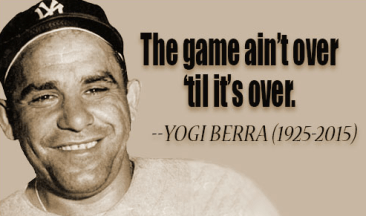
The baseball coach, Yogi Berra, was famous for his malapropisms (or “Yogiisms”), and forScreen Shot 2017-05-26 at 3.36.50 PM their humor and everyday pithy wisdom.  Phrases like “It ain’t the heat, it’s the humility,” “Nobody goes there anymore, it’s too crowded,” or “When you get to a fork in the road, take it” bring home some shared sense of the absurdity of everyday life.  Rather than bringing out the dictionary and calling Yogi to the mat for being incorrect or nonsensical, people have ended up repeating these Yogiisms-turned-aphorisms.  An internet search yields dozens of sites compiling his top 20 (or 50!) phrases.
Now, Donald Trump has become a modern proliferator of malapropisms:

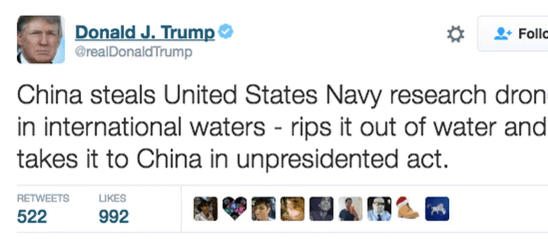
Unpresidented or Unprecedented When condemning China’s actions in international waters, he referred to their actions as “unpresidented”:
Screen Shot 2017-05-26 at 12.47.09 PM

7/11 (The convenience store?) versus 9/11 During his presidential campaign, he denounced the terror attacks on the World Trade Center—those that occurred on “Seven Eleven.”

“I watched our police and our firemen down on 7/11, down on the World Trade Center before it came down.”

Bigly versus Big League Also during his campaign, Trump repeatedly used the term “bigly.” Though his handlers claimed he was saying “big league,” this odd usage stood out so prominently to citizens that memes around “bigly” have proliferated…bigly.

Screen Shot 2017-05-26 at 3.41.59 PM

There are probably more, and more serious malapropisms in Trump’s repertoire.  But even this short list suggests a qualitative difference between Trump’s malapropisms and Yogi Berra’s—or even Archie Bunker’s.  Trump’s seem worse.

But, if malapropisms aren’t inherently bad, what exactly is wrong with Trumpisms?

It’s not that they are “poor English.” Many people have written about how Trump abuses the English language. Some have catalogued Trump’s malapropisms as “Times when the English language took a hit”. But abuse of the English language is not the real problem here.

The problem isn’t that Trump uses words in unorthodox ways, but the precise quality of the missteps he makes.  They show none of the qualities of time-tested malapropisms—humor or tacit wisdom.  Granted, the 7/11 gaff may have dark humor to it.  But, generally, Trumpisms are not funny.  He certainly has no sense of humor about them.  In fact, he often tries to correct them immediately by removing tweets (like the “unpresidented” tweet above) as soon as he’s been called out.  Trumpisms shed no wisdom or whimsical perspective on the human condition.  The only tacit message they communicate is (at best) that he doesn’t really care that much.  And no amount of time with a dictionary, grammar book, or linguistics professor will cure that.

Good news: Despite Trump’s use of bigly, unpresidented, 7/11 (for 9/11), and probably many more absurdities, the English language is safe.  Trump may spew malapropisms, but malapropisms in themselves are not bad—they show us that language is alive and inevitably unorthodox at times. Every day, people use words in ways which create new (unpresidented?) meanings.

And who knows, maybe soon we will be unpresidented!  Patience is a virgin.

Please add your comments below! Do you have malapropisms you love or hate?  Any recent Trumpisms to add? What can we learn from these?

The Ghost Emoji: A Riddle Wrapped in a Mystery inside an Enigma

Screen Shot 2017-04-17 at 12.28.04 PMHave you ever sent or received a ghost emoji? What does it mean? This is a perfect question for the Citizen Sociolinguist—because we can only answer it by asking what citizens-who-use-ghost-emojis say about it.
The question, “What does a ghost emoji mean?” occurred to me because, not to brag, but, recently I’ve found myself using the ghost emoji in a way that feels “fluent.”

Then, I unthinkingly used it with a distant acquaintance to indicate, “Thanks! I’m glad you liked the photo!”, and I started second-guessing my fluency. Suddenly I felt nervous that the seemingly innocuous winking ghost may have some offensive history of use (see, for example, the eggplant emoji).

So, wearing my Citizen Sociolinguistic curiosity cap, I hit the internet.

A quick google search for the definition yielded, somewhat unexpectedly, an article on the topic in GQ magazine entitled (to my relief), “The Ghost Emoji is Perfect.”

Fortunately, the ghost emoji works in almost any situation, according to the author, Maggie Lange:

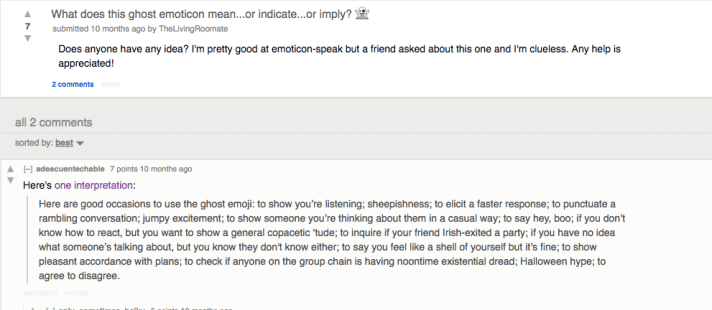
Here are good occasions to use the ghost emoji: to show you’re listening; sheepishness; to elicit a faster response; to punctuate a rambling conversation; jumpy excitement; to show someone you’re thinking about them in a casual way; to say hey, boo; if you don’t know how to react, but you want to show a general copacetic ‘tude; to inquire if your friend Irish-exited a party; if you have no idea what someone’s talking about, but you know they don’t know either; to say you feel like a shell of yourself but it’s fine; to show pleasant accordance with plans; to check if anyone on the group chain is having noontime existential dread; Halloween hype; to agree to disagree.

Even though the ghost emoji doesn’t mean anything–or could mean everything–it seems to do a lot. So, a better question, and one better suited to Citizen Sociolinguistics may be “How do you use the Ghost Emoji?”.

I googled this question and immediately was directed to Reddit. In the “NoStupidQuestions” subReddit (other questions include, “how do blind people know where the braille signs are?”) we find an answer:

Screen Shot 2017-04-17 at 10.06.16 AMSound familiar? This response is a direct link back to the GQ article I previously mentioned.

Are there no dissenting opinions?  Even on Reddit?

There is one more comment in the Reddit thread.  I clicked on it nervously to find…

Screen Shot 2017-04-17 at 10.22.01 AM

Just the ghost emoji!  Now officially my favorite riddle inside a mystery wrapped in an enigma.

***

Do you use the ghost emoji?  How?

Why does it exist?

Can you think of equivalents of the ghost emoji in any (other) language?

Please share and comment below!

Anarchism and Citizen Sociolinguistics

What could anarchism possibly have to do with citizen sociolinguistics?Screen Shot 2017-03-10 at 10.25.02 AM

The word “anarchism” may suggest the big circled A (usually in graffiti form) or even images of “anarchist” punks overturning tables or setting fire to McDonalds— the opposite of responsible citizenship. And certainly a departure from any form of sociolinguistics.

Citizen sociolinguistics as anarchism? Let’s think this through…

First, many forms of anarchism do not involve violence and vandScreen Shot 2017-03-10 at 10.26.19 AMalism.  A google image search yields images representing anarchy as associated with liberty, peace, collaboration, freedom, and mutualism. Rather than relying on overt violence, anarchism usually flies below the radar.  It’s tricky, often clever, and often (for example, in cases of poaching or squatting) a matter of survival.

In his brilliant book, Two Cheers for Anarchism, James C. Scott illustrates that in unobtrusive, yet subtly influential ways, anarchism is everywhere.  He gives examples of everyday forms of anarchism, starting with the most mundane, jaywalking.

Like other forms of anarchism, jaywalking is a subtly coordinated act of rule-breaking. For example, you might decide not to jaywalk when walking with a small child (it would set an unsafe example). But if it’s three a.m., you’re alone with not a car in sight, you might cross at a red light, or even in the middle of the block! As Scott writes, “judging when it makes sense to break a law requires careful thought, even in the relatively innocuous case of jaywalking” (Scott, 2012, p. 5).

Scott goes on to mention more radical forms of lawless behavior: desertion, squatting, poaching and points out that these are often the lowest risk options at hand: “desertion is a lower risk alternative to mutiny, squatting is a lower-risk alternative to land invasion, poaching is a lower-risk alternative to the open assertion of rights to timber, game, or fish.  For most of the world’s population today…such techniques have represented the Screen Shot 2017-03-10 at 10.25.49 AMquotidian form of politics available” (p. 12).

Now, what does anarchism–even in its most subtle forms–have to do with citizen sociolinguistics?  This: Everyday understandings of language generated by citizen sociolinguists follow the same tactics of everyday acts of anarchy.

Just as anarchists go out and jaywalk, desert, poach or squat, citizen sociolinguists get online and post videos about “How to Speak Singlish,” engage in lengthy and opinionated dialogue about the finer distinctions of South Philly (Sow Philly) vernacular, post tutorials on varieties of English in Yorkshire (I’m proper chuffed about it!) or engage in Indian language(s) play in the YouTube videos like “Google my Bulbul.

These acts of citizen sociolinguistics, like many acts of anarchism, are not concerned with developing a coordinated social movement. And yet, like sustained, tacit anarchism, they gradually build valuable knowledge from the ground up, drawing on fine-grained distinctions provided through living locally and perceptively, and sharing that knowledge in everyday ways, often via social media like YouTube and Twitter.

Like anarchists, citizen sociolinguists are usually breaking the rules of “elites”:  Singlish is outlawed in Singapore classrooms. South Philly vernacular or Yorkshire expressions like “I’m proper chuffed” are not considered “proper English.” Videos like “Google my Bulbul” mix languages, defying named language boundaries.  These acts of citizen sociolinguistics, like acts of anarchy, illuminate the workings of human communication precisely by departing from its standardization.  Enforcing rules of language, in many contexts, may seem as silly as stopping at a red light on a deserted 3 a.m. stroll.  Ain’t nobody got time for that!

Just as acts of anarchy are lower-risk alternatives to official political action, acts of citizen sociolinguistics are very low risk.  But they are more likely to affect language use at a local level than more organized, top-down attempts to re-legislate language standards. People use languages in infinitely variable ways around the world–and in ways that change from day to day.  Everyday language use never aligns completely with those narrowly functional standards, frozen in time, laid down in language textbooks or even in sociolinguistics class. Instead, most language users develop fine-grained local understandings of their own language use by using their own language. And quotidian language politics for them takes the form of citizen sociolinguistics: Like everyday acts of anarchism, the posts and musings of citizen sociolinguists illuminate the fine-grained knowledge of those tuned more closely to the workings of the social order than those who are making the laws.

***

Do you participate in acts of citizen sociolinguistics?  What are they?  Why? Do you see the “anarchism” in them? Or do you more highly value top-down understandings and legislation of linguistic practice? Where do you stand?  Add your comments below!


Citizen Self-Transcription and Eye Dialect 

Screen Shot 2016-09-24 at 6.37.24 PM.pngHave you ever had to transcribe oral speech?


If so, you know it can be a tedious process–listening to a recording and then typing out utterances word for word.  Word. For. Word.

But transcription is not as easy—nor necessarily as boring—as it sounds.  It involves translating spoken language into written words and like any other translation project, this requires some interpretation and finesse.  For example, when a speaker says what sounds like “I’m gonna leave now.”  Should that be written as “I’m going to leave now”? or “I’m gonna leave now”?   If an adult English Teacher says it would you be more likely to write “going to”?  If a 10-year-old in the class says it, would you be more likely to write “gonna”?  How do age, race, gender,  socioeconomic status, institutional role, and any other aspect of the situation figure into that interpretation?

The sociolinguistic, Mary Bucholtz, in her article, “The Politics of Transcription,” has pointed out that even established researchers often make transcription decisions in ways that indicate underlying biases.  When someone uses a certain spelling for one demographic or social role and a different spelling for another, Bucholtz calls this “eye-dialect.”

So, the tedious act of transcription becomes political, and the stakes can be high: A courtroom transcript, for example, that represents a defendant’s speech in stigmatized eye-dialect, could leave a record that unfairly influences a jury’s perception of that individual.  Bucholtz urges transcribers to be mindful of the choices they make when they transcribe—accounting for how their representations create identities for speakers.

Last week, however, when talking about “The Politics of Transcription” in my graduate class on Classroom Discourse Analysis, one of the students pointed out that many individuals—especially teens-these-days—use something like “eye-dialect” to purposefully add nuance to their text messages, Facebook and Instagram posts, snap-chat stories, or any social media that mimics “conversation.”

In these kinds of self-transcriptions, people usually call on eye-dialect to deliberately construct identities for themselves.   In this way, they are creating citizen transcriptions of themselves, calling on their own knowledge of local social value connected to transcribed forms of talk.  Citizen self-transcribers crafting a text message, just like reflective researchers transcribing language “data”, can be painstakingly mindful of the identity they present when they translate a spoken-like message into a social media message.

Here is an example of my own speaking-to-my-son self which I found in our text message history:

screen-shot-2016-09-24-at-5-16-20-pm

In my mind, this message, including its eye dialect, captures my kind yet concerned loving self.  The spelling of “Pleez” conveys my sheepishly earnest need for my teenage son to keep me in the late night loop.

Probably the best guard against bias among social scientists or courtroom transcribers is to treat all speaking the same way and be as uniform as possible.  But when we everyday individuals transcribe our own voices into text messages, we participate in an unstandardized, yet high-stakes world of eye dialect.  My own Emoji smiley-face, heart, and old-lady face probably also convey some middle-aged white lady dialect.  But that’s okay.  That’s who I am. And, I’m the one who transcribed it.

Those same features of transcription that can seem to unfairly bias social science research or stigmatize a defendant in the courtroom, become powerful communicative resources for the citizen self-transcriber.  And, the citizen self-transcriber might have a more sophisticated command of bias than your average social science researcher—because they know that there is not a “correct” way of doing it, only better and worse ways of communicating one’s identity in each unique socially mediated context.

What type of eye-dialect do you deliberately use in your text messages or social media self-transcriptions?  How do you use it to craft identities for yourself?  How do you read other messages and interpret “eye-dialect” there? Do you ever write messages that used your own “speshul” brand of spelling? Please comment and share your ideas and examples below!


Keeping Language in a Locked Drawer (Not)!

Screen Shot 2016-09-02 at 1.39.12 PMAs all University researchers working with language know, if you record language, you must keep it in a locked filing cabinet or a password protected web location.  For ethical reasons.  Our Institutional Review Boards will insist on this.
What (you may be wondering) is ethical about locking up language samples? Even keeping them from the speakers who created them?  The idea is that if you are collecting talk from someone, you need to guard that “data” to protect the speakers from anything damning (embarrassing? false?) about them that those samples might reveal.

Only the researcher will still have access to this data.  Ostensibly, in the role of a professional, with the training necessary to responsibly handle this language, the researcher will have the skills and knowledge to do the right thing, should they want to say something touchy about that language.

But, even as researchers lock up the drawer or type up a passcode for a website, people continue to talk.  The voices we record for our research do not fall silent once we turn off the recording device.

Speech –our own and others’—is all around us.   How do we protect those people from being interpreted in dangerous ways by the random ordinary people walking around judging how they speak? We don’t!

Fortunately, in real life we don’t need to hack into some password protected site to hear real language—or to analyze it.

We don’t even need to be professionally or academically affiliated in any way.  Many people out there listening to the freely available language samples are expert language analysts.  Their expertise may differ from that of a PhD Linguist, Applied Linguist, Sociologist, or Linguistic Anthropologist—but those everyday language analysts (I call them Citizen Sociolinguists) are not necessarily any more or less responsible in their interpretation of other peoples’ speech than a trained academic researcher.

Nor are those everyday analysts necessarily more or less tuned into their sense of ethical obligation toward speakers.

Nobody–University researchers or everyday opinionators—exclusively holds the ethical high ground when it comes to making statements about other peoples’ language.

Nobody has a premium on dumb or misguided interpretations—or on the most definitive explanation.

A good analogy might be the “Traditional Dictionary” versus “Urban Dictionary”.  Which is most definitive?  It depends on what you’re looking for and what sorts knowledge you care about.

Similarly, “Sociolinguist” versus “Citizen Sociolinguist”:  A sociolinguist may notice, measure, and catalogue discrete aspects of sound—but a citizen sociolinguist may notice identical features and simultaneously many other social features that go with those discrete linguistic bits: the types of people who use that type of speech, the way they dress, where they live, or personal stories and experiences with that bit of sound.   Anyone can easily access these types of everyday insight by looking up questions about language on line.  Google “How to speak like a _____” and you will encounter many examples of Citizen Sociolinguistic analysis—from the most raw to the most subtly incisive—and you will see many comments sounding off on the accuracy of these linguistic portraits.

Back to Locking up Language: When we officially gather and lock away some bits of language, we also place limits on our own knowledge, because we only let a few people interpret it and publish the results.  Locked up language isn’t even available to the people who spoke it.

So, what to conclude?

I’d like to suggest an Open Source approach to language.  If you record some, share it! And, certainly share it with the people who spoke it.  But also share your analysis.   Let ordinary speakers share theirs.  Just as Open Source software improves when more coders are involved, understanding human language will inevitably become more important and relevant when it includes more perspectives. Tell that to your Institutional Review Board!

But—you may disagree.  How might sharing language data be unethical?  What might we lose in the open-source approach? What are other ways to ensure all language gets treated with respect?  Please share your thoughts below!

Speak Good Singlish: A Form of Citizen Sociolinguistics

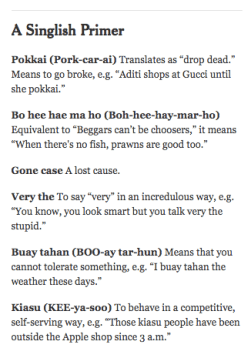
Screen Shot 2016-05-24 at 12.52.27 PMLast week, the New York Times published an opinion essay  by Mr. Gwee Li Sui.  In it, he suggested the Singapore govenment’s “war on Singlish,” had some problems. Singlish (Singapore English), he argued, represents Singapore well, bringing together many of the languages of that nation. Mr. G even asserted that Singlish has the power to “connect speakers across ethnic and socioeconomic divides like no other tongue could.”
He included a short glossary, illuminating Singlish’s internal variety (see sidebar).

Mr. G also pointed out that the more restrictions placed on Singlish, the more it seems to flourish: “In the eyes of the young, continued criticism by the state made it the language of cool.”

And, as his essay illustrated, individuals needn’t choose between Singlish or Standard English, as many people are aware of both (and other languages) and fluently switch between the two.

A few days later, the New York times published a letter from Li Lin Chang, press secretary to Prime Minister Lee Hsien Loong of Singapore.

This letter emphasized that the type of creative language use that Mr.G praised was only the purview of highly educated people, not everyday people in Singapore who need “standard English” to get ahead:

Not everyone has a Ph.D. in English Literature like Mr. Gwee, who can code-switch effortlessly between Singlish and standard English.

This statement piqued my curiosity.  Using Singlish does seem complicated—as it combines so many languages and grammatical systems. But I know many code-switchers in the United States who do not have PhDs—even some toddlers! Is code-switching between Singlish and Standard English different? Something only PhD educated people can handle?

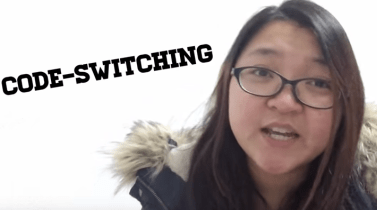
In Citizen Sociolinguistic mode, I started searching the Internet to see who (in addition to Mr G, PhD) was facile with this type of “code-switching”.  It appears there are many non-PhDs who, like Mr. G, capably code-switch between Singlish and other forms of English, as illustrated (and discussed) in this YouTube Video :

Screen Shot 2016-05-24 at 2.12.08 PM

In about ten minutes’ more poking through the Internet, I also learned about the “Speak Good English” campaign in Singapore and spied this logo:

Screen Shot 2016-05-24 at 1.34.40 PMThe Speak Good English movement also includes  post-it note style signs like this, emphasizing the edits needed to “get it right”:Screen Shot 2016-05-24 at 1.08.27 PMI also started finding quite a few signs suggesting an underground “Speak Good Singlish” movement, and even a counter logo:Screen Shot 2016-05-24 at 1.33.55 PM
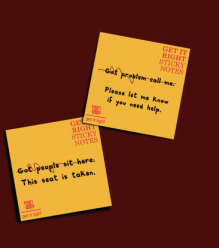
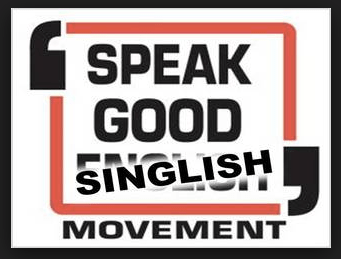
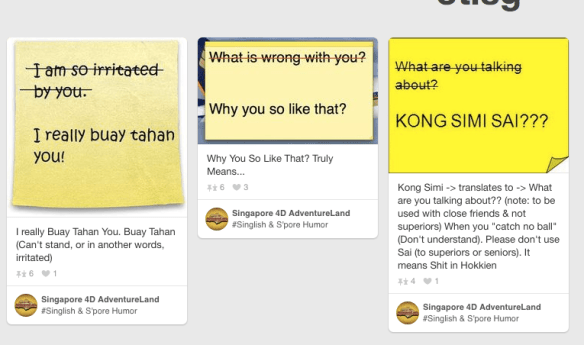
This movement also counters the official post-it notes with deftly edited signs translating “Standard English” into “Singlish”. Here are a few Pinterest posts to illustrate:

Screen Shot 2016-05-24 at 1.15.16 PM

This Pinterest user seems to have a good grasp of “code-switching” between Standard and Singlish.

A Google image search illustrated many more playful post-it style notes like the following English/Singlish translations:

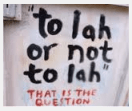
And this sign even merges Singlish with Shakespearean diction (lah!):

Screen Shot 2016-05-24 at 1.39.43 PM

“Lah” seems important:

Screen Shot 2016-05-24 at 1.38.41 PM

Long before Mr. G wrote his New York Times editorial, the Speak Good Singlish movement seems to have grasped the import of Singlish for Singaporean Citizens.

Who was behind this “Speak Good Singlish” counter-punch?  Does their language awareness and ability to code-switch entail PhDs?

No. They are Citizen Sociolinguists, illustrating—with humor and creativity—how language connects to social value in everyday lives.  In the process, they are building everyone’s repertoire, rather than holding up one “standard” as the only functional way to succeed.

Of course, some readers may still feel that proud Singlish speaking citizen sociolinguists are missing out on something that a more rigid “Speak Good English” regime might provide them. What’s your opinion on Singlish? Or the “Speak Good Si/English” movement? Please add your comment below!!!


Retweet! and Other I-Agree Signals

“Retweet!”

Screen Shot 2016-02-23 at 9.35.05 AM

This week, listening in on a heated high school discussion, I heard someone shout out “Retweet” from across the room. I wasn’t sure what was going on. Was our conversation being tweeted about?

Later, in another class, while gathering lists of words (using pencil and paper) for our semester-by-semester slang tracking, the word “retweet” appeared on someone’s list.

I had to ask, “Do people actually say that?”

Sure.  It means “I agree with you,” or “I feel the same way,” or “I TOTALLY AGREE!”

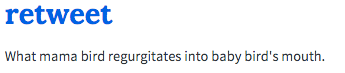
These kids had some pin-pointed expertise:  I couldn’t even find this definition of “retweet” on Urban Dictionary, where the only definitions offered are the literally literal

Screen Shot 2016-02-23 at 9.52.49 AM

and the facetious (?)

Screen Shot 2016-02-23 at 9.53.04 AM

Yuck!

So… here’s the scoop:  Certain teenagers say “retweet!” out loud—in the same place other people might say, “thumbs up!” “here-here!” “right on!” or even “I concur.”

Why so many expressions for “I agree”?

Slang expressions tend to proliferate around taboo topics like sex and drugs, or insulting remarks about men, women, race, ethnicity, religion, nationality.  We as a species seem to have an unlimited capacity to make new words for the skeezy, forbidden, or embarrassing. And it makes sense that we would want to be more creative (or secretive) about how we talk about them.

Less obvious:  Our species-wide love of agreement and new ways to do it!

Just as ways to talk about being “wasted/lit/turnt/smashed/etc” proliferate like crazy, so do ways of expressing the fact that “I feel the same way.”

Screen Shot 2016-02-23 at 9.32.51 AM Look around you and you will see all kinds of evidence that people like to agree!

Many of these, just like many other new words, are boring and sheep-like (think thumbs ups, viral videos, proliferations of exclamation points!!!). But others tip toward the profound, or at least show that how we agree may be a powerful glue holding us together.

Call and Response is one of the most moving forms of “retweet!” Listen to all the buzzing agreement, for example, during Dr. Martin Luther King, Jr.’s “I have been to the Mountaintop” speech:

Screen Shot 2016-02-23 at 11.07.33 AM

MLK: “Somewhere I read of the freedom of speech”

Audience: “YEAH!”

MLK: Somewhere I read of the freedom of press”

Audience: YEAH!

MLK:  Somewhere I read that the greatness of America is the right to protest FOR right.

Audience:  YEAH! ((Clapping and screaming in agreement))

Enthusiastic agreement happens when reading too. Look through a book that someone appreciated:  Underlining!  Highlighting!  Post it notes!lovingpostits

I happily notice when students show up with books like this in class.  So many post-it notes can’t simply be superficial display.  This student found a connection with Mr. Bakhtin.

Teachers also recognize when there is a buzz of agreement in a class.  When faces light up, I’ll sometimes stop and ask, “You’re smiling.  Do you agree?” Yes—and the discussion gets better.

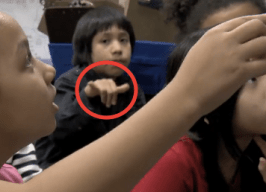
Some teachers even use silent hand-signs for agreement.  At this website about “talk moves,” one teacher illustrates how she embeds this agreement sign in her discussions, apparently with some success:

Screen Shot 2016-02-23 at 10.25.02 AM

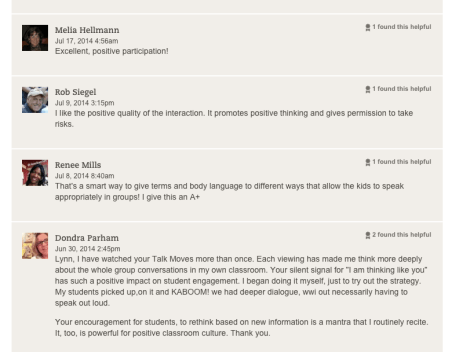
Comments on this video also enthusiastically agree that the “I agree” sign improves classroom discussions:

Screen Shot 2016-02-23 at 10.30.16 AM

Piling on, readers of the comments that agree with the “I agree” sign also receive “I found this helpful” agreement award symbols.Screen Shot 2016-02-23 at 10.32.01 AM

People seem driven to express agreement and we keep finding new ways to do it.

As the “talk moves” teacher explains, the “I agree” sign is a way to “encourage discourse in the classroom.”  Agreement signals involvement. Humans learn and develop through interaction. But we also want to keep it real and display our unique identities: Different groups, different media, different attitudes, different styles require different agreement expressions.  I may agree with much of class discussion—but  I doubt I’ll ever say “retweet!” to express that agreement. I have my ways.  You probably have yours.  And the conversation continues…

How do you express agreement?  When, where and why? What are the effects?  Please comment here!


Is This Realistic? Citizen Sociolinguistics and The Movies

A question I often ask when I’m watching a movie’s depiction of local speech, a stigmatized dialect or mock-worthy speech act is, “Is this realistic?”

How could one possibly answer that question?

Would you find a “real” speaker of that local or stigmatized variety or notable swatch of talk and check with them?

Who might that be?  And who am I to label that variety “local,” “stigmatized,” or “mock-worthy” anyway?

From a Citizen Sociolinguistics perspective, one route to go is to look at the comments on-line.  Take a look at a stretch of movie dialogue on YouTube—inevitably you will find an example—and see what commenters say.

Here are a couple examples to illustrate:

Example 1:  Akeela and the Bee. 

This movie is about Spelling Bee competitions and an unlikely competitor, Akeela, who comes from a predominantly African American neighborhood in Los Angeles.  The movie makes a big deal about ways of speaking, as illustrated in this clip, where a Professor criticizes Akeela for her use of “ain’t”:

I like this depiction of Akeela’s snappy retort to the obviously lonely and socially awkward professor.  As the movie proceeded, I kept wondering how this clash of language attitudes and lifestyles would unfold.

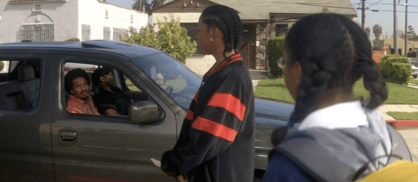
Then, in another pivotal scene, Akeela’s brother tries to weasel out of helping her learn spelling words, but is peer-pressured (by an older and cooler guy from the neighborhood) to help her.  The scene seems almost goofily Hollywoodish, as it depicts, in a heartwarming way, the neighborhood rallying around Akeela to help her learn crazy-hard words like staphylococci.   

Screen Shot 2016-01-29 at 7.16.44 PM

After I see this, the “is this realistic?” question kicks in big time.  Here’s when I start scanning the comments.  And the commenters seem to answer, “yes!”  While some chime in simply criticizing (“Fuck this wake ass shit”[sic]) or loving it (“Love this Movir so bad”[sic]), the more specific comments remark on its authenticity:

Screen Shot 2016-01-29 at 6.20.25 PM

Screen Shot 2016-01-29 at 6.21.37 PM

These commenters rally around the positive depiction of Akeela as a flexible speaker of both a local African American variety in Los Angeles and Akeela’s prowess as a spelling hero for the community.

Example 2:  Ferris Bueller’s Day Off

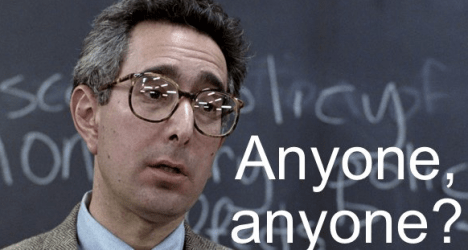
Straying far from Akeela and the Bee territory, Ferris Bueller’s Day Off throws intense shade on anything having to do with school.  In one of its most quoted and widely circulated scenes, an Economics teacher (played by Ben Stein) bores the class with his “discussion” of The Great Depression, tariffs, and supply-side economics (aka voodoo economics).  In this clip, his “Anyone? Anyone?” refrain is featured as a non-question, a feeble bid to get students talking:

https://www.youtube.com/watch?v=uhiCFdWeQfA

Screen Shot 2016-01-25 at 2.33.13 PM

This clip, like the Akeela clips, while entertaining, smacks of Hollywood overkill.  Teachers aren’t really THIS BAD are they?  And again, I find myself asking the question, “Is this realistic?”  It does seem to illustrate a recognizable and much-mocked speech act, often referred to in educational research circles as the “guess what I’m thinking” question.  But does this really happen in schools anymore?

To answer that question, I turned again, as is the Citizen Sociolinguistic way, to the comments.  Of course, many commenters recognize and appreciate simply the hilarity of Ben Stein’s performance.  But, additionial comments pile up in painful recognition of the “Anyone? Anyone?” speech act:

Screen Shot 2016-01-29 at 6.38.41 PM

Screen Shot 2016-01-29 at 6.38.58 PM

Screen Shot 2016-01-29 at 6.39.23 PM

Screen Shot 2016-01-29 at 6.39.36 PM

Screen Shot 2016-01-29 at 6.39.43 PM.png

Screen Shot 2016-01-29 at 6.40.31 PM.png

Screen Shot 2016-01-29 at 6.40.50 PM

Screen Shot 2016-01-29 at 6.41.10 PM

For these viewers, Ben Stein’s performance smacks of today’s dysfunctional classrooms.  Part of the hilarity of his performance, I suspect, comes from its pinpointed realism.

Some of you astute readers might be questioning this Citizen Sociolinguistic method of gathering evidence of the “realistic” quality of these Hollywood performances.  Why grant any credence to YouTube commenters?  Why even believe what they say?  They might even be being ironic!  Yes—and perhaps some readers will interpret these comments this way.  And yet, even the existence of these comments (ironic or not!)  illustrates that these ideas are circulating out there in the real world.  And, as soon as they get put down in YouTube, they continue to circulate.  The comment regarding Ben Stein’s performance, “This never gets old.  I still have classes like that,” for example, has (so far) received 45 likes.  Viewers seem to identify with this perspective.  This performance of “teacher” seems to be a recognizable prototype; his much-maligned questioning style is one that students out there recognize and loathe.

And Akeela’s neighborhood peers, rallying behind her spelling training, seem to also be illustrating recognizable attitudes about ways of speaking and studying language.

These performances resonate.  That’s why they are up on YouTube.  That’s why they garner comments and why those comments garner thumbs ups (in some cases, many thumbs ups).  Those comments and thumbs ups perpetuate an understanding of these as recognizable ways of speaking—and attitudes about those ways.  Is something realistic? It never starts out so.  It becomes realistic in how people, subsequently, display their answers to that question.

What movie depictions of speech have you wondered about?  Do Citizen Sociolinguistic investigations shed light on those wonderings?  Please comment below!

Talking Music and Singing Language: More is More

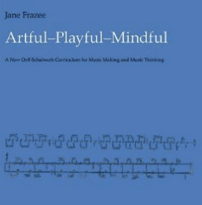
Screen Shot 2015-12-16 at 9.23.40 AMJane Frazee (a renowned music educator who also is my stepmother) has spent most of her life teaching and writing about music and music teachers (see her latest here).  She constantly thinks about questions of music and children.  And when I talk to her about Citizen Sociolinguistics, she keeps thinking about music and children. I’ll tell her about the “Accent Challenge” or “Language Pies” or high school students’ fascination for “slang,” and she says, “that’s a lot like what we are trying to do with music!”
What’s the connection?

One of the questions Jane has been thinking about has to do with music Screen Shot 2015-12-16 at 9.29.08 AMnotation.  Why do we teach children to read music notes when their natural sense of rhythm and melody is always initially much more sophisticated than anything they can read on paper? Children who are jump-roping, hand-clapping, rapping, singing, patty-caking, Miss Mary Mack Mack Macking during recess, are looking at quarter notes and eighth notes in the music classroom and saying, in unison, “Ta Ta Tee Tee Ta.” Most children love music!  But Music Class can seem disconnected from other experiences kids have making music. And as kids get older, into their teens, they want to be playing their own instruments, in bands with friends, or socializing around music in other ways that don’t seem to connect to more formal music instruction.

So, why are we teaching “Music” when they already know it?

And, here’s the connection to Citizen Sociolinguistics: Why do we teach children—and young adults—“Language Arts” as if they don’t already know how to use language?

How can music and language teachers capture the knowledge and joy their students have for music and language without stifling it?

Many kids in music class –at least in the Ta Ta Tee Tee Ta style music class— have no idea they could make connections to what they may have been doing five minutes ago, singing with friends, before they walked into class.  In part, this is because the sophisticated musical things that kids do together without any teacher around –the moves they easily make rhythmically and melodically as they syncopate hand claps, lyrics, or jump-rope steps–take a long long time to learn formally and to put on paper.  Jane’s work explores how to give children the tools, gradually,  to represent and build on those rhythmic and melodic inclinations in notes, on a score.

From a Citizen Sociolinguistics perspective we can do something similar.  We’ve got the tools to explore what students know about language.  But students need permission to “count” what they are already doing as important knowledge about how language works.   When we talk about language from a Citizen Sociolinguistics perspective in English class, students reveal things that have never come up before:  “My mom sounds so formal whenever she is on the phone!”  “My mom uses a Chinese accent when ordering dim sum in English.” (Moms come up a lot.) “My teachers have no idea how emojis work!” “What would you call the store Five Below in Spanish? Cinco Abajo or still just Five Below?” “What are “salty looks”?”  Like kids playing with music and rhythm on the playground, these kids continually play with language, exploring different accents, languages, meanings, phrases, and creating new words and ways of speaking daily.

But if kids already know and love music, know and love language, what are teachers supposed to do?  Should we just give up and let them do their thing?  Is there no point to teaching music and language arts?    As music teachers and music lovers, as language teachers and language fanatics, music speakers and language singers, lifelong students and teachers, Jane and I would agree: No! We don’t stop teaching, but we don’t discount the richest foundation for what we teach: the music and language kids already make everyday.

We build connections:  That music you love on the playground? That counts as music in class too! That language you’ve noticed in that rap song that sounds amazingly cool? That counts as “Language Arts”!  Now let’s start thinking about how those daily discoveries you make about language relate to music notation, to English literature.  In music, this is called “improvisation” “song-writing,” or “composition.”  In English, “creative writing” or –hey- “composition.”   These are the most sophisticated skills musicians and language users can get –and teachers  can help them get there.

For me, Citizen Sociolinguistics provides a framework to gather everyday language knowledge and legitimize its role in the language arts classroom so that students’ language awareness and creativity grows.  For Jane, her half-century of experience with music teaching and teachers has given her a massive repertoire of music projects that build on students’ knowledge of music and connect it to the techniques of improvisation and composition.

Sure, there are musicians out there who never took music class, who never learned to read notes.  There are brilliant story-tellers who never wrote down a word of their stories.  As Jane and I agreed yesterday, “More is more–Not either/or”  (and hey! that makes a nice poem, or song!). So lets develop ways to make the connections that make the most of language and music in and out of class.

How do you make connections from language to language arts?  From music to music lessons?  From music to language and back? What do you think music notation and the written word have done to build language and music awareness? What are some of the ways we can concretely build these connections—in classrooms and out?  Please comment below!

Crossposting—Dumb or Delightful?

Screen Shot 2015-11-20 at 8.07.40 PMHave you ever tried crossposting?

Most literally, crossposting is the practice of posting the same message on two or more of your social media accounts.

For a while, this was happening to me by accident when, unbeknownst to me, my Twitter account was linked to my Facebook account. It was dumb—and delightful at the same time.

Dumb—because suddenly all my nerdy language tweets, focused on an audience of students and colleagues were now posted to my family and friends from across the myriad phases of my life.

But also delightful! Suddenly unlikely friends from high school started tagging me on language related posts on Facebook, or sending me breaking news about the Word of the Year, or drawing on my expertise (“What is dabbin’?”).

Eventually, I figured out how to unlink the two, and I unlinked them, probably saving the majority of my Facebook friends from a lot of spam.

Through this accidental experiment, the value of crossposting came through to me. Not only did I discover Facebook friends who cared about language like I did—I also became more careful about the kinds of language posts I was making on Twitter. Would my mother be offended by this post? As long I was crossposting to Facebook and Twitter, that question always had to be in the back of my mind.

But this got me thinking about communication and social boundaries Screen Shot 2015-11-20 at 8.08.53 PMmore generally. Crossposting—and its ramifications—as a metaphor for communication seems worth considering. What happens when you “crosspost” across the various social groups you are part of? Being completely oblivious of the participants and audience in each of these groups seems socially naïve—at best. And, this seems to be what happened at Yale last month, when professor Erika Christakis notoriously posted, to a college house e-mail listserve, the idea that Halloween is a chance to be “a little bit obnoxious,” countering the campus-wide e-mail suggesting students be sensitive about Halloween costumes (and, for example, avoid blackface). Bringing up the value of obnoxious Halloween costumes might be a nice debate on one of prof. Christakis’ “social media platforms”—say dinner with like-minded colleagues—but, as it turns out, it may be a dumb thing to crosspost to hundreds of Yale freshmen.

These days, social media may be making us more aware of the ramifications of crossposting in real life. People who use Facebook, Twitter, Instagram, Snapchat, etc., tend to mindfully tailor their messages to whomever they imagine is listening/reading/over-hearing on one of those apps.

Highschool students I work with, for example, know a lot about mindfully crossposting. As a way of exploring language in their lives, we have had them represent the various sectors of their lives as pie charts (see previous post on language diversity pies) and talk about the language they use differently in each of those sections. Many students list a dozen or more sections in their pie, making fine-grained distinctions, for example, between language used with one’s own parents, other adults, and one’s girlfriend’s parents. They include “slang” in some sections and not in others. Sometimes they include named languages in certain sections, including separate spots for “Chinese,” “Chinglish” and “English.” They seem intuitively aware that certain ways of speaking work well in some slices of their daily language pie, but that it would be very dumb to speak that way in others.

But, this does not mean students don’t engage in some forms of delightful “crossposting.” These same high school students have also mentioned that, sometimes, the most fun people are the ones who don’t keep their language rigidly aligned with a certain slice of their language pie–instead, mixing slang with formality, French with English, or purposely mispronouncing certain words.

Still, students also admit, part of the joy of this kind of language crossposting is the inherent risk involved. The danger of overstepping remains—crossposting might be dumb or delightful. It might be offensive and even incite mass protest (as in the unfortunate case at Yale). It might be hilarious and spark new ways of thinking (think Key and Peele style humor). In either case, “crossposting” reveals the borders we cross repeatedly in our everyday lives. When we start crossing those borders, we are taking risks. But they may be worth it.

Apparently, the Christakis professors are now encouraging Yale students to join them in further discussion. And, already, the general public has been made more aware of a variety of student voices on Yale’s campus. Let’s hope this leads to more crossposting across social groups there and even some new discoveries about each other. I would hate for it to lead to “delinking” our social circles permanently.

What social media do you crosspost too? How selective are you about what you post to which platform? In which sections of your life have you done more radical crossposting? What have been the effects? Please comment below!