Language Diversity Pies

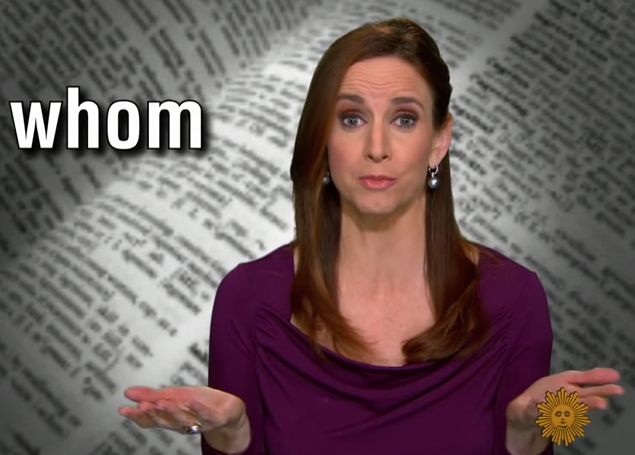
whomCBSWhat if you had to fill in a pie chart with different slices representing all the ways you speak? How many different slices would there be? Or, would you have just one whole pie called “Perfect English”? Would that be ideal?

Some news media, of late, suggest that the “Perfect English Pie” should be the goal. In this editorial today on CBS Morning, Faith Salie bemoaned the fact that many people do not follow her rules for proper “whom” usage.

Salie implies there should be only one uniform type of slice in our language pie, the one in which we are “speaking well.” This is especially true in “America,” Salie says, because according to her, most Americans only speak English:

Very few Americans, myself included, speak more than one language fluently. So, the least we can do is try and honor English by speaking it well.

Besides, she added, using “whom,” just makes you feel more special:

It’s like putting lipstick on your sentence.

The two comments posted, which don’t seem to even hint at irony, endorse Salie’s perspective:

VEGANSAM THANK YOU!

Cfc EditorTerrific vid. It’s nice to know that someone still cares.

Two days earlier, a Saturday New York Times front page story voiced another view on cleaning up language—not “who” and “whom,” but a certain way of saying “Wiscahnsin.” The headline reads:

 For 2016 run, Scott Walker washes “Wiscahnsin” out of his mouth

In this video, and the accompanying article, the author points out that Mr. Walker, now that he is running for national office, has changed how he speaks:

[Scott Walker] has left “Wiscahnsin” back home in Wisconsin. He now wants to strengthen the economy, not the “ecahnahmy.”

At the end of the essay, Jennifer Horn, Chairwoman of the New Hampshire Republican Party remarks:

I didn’t hear it [the Wisconsin honk]. Good for him, good for him.

Both Ms. Horn and Ms. Salie voice the view that we need to avoid certain ways of speaking and use those that are proper or less local seeming. Ms. Horn admires Walker’s new Wiscahnson-free diction, suggesting this makes him more palatable as a candidate. And, Ms. Sadie tells us we need to be especially protective of English, since it is the only language most Americans speak.

But, how do “Americans” really use language? Walker may be ditching his Wisconsin “honk,” but he is not replacing it with a sublime original super-perfect “American” speech. Instead, the article suggests, he is picking and choosing different types of language, adding variety to his language pie. When addressing Republicans in South Carolina Mr. Walker told them, in a characteristically un-Wisconsin-like way, that he enjoyed “talkin’ with y’all.”

To connect with people, even as a Republican in the United States, only speaking English, Mr. Walker’s Language Pie must contain some variety. He might be using “y’all,” in South Carolina, but he probably doesn’t in New Hampshire. And he may still talk about the “ecahnomy” when he is back at the family dinner table in “Wiscahnsin.”

But let’s suppose people are not running for office. Do people in the United States still need several different slices in their Language Diversity Pie? Or should they just focus on “speaking well” as Faith Salie suggests?

Last week, exploring this angle with 11th graders and their teachers, we had them create their own language pie charts. In just a few minutes, many divided their pie up into seven or more sections, including different language for the following slices of social life:

  • Friends
  • Close friends
  • Adults
  • Parents
  • Parents’ friends
  • Home
  • Texting
  • Babysitting
  • With siblings
  • With brothers
  • With animals
  • At work
  • At school
  • With teachers
  • With sports coaches
  • Just Dad
  • Just Mom
  • Nice friends
  • Vulgar friends
  • Girlfriend
  • Professional situation
  • Writing papers for school
  • Writing sentimental texts
  • When complaining
  • When angry or snarky
  • When giddy or happy
  • When tired or depressed

Most students specified slices for “friends,” “adults,” “home,” and “school,” adding varying degrees of nuance. “With animals” was a pie slice only one student came up with at first—but after being reminded of special animal pet voices, many classmates agreed they would add this slice to their pie too. (I doubt they use “whom” with their pets.) Momentary moods were crucial to a few students—clearly different ways of speaking come out when tired or depressed, angry, or giddy.

Nobody spontaneously mentioned anything about languages other than English. But, when I asked about multiple languages in their lives, several students had more slices to add to their Language Diversity Pie:

  • Mandarin with Mom (not Dad)
  • Danish with Mom (not Dad)
  • “Asian”-accented English with Mom, or when ordering Dim Sum in Chinatown
  • Persian with parents
  • Mix of Persian and English in general when at home

A ten-minute discussion revealed a profusion of ways of speaking, languages and “accents” that fit into any one individual’s pie.

These teens easily recognize the distinctive relevance of all the slices of their pie at different moments, or with different people, or to convey different moods. Even these young 16-year-olds, in Honors English, most of whom have spent their entire lives in one suburban community, have wide-ranging communicative repertoires, and can recognize their distinctive utility.

I hope these wise 11th graders can also address those media voices, like Faith Salie, that suggest our language goals should lean toward less language diversity in our pies. Today’s teens will need to use different kinds of language to do many things: babysit, snuggle with their cat, comfort a friend, write poetry, mediate neighborhood conflict, apply for college, be President…

One unitary language pie called “Perfect English” could never do all that.

What slices make up your Language Diversity Pie?

Word Wars: Shakespeare, Hip Hop, and the Common Core

Aesop RockEvery Wednesday morning, I visit a class of very smart, insightful, and surprisingly alert (considering class starts at 7:30 am) 11th graders during their English class. This week, they were finishing up their analyses of Hamlet soliloquies, and I took this opportunity to ask a few lingering questions about Shakespeare and Hip Hop (see previous post). What are some reasonable points of comparison?

Almost immediately, vocabulary began to emerge as the common ground.

One music fan pointed out that, like Shakespeare, the Hip Hop artist Aesop Rock commands a gigantic vocabulary, a fact documented last spring when this Shakespeare/Hip Hop infographic came out in an article by Matt Daniels (“designer, coder, and data scientist”) entitled, “The Largest Vocabulary in Hip Hop.” Daniels conveniently located Shakespeare’s relative spot in the lineup:

rapvocabinfographic

All the way to the right, sits Aesop Rock. And just to the left of him, members of Wu-Tang Clan and the Roots. These guys far surpass Shakespeare, and fans know it. Daniels writes that he originally excluded Aesop Rock (he seemed too obscure), but Reddit Hip Hop fans were insistent he be included. They knew he would shine in this comparison. So, Daniels ran the numbers and found they were right.

Voluminous Internet feedback followed the posting of Daniels’ article. As soon as Daniels’ chart came out, people began using it as a way to compare the quality of Hip Hop artists. Commenters suggested that it would follow that since Drake and JayZ are far to the left, they are obviously inferior artists to Aesop Rock or Wu-Tang. True?

Not really. Daniels quickly argued against this interpretation. First, he pointed out, vocabulary and verbal artistry are not the same. In a follow-up article, Daniels drew on a response to his first version, by Robert Gonzalez, to support his point of view. Gonzalez wrote that “On The Black Album track ‘Moment of Clarity,’ Jay-Z contrasts his lyricism with that of Common and Talib Kweli (both of whom “rank” higher than him, when it comes to the diversity of their vocabulary).” Then, Gonzalez cited these lines from Jay-Z:

Truthfully I wanna rhyme like Common Sense

But I did 5 mil – I ain’t been rhyming like Common since

Jay-Z is claiming to step down in terms of lyricism and vocabulary, gloating over his millions, but relinquishing any real claims to artistry to the hip hop artist Common. But is he really letting go of those claims to verbal art? He cleverly plays with the name “Common” and the phrase “Common sense” and in the process he implies that, in addition to doing “5 mil,” he still has some verbal skills. This suggests there is more to Hip Hop artistry than simply knowing a lot of words.

Other responses to Daniels’ Hip Hop vocabulary post point out that an artist’s “vocabulary” includes expressive devices that extend beyond words. Nathan, on Pigeons and Planes, brings this point home, when he writes:

In hip hop, and music in general, words aren’t the only thing that makes up an artist’s vocabulary.

As I followed this chain of remarks about vocabulary and Hip Hop, from the 11th grader’s comment on Aesop Rock, to the Internet posting, to the comments on that, I noticed the marked insistence that vocabulary, alone, can’t account for someone’s artistry or the extent of their communicative resources.

Delving into language artistry—be it Hip Hop or Shakespeare or Rush (another musical group the 11th graders invoked)—seems to be a much more complicated matter than counting words. For any director adapting Shakespeare to a new stage or in a new context, choosing costumes, deciding on the pacing, delivery, voice, pitch, tone, accent, and gestures, all enter into decisions for how to make a play that communicates with its audience. These decisions seem to align with those of Hip Hop artists like Jay-Z, similarly making “Common” sense decisions about how to reach their listeners.

Recent debates about the Common Core State Standards and their requirements for “vocabulary acquisition and use” traverse the same theme. Some have been worried that the common core designates specific vocabulary to be learned, ranging from outrage that the common core designates left-wing vocabulary or overly specified “academic” vocabulary or even the teaching of “Islamic” vocabulary.

Upon closer (any) examination, the Common Core encourages reflection on vocabulary and nuances of meaning precisely along the lines of the Internet exchanges surrounding the use of Hip Hop vocabulary and its relative worth. For grades 11 and 12, standards for “vocabulary acquisition and use” include the following:

CCSS.ELA-LITERACY.L.11-12.5
Demonstrate understanding of figurative language, word relationships, and nuances in word meanings.

CCSS.ELA-LITERACY.L.11-12.5.A
Interpret figures of speech (e.g., hyperbole, paradox) in context and analyze their role in the text.

CCSS.ELA-LITERACY.L.11-12.5.B
Analyze nuances in the meaning of words with similar denotations.

These standards do not focus on accumulating huge quantities of vocabulary words in isolation or determining the specific words that should be learned. Instead, these standards direct teachers and students to relish the “nuances” of word meanings, to understand that nuance “in context” and to make fine distinctions between words of similar meanings. Addressing these standards might even bridge the sophisticated types of debate that surround postings about Hip Hop and other music lyrics, and the kind of talk English teachers hope to encourage around literature like Shakespeare.

What do you view as a sophisticated use of vocabulary? How do you define “vocabulary”? Is it only words? How do you judge the relative merit of different verbal artistry? Please comment!

Shakespeare or Hip Hop?

wutang  Shakespeare

Last week in an 11th Grade English class, the English teacher and I started a discussion of language in Hamlet by presenting this poetic musing from D.H. Lawrence:

When I read Shakespeare I am struck with wonder

That such trivial people should muse and thunder

In such lovely language.     

Then we asked students about their experiences reading Shakespeare’s language so far. They shared frustrations (Too repetitive! Confusing word order!) and doubts (No way could one man have written so much!). Nobody fully embraced the idea that Shakespeare was a creative genius.

Nor did anyone take issue with Lawrence’s glib use of the phrase “trivial people” or the condescending tone he took toward them. Why shouldn’t everyone muse and thunder in lovely language?

Then, we trotted out this Shakespeare versus Hip Hop quiz (one I also shared with my Facebook friends, thus the 79 responses).

The questions and answers (quiz adapted from Ammon Shea’s book Bad English (2014)):

Quote Answer % Correct (n=79)
1.   The music, ho! 1.     Shakespeare, Anthony and Cleopatra 78%
2.   But if you don’t, I’ll unsheathe my Excalibur, like a noble knight 2.     Gangstarr, “Step in the Arena” 66%
3.   Holla, holla! 3.     Shakespeare, King Lear 62%
4.   This is the proper way man should use ink. 4.     Big Daddy Kane, “Taste of Chocolate” 45%
5.   Welcome, ass, Now let’s have a catch. 5.     Shakespeare, Twelfth Night 68%
6.   The money that you owe me for the chain. 6.     Shakespeare, Comedy of Errors 48%
7.   Pay me back when you shake it again. 7.     Nas, “You Own Me” 67%
8.   Holla, ho! Curtis! 8.     Shakespeare, Taming of the Shrew 60%
9.   Sabotaged, shellshocked, rocked and ruled, Day in the life of a fool. 9.     Public Enemy, “Brothers Gonna Work it Out” 70%
10.          Every square inch of it, that he chose for himself, is the best part. 10. Wu-Tang Clan, “Wu-Revolution.” 37%
AVERAGE PERCENTAGE CORRECT:       60%

People seem to get the right answer an average of about 60% of the time. Just barely a collective D-.

As some astute 11th graders pointed out, they were able to choose the “right” answers by second-guessing the test, not by deciding whether the language represented the “essence” of Hip Hop or Shakespeare.

Number 1 (78% correct!), for example, seemed to point to Shakespeare only because it sounds obviously like Hip Hop. Typical test-designers, students speculated, would include “ho” just to trick people.

Number 9 (70% correct) includes the word “shellshocked,” which another student pointed to as a giveaway, since that word didn’t exist until after the First World War. Shakespeare didn’t have any shells of that kind!

So, unless you know the exact lyric or play, or recognize testing tricks or oversights, the average person seems to have about a 50/50 chance of correctly guessing whether these quotes come from “Shakespeare” or “Hip Hop.” What does this tell us? Perhaps Shakespeare’s forte was not in his isolated mastery of “The English Language.” Instead, he may have been capturing exactly what “trivial people” said. Their wondrous language (including “ho” and “holla holla”), gleaned from Shakespeare’s active life in the pubs (so we’ve heard), may be precisely what Shakespeare wrote down.

What does that tell us about literary language? About Hip Hop? About our collective language resources? Do you know some “trivial people” that “muse and thunder” in lovely language? How do today’s artists—musicians, screen-writers, poets, playwrights—take up the talk of everyday people and use it for effect?   Please comment!

Language “Rules” and the Common Core State Standards

CCSSImageWhat do the controversial Common Core State Standards (CCSS) have to say about language? I’ve heard teachers and students, colleagues and friends, talking about the Common Core, hinting at worries about yet more standardization and inevitable high-stakes testing. I can agree that more standardization, especially regarding language in a massively multilingual and rapidly changing educational context is worrisome. But, what do the CCSS actually say?

Anyone with Internet access can take a look and navigate through all the standards on the website (www.corestandards.org). So, I did. I had one guiding question: What are the CCSS telling teachers to teach our kids about language? I found some happy surprises.

First, I found this statement in the introduction to the “Language” standards:

Language: Conventions, effective use, and vocabulary

The Language standards include the essential “rules” of standard written and spoken English, but they also approach language as a matter of craft and informed choice among alternatives.

Those quotation marks around “rules” were my first hint of potential CCSS flexibility. Perhaps the crafters of these standards take the concept of language “rules” with a grain of salt. If “rules” are in quotes and craft and informed choice considered important, teachers could be liberated, rather than constrained by the Common Core.

Could this stance be consistently maintained from Kindergarten through Senior Year? I continued through the Language standards to see.

The word nuance in one of the Kindergarten standards (#5) caught my attention and supported my first impression that strict definitions and rigid “rule”-learning wouldn’t be the focus. So, I began there:

K5: With guidance and support from adults, explore word relationships and nuances in word meanings.

K5C:Identify real-life connections between words and their use (e.g., note places at school that are colorful).

K5D: Distinguish shades of meaning among verbs describing the same general action (e.g.,walk, march, strut, prance) by acting out the meanings.

This sounds like a nice way to learn about language and meaning in context: Walking through a school, noting places that are “colorful”–or, marching, strutting and prancing, accentuating the nuance in each gait (and word)!

But, Kindergarten is supposed to be fun. Even standards writers might think so. What happens in first grade? They must start memorizing dictionary definitions then, right? No!

In first grade, this standard remains the same:

With guidance and support from adults, demonstrate understanding of word relationships and nuances in word meanings.

Now students note “places at home that are cozy” and continue to “distinguish shades of meaning,” of verbs like look, peek, glance, stare, glare, scowl or adjectives like large, gigantic.

And in second grade, students must demonstrate their recognition of nuance without “guidance and support from adults”:

Demonstrate understanding of word relationships and nuances in word meanings.

In third grade the standard adds “figurative language” but maintains the need to find nuance.

Demonstrate understanding of figurative language, word relationships and nuances in word meanings.

This standard remains exactly like this through 12th grade. Children go from marching, strutting and prancing around school to analyzing the shades of meaning of hurl versus throw to identifying hyperbole and paradox. Students’ understanding of word nuance consistently grows along the way.

But by starting with the “nuance” standard, I may have created a biased impression.  What about other standards? Are the rest more “rule” bound, standardized and lacking in nuance?

I started over in Kindergarten, this time with the most boring looking standard I could find, 1A. No nuance there:

Print many upper- and lowercase letters.

1A progresses to first grade like this, with even less nuance, as many changes to all:

Print all upper- and lowercase letters.

To second grade:

Use collective nouns (e.g., group).

And third grade:

Explain the function of nouns, pronouns, verbs, adjectives, and adverbs in general and their functions in particular sentences.

And, Common Core State Standard 1A continues in the same vein from 4th to 10th grade:

4th: Use relative pronouns (who, whose, whom, which, that) and relative adverbs (where, when, why).

5th: Explain the function of conjunctions, prepositions, and interjections in general and their function in particular sentences.

6th: Ensure that pronouns are in the proper case (subjective, objective, possessive).

7th: Explain the function of phrases and clauses in general and their function in specific sentences.

8th: Explain the function of verbals (gerunds, participles, infinitives) in general and their function in particular sentences.

9th and 10th: [in an abrupt and ironic break with previous grades] Use parallel structure.

Grammar rules seem to be piling up.

But I also noticed a healthy pattern of explanation of rules of “proper” usage (grade 6), interspersed with the slight concession to context, noting these features may function differently in “particular” (grade 5 and 8) or “specific” sentences (grade 7). But where does this all lead? What happens in 11th and 12th grade. Certainly you can’t be teaching more grammar points to 17 and 18 year olds?

Nope! In 11th and 12th grade, rules become “rules,” or, more explicitly, a “matter of convention” that “can change over time” and be “contested”:

11th and 12th: Apply the understanding that usage is a matter of convention, can change over time, and is sometimes contested.

After this dip into the Common Core website, following the ripples of a couple standards through the grades and into adulthood, I began to feel reassured that the CCSS (on their own) will not doom us to decades of robotic teaching and learning.

Understanding nuance is officially Language Standard #5. Nuance also infuses these standards and their interpretation. Like so many educational tools, they can be used and abused. I’m hoping to use them to support more critical thinking about language in classrooms, among students and their teachers, the community, and beyond. I’m also hoping that when students are exploring “shades of meaning,” (CCSS language standard 5D) those who speak several languages, or varied dialects, will be invited to share those shades of meaning too. (See Nelson Flores’ post on Multilingualism and the CCSS). Ideally, up to and beyond graduation, students will engage with the nuance of language, knowing they can also be the ones who change language “rules” and contest conventions.

What have your experiences been with the CCSS? Have you been aware of them as a teacher, a professor, an administrator, policy-maker, or a parent? As a citizen who consumes media about education policy? What do the CCSS ignore or leave out? How are they constraining? How might they be liberating?

Language Diversity Laugh Tracks

Laugh tracks, those recordings of canned laughter that at one time predictably accompanied all TV comedies, are supposed to cue an audience response, anointing certain comments, actions, or dialogue as funny. The laugh track says: It’s good to laugh now.

FreshOfftheBoat     laughingpeople

Laugh tracks also suggest we are similar. We are all part of an audience that laughs at the exact same things. One reason laugh tracks were originally created was to provide that feeling of shared laughter—the pleasure you get in a movie theater or a live performance when the entire audience is laughing together.

But, usually in life, we don’t have laugh tracks to cue that laughter. And, increasingly, we don’t have that shared background with those in the theater, or even in our living room. As audiences become more diverse, who laughs (at what and why) becomes more divided.

This becomes especially apparent when comedy lampoons different ways of speaking. A lot of humor depends on stereotyped portraits of speech-types. These depictions can be hilarious at times, offensive at others—and often simultaneously so to different groups of people. So, creating one unified laugh track would be impossible.

Why can’t we all laugh together?

Sometimes, we don’t all get it. For example, a few weeks ago, a student showed me this depiction of Asian accented Englishes (including Japanese, Korean, Chinese, Cantonese, Thai, Filipino, and Indonesian):

SingaporeAccents

https://www.youtube.com/watch?v=2OiDvo_XtV4

On watching this video with others in the class, half of us—those from China and Singapore—laughed heartily. The other half—those of us from the United States—just sat there, fascinated and puzzled. Not laughing. We weren’t trying to be tasteful or polite, expressing our offense at the crass depictions of stereotypes across East and Southeast Asia. We didn’t even know enough to make such judgments. We just didn’t get it.

In other cases, everyone “gets it” but in a slightly different way. Then laughing together may be possible–but complicated. Many comics build their routines through self-mocking depictions of their own (or their parents’ and grandparents’) ways of speaking English. When humor depends on this kind of linguistic self-mockery, laughing “with” someone might border on laughing at them, or at an entire imagined group.   In this clip, for example, Russel Peters imitates his dad, who moved to Canada from India, through easily recognizable stereotypes of Indian English:

https://www.youtube.com/watch?v=63_lFztZ0rw

And in this performance, Margaret Cho mocks her mother’s Asian accent:

https://www.youtube.com/watch?v=gevWOlEI5cc

In each of these live performances, the audience laughs with gusto. They clap and chuckle enthusiastically at Peters’ imitation of the many different ways his father says “Come!” in stylized Indian intonation, his eyes growing wide, head bobbling from side-to-side. Similarly, Cho’s audience enjoys her depictions of stereotyped guttural, r-less Asian speech. The YouTube comments immediately savor Cho’s portrait of her mother’s accent, attempting to represent it in their direct quotes:

fossilmusictv dis is da best mothas day. eva.

Ferd617…Oh, dere was one mudder day dat was a little bit bettuh.

But, this savoring of stereotyped accent, gestures and demeanor can also be troublesome. As the sociolinguist Elaine Chun points out, sometimes Margaret Cho’s depictions of Asians are such stark caricatures it seems okay for Asians and Asian Americans to laugh along, but disconcerting when white people join in. She writes of Cho’s performance at a show in Austin, TX, where more than half the audience appeared to be “European American”:

I had feelings of both pleasure and discomfort when hearing peals of laughter from non-Asians who seemed to profoundly enjoy her caricatures of Asians and Asian speech. (2004, p. 278, fn17)

For Chun, Asians’ enjoyment of Cho’s stereotyped versions of Asian speech seemed more straightforward then “out-group” laughter.

Cho’s TV show, All-American Girl, was canceled after one season, in 1995.

Now, depictions of Asian Accents are surfacing again as mainstream TV material. Fresh off the Boat, a new comedy about an Asian American family, premiered last month to mixed reviews. Many have critiqued the stereotypes and, specifically, the stereotyped language used in the show. Angela Tom, wrote:

Eddie’s mother played by American actress Constance Wu must fake a Chinese accent throughout the show. It hurt my ears even more when I heard Wu speaking in her normal, unbroken, smooth-as-silk English during a TV interview.

But other reviewers appreciate the negotiation between ways of speaking depicted in the show. Wu’s accent is not necessarily “fake,” but a performance. Like Tom, Shalini Shankar points out that the parents in the show perform stereotyped “Chinese” accents. But, she also stresses the importance of getting these performances out there:

As we get to know these more well-rounded accented English speakers as people, hopefully it will make it harder to see them as one-dimensional punch-lines.

Another critic’s list of “8 Reasons to Catch Fresh off the Boat” includes this observation:

 Fresh off the Boat is blessedly absent a laugh track.

Language variety and stereotypes of talk seem to be fodder for humor. But, the humor may appeal in different ways to different audiences, in ways the universalizing presuppositions of a laugh track could never capture. At least leaving the laugh track out of shows like Fresh Off the Boat lets the audience figure it out for themselves—and with each other.

How do you react to comedic depictions of language diversity like those in Fresh off the Boat? Have you found yourself wondering why certain accents are funny? Or whether you should be laughing at all? Please comment.


Frank Underwood Versus the Accent Commandos

spacey

Is Kevin Spacey’s accent as a South Carolina politician in House of Cards any good?

After Season 3 debuted this week, a posting by VOX took him through the wringer. In a little over three minutes, this YouTube video presents a history of Southern accents and intro linguistics, explaining how Spacey’s accent misses the mark. The narrator asserts, “R-dropping probably can’t be the shortcut that actors use in the future to sound Southern.” The video advises, instead, actors try “/ay/-ungliding.”

https://www.youtube.com/watch?v=mgCeH3xovDw

But, the viewers don’t buy it! A revealing critique of this perspective on Kevin Spacey’s performance comes from the citizen sociolinguists who comment on this video. 53 comments have already piled up.

A few agree with VOX, though on terms that wouldn’t be in an Intro Linguistics textbook:

XBLArmory As a southerner I find it interesting but by no means is it authentic; he sounds more like Foghorn Leghorn to me than any real southerner.

But many more disagree. Some point out the show is a performance. There may be deliberate reasons the accent is not right:

Nicodin Bogdan I think it’s interesting to point out that it might not be super correct geographically but maybe this is a trade-off for accuracy versus feel. We feel like Spacey comes off as an old-school, “elite” southern gentlemen and that’s what the show wants.

Echoing this point of view, another commenter suggests Spacey’s verion of “southern” relates to social class:

David Parker That is interesting, however, as a man from the Southern US, his accent is pretty accurate for the background of his character. The video really undercuts the significance of economic status and power and it’s influence on accents in the American South

As ZestyItalian points out, maybe Spacey wants the character to sound a little phony. Ahem, while Spacey is not a linguist, he is a professional actor:

ZestyItalian2… [his accent is] not “off”, per se. It’s just an older accent that’s associated with the southern aristocracy. It’s not extinct- just less common than it used to be. And considering the character background of Frank Underwood- poor boy, self-made man from the small town south- it’s not unreasonable to suggest that he affected a highborn, genteel southern accent, just as Scots and Irish of a certain generation (think Peter O’Toole) affected a semi-aristocratic RP English accent to bolster their careers and statuses.

And trust me- Spacey leaves nothing to chance- least of all something as essential as an accent. Spacey is a technician. One of the most technical of all American actors, in fact. He draws characters out as if they had blueprints or schematics. Nothing he does, physically or vocally, is an accident. And I have a very hard time believing that he didn’t do his research into the specific type of dialect Frank Underwood would have. I’ve always thought he sounded a lot like Jimmy Carter.

Another group of comments point out that labeling things with scientific terminology does not make them into an argument.

Furball Ay-ungliding. So glad I know what that phonetic mechanism is now. [I’m assuming sarcasm here]

And, as this person points out—no matter how scientific VOX attempts to appear with all their fancy sagittal diagrams and lingo, the links to “social class” are specious:

Robert Heinl Cut this out, Vox.  No one cares about you or your useless linguistics college major…. youre obviously incapable of making any substantive contribution to society whilst diagramming the posterior oropharynx and somehow linking it to socioeconomic status…

I appreciate the smart relevance of these comments that contest VOX’s sociolinguistic exegesis. Given the nuance that goes into the performance of a fictional character, the VOX video critique seems to me to be analogous to those of Grammandos who assert their grammatical expertise by criticizing people who write the phrase “comprised of” or use the word “literally” figuratively (The Language Experts).

Are Accent Commandos are now taking up that gauntlet? Fortunately, citizen sociolinguists, like these commenters, are out in force, making nuanced points revealing the complex way languages work in social life, the theater, Hollywood, politics –and Netflix.

What do you think of Frank Underwood’s accents? Or others in the public view? President Obama, for example, has also been criticized and mocked (Language Awareness or Linguistic Insecurity?) about the “authenticity” of his various performances of language variety. Why grant authority to the categorical decrees of Accent Commandos? Please comment below!

Google Translate Hacks

How do you translate talk and text? For many, Google Translate, the on-line translation robot, comes into play. But Google Translate makes mistakes, so ingenious humans have figured out nuanced ways of using it in not exactly the way it was intended: Google Translate hacks.

Hack #1: The Stereotype Detector

In this post on Google Translate one blogger asked “Is Google Translate Sexist?” and then suggested that, indeed, it is. He showed this by running tests in German, in which, for example, the word “teacher” in the phrase “Cooking teacher” translates as “Lehrerin” (feminine) while in “Math teacher” it translates as “Lehrer” (masculine).

I tested this myself, with Spanish: Sure enough, a “Cooking teacher” is a “professora” (feminine), while a “Math teacher” is a “professor” (Masculine).

cookingteacher

mathteacher

This does not necessarily mean Google Translate is sexist. Instead, this “sexist” translation illustrates Google Translate’s strength as a potential stereotype detector. Some words collect in gendered ways. We recognize these stereotypes—in concert with Google Translate.

Hack #2: The Bilingual Expertise Detector

In the transcript below, from Meredith Byrnes’ research on bilingual family literacy, a bilingual mother is explaining to her two boys (ages five and six) how she translates the English idiom, “school of fish”:

¡Porque aquí dice school of fish y abajo dice banco de pescado. Pero si fuera- si como dice arriba school of fish seria escuela de pescado!


(Because here it says school of fish and down here it says bank of fish. But if it was- if it says school of fish it would be school of fish!)

Bilingual people like this mom have special knowledge. The boys will not be able to simply use word by word translation or  a dictionary or even Google Translate for an idiom, because it does not translate literally:

schooloffish

Nope! Google Translate doesn’t get it. But this “mistake” reveals how Google Translate can work well as a Citizen Sociolinguistic tool. In its dumb errors (or “sexist” oversteps) Google Translate can reveal the nuanced knowledge of human beings, like this bilingual mom.

Hack #3: The Bilingual Collective Expertise Detector

Flash forward 10 years in the life of a bilingual family. Often, bilingualism is distributed across a family, parents having expertise in one language, children in another.   Robert LeBlanc’s research on multilingual literacy among teens who attend a massively multilingual Catholic Church (services offered in English, Spanish, Vietnamese, and Tagalog) illustrates this point.  And, he learned about this Google Translate hack one family developed there.

Teens who attend this church regularly use Google Translate as just one of several translation steps to read scripture publically. One teen, who doesn’t speak much Vietnamese, or read any, manages to recite scripture aloud in church. These are his basic steps:

  1. Types bible passage into Google Translate
  2. Prints out Vietnamese text from Google Translate
  3. Asks mother (who speaks and writes in Vietnamese, but not English) to edit, smoothing over the inevitable Google Translate errors.
  4. Records mother reading the passage aloud, using his phone.
  5. Listens to audio from phone during spare moments and repeats it until it is committed to memory.
  6. Recites memorized Vietnamese bible passage in church.

With this hack, Google Translate, which seems impersonal and error-prone, has the potential to function as an intimate medium, forcing at least one teen to engage deeply on a multilingual task with his mother.

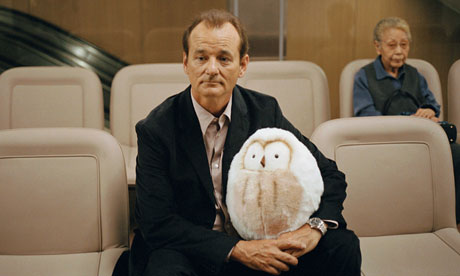
2003-LOST-IN-TRANSLATION-007

Lost and Found in Google Translation

Because Google Translate is imperfect, much is lost in translation. But when we use Google Translate as Citizen Sociolinguists, in concert with multilingual acquaintances, friends, or family members, much more can be found. How do you use Google Translate? What Google Translate hacks do you know?  Please share and comment below!


Language Diversity at the Oscars

The lack of racial diversity in the “Academy” (of Motion Pictures) was well publicized long before Oscar night. It even gave writers enough time to come up with Neil Patrick Harris’ quip about “the best and the whitest– oops brightest” to kick off the show. And, with #OSCARSSOWHITE cresting as a popular twitter hashtag, white homogeneity was in the spotlight.

But how did language diversity fare? There is no #OSCARSSOSTANDARDENGLISH or #OSCARSNOLANGUAGEDIVERSITY2015 to track on twitter. How inclusive is the Academy when it comes to different ways of speaking?

As Citizen Sociolinguists, we have the tools to investigate. First step, we can look at what people were saying then and there, at the Oscars, about language. Then we can ask our social networks: What memorable moments of language talk could people recall the next day?

People I’ve talked to immediately recalled two primary ultra-awkward moments of talk about language (and these seem to have been underlined in real time Twitter feeds too).

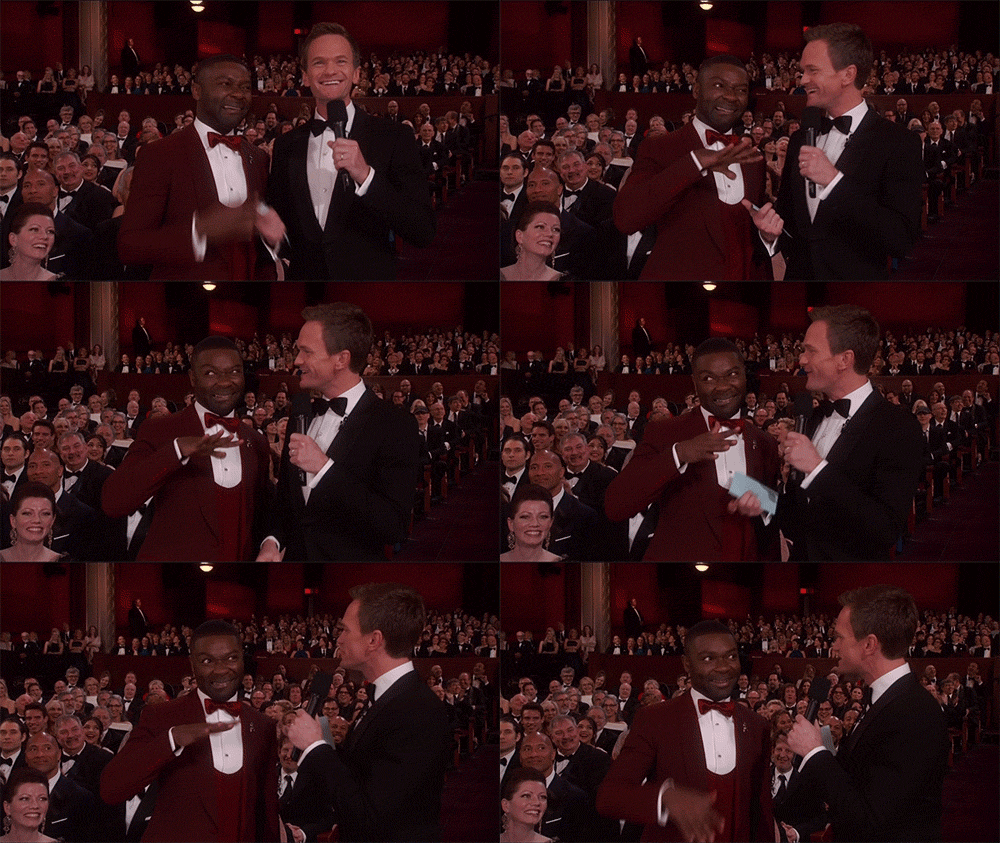
The first of these two key language awareness moments was Neil Patrick Harris’ attempt to talk about the “British Accent” with David Oyelowo, best actor nominee for his role as Martin Luther King, Jr. in Selma. Neil Patrick Harris jokes, “Help me prove that everything sounds better in a British Accent. I’m going to do this setup for a joke and then I’ll give you the punch line.” The joke and the punch line are not worth repeating—only barely funny, clearly tasteless. Simply the expressions on the faces of the audience were enough to indicate the sourness of this routine. And on the web, Oyelowo’s gif-immortalized gesture echoed this impression. Even British English couldn’t patch things up:

Oyelowo

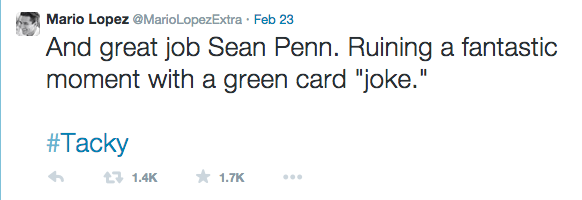
The second memorable language awareness moment began when Sean Penn announced the winner of Best Picture, for Birdman, directed by Alejandro González Iñárritu. After the usual pregnant pause and before he announced the winner, Penn’s off-the-cuff “green card” comment—alluding to Iñárritu being Mexican—met with immediate revulsion on Twitter. As exemplified here:

Screen Shot 2015-02-25 at 12.11.46 PM

A few glum faces, even among the best picture winners, gave hints that this humor didn’t fly with everyone in the room either. Iñárritu then brilliantly stepped on stage with the cast of Birdman and took the microphone. Self-deprecatingly, he described his own English accent:

Oh my god, they want me to talk because I am the worst English-speaking guy here.

Then he proceeded to put to shame the evening’s countless scripted and non-scripted attempts at language artistry. He spoke up for Mexico and for Mexicans’ contributions in the United States, and he implicitly punched back at Sean Penn’s joke:

Finally, I just want to take one second. I want to take the opportunity to dedicate this award for my fellow Mexicans. The ones who live in Mexico. I pray that we can find and build a government that we deserve. And the ones that live in this country, who are part of the latest generation of immigrants in this country. I just pray they can be treated with the same dignity and respect of the ones who came before and build this INCREDIBLE. IMMIGRANT. NATION. Thank you very much.

If that is the “worst English-speaking guy” in the room, what might we call some of the other English speakers present that evening? And how well does the Academy seem to recognize the verbal artistry involved in language diversity?

What moments of talk about language did you hear at the Oscars? What do your social networks have to say about language diversity that night?

Leave your comments below!

Sociolinguistic Outtakes: Footnotes, Epilogues, Anecdotes and Asides

Have you ever indulged in a movie… outtake? The DVD ends and scenes flash beside the credits, featuring the very same movie actors you just watched–breaking character. They swear or burp or burst into belly laughs, when they are supposed to be exuding wisdom or dying or committing a felony.

 FellowshipOuttake“I’m sorry I cannot get up these god damned steps smoothly” (Ian McKellen outtake from The Fellowship of the Ring)

Even animated movies have outtakes. Toy Story outtakes, for example, proliferate on the web—as if the anthropomorphized toys are so real that they, like human movie actors, sometimes break character and burp or giggle at the wrong times.

BuzzBurp Buzz Lightyear after burping in his packaging (Toy Story outtake)

Outtakes were once perhaps simple teasers to make people keep watching during the credits after the movie ended. Now they are specially produced and sought out on the web for their own, unique merits (one Toy Story compilation on YouTube has over six million hits). Why? What makes outtakes interesting to people?

Outtakes show that actors—even the toy Pixar characters?—have lives beyond the artifice of the movie set piece. They react to situations and interact with each other in a huge variety of ways, some of which may be familiar to us, or idiosyncratic and new (like the way Seth Rogan giggles). Also, they make us feel like Hollywood insiders. Movie making isn’t as elite and exclusive a process as we may have thought. Outtakes reveal the process. They also suggest the joy in it. Maybe making the movie was even more fun than watching it.

Now, how does this citizen enjoyment of movie outtakes relate to Citizen Sociolinguistics? Think of the “research article” in place of the “movie.” The article, conference address, or book, like a Hollywood production, emerges from careful editing–the squeezing of countless interviews, observations, field notes, recordings, videos, into the professional medium of a journal article. As with moviemaking, quite a bit ends up on the cutting room floor.

But, language researchers seem to delight in resurrecting those bits that didn’t fit their professional storytelling venture (or research methodology). Just as movie producers (and viewers) delight in replaying Ian McKellen swearing about his robes in The Fellowship of the Ring, language researchers (and readers) relish the unexpected stories that emerge inevitably when doing research with our fellow humans.

It seems that the more rigidly traditional the research parameters, the more delightful the cutting room scraps. William Labov, for example, in a write up of a study that focused on five phonological features and their stylistic variation across five domains of use in New York City, honors his readers with dozens of asides and footnotes that call attention to idiosyncratic features of the humans involved. For example, the research subject Steve K draws these anecdotal descriptions from the staunchly quantitative researcher:

He studied philosophy for four years at Brooklyn College, but left without graduating; he had turned away from the academic point of view, and as an intense student of Wilhelm Reich, sought self-fulfillment in awareness of himself as a sexual person. (p. 104-5)

While Labov includes these descriptions of his subjects (and this one continues in a footnote), he concludes that they play no part in the focus of his research on stylistic variation. Yet these Steve K sorts of descriptions remain a hallmark and entertaining highlight of all Labov’s research.

Linguistic anthropologists, like sociolinguists, also indulge in the anecdote and aside. I still recall clearly the story one of my anthropology professors relayed about a white (Caucasian) anthropologist’s fieldwork. In a discrete epilogue to his book length ethnography, he revealed that, during his entire time living as a participant-observer in remote Indonesia, the community thought he was a ghost.

In the spontaneous moment of an introduction or over wine at the post-talk reception, a researcher might share something about the connection of their work to their own life. Last month, for example, an esteemed, senior sociolinguist gave a talk here at Penn, and introduced his quantitative, fine-grained analysis with a story about his own experience as a graduate student with a stigmatized North Philadelphia accent. Long after he had finished his PhD and had begun to emerge as a leader in the field, his mentor/professor confessed: From the way you sounded in class, I never thought you would really make it through.

These research outtakes reveal the artifice of the research project and even the research training process, throwing what we might have ignored into the public’s view.

What we thought was marginalia may be what drives the work.

These days, sociolinguistic outtakes need not drift into the obscurity of footnotes, or asides during the post-talk reception. The structure of social media, the networked arrangement of the Internet, digital media that hyperlinks footnotes and other information, all make asides as easily accessible as the main research article. And those who are “subjects” in that article may be reading or listening to those asides. What if they joined the conversation?

What if we focused on the outtakes? That’s a Citizen Sociolinguistic approach. Now with social media and hyperlinks to even the most obscure trivia, the institutionally sanctioned research question can easily fall to the background, and the footnote can become focal. As the Cowgirl from Toy Story says in a blooper when she accidentally pulls off part of Buzz Lightyear: Should we put this in the movie now?

OutTakeToyStoryMaybe we should put more sociolinguistic outtakes into the official research. We may discover that the new post-globalization, post-Internet language diversity (or “super-diversity”), has been here all along, in the outtakes.

What “asides” become central to you? Do they take you off-track, or show you a new perspective, something you never knew about before? Please comment below!

The Language Experts

Who are the Language Experts?

When you have a question about language, who (whom!) do you ask?

Sometimes it may seem the experts are those language bullies or “grammandos” who peevishly correct grammar no-nos. If you are not sure of the difference between “comprised of” and “composed of” (and care), the man who has spent years combing through Wikipedia “correcting” those phrases over 47,000 times may seem like the best person to explain it to you.

But what if you have a question about less rule-bound ways that people use language?boutaweekago

For example, who provides expertise on these questions about speaking English in Philadelphia?:

  • What does “Salty” (or “sawdy”) mean when used by Philadelphia second graders?
  • Who says “Ac-A-Me” instead of “Acme” when referring to the Acme grocery store?
  • Why do some teenagers start rapping and dancing whenever they hear the phrase “bout a week ago”?

Moving beyond Philadelphia, suppose you have a question about a phrase you’ve heard in Spanish. What if someone called you a “fresa” and you had no idea what that meant? Would you consult a dictionary? That couldn’t tell you, like my friend from El Paso could, that “fresa” is a word often used for slightly spoiled, entitled girls from Mexico.

What expert on language could you consult if you encountered this English/Chinese phrase:

Hold住

A language purist might despise it, a Chinese Dictionary might translate it, but a Chinese 20-something could probably provide a more robust explanation for this phrase, (which translates into something like “hang in there!” or “deal with it!”), how commonly it is used, and its connection to a certain TV character.

This phrase might lead you to questions about other Asian World Englishes. How do Koreans, Chinese, Thai, Taiwanese, and Japanese use English differently? Who holds the expertise on this massive variety? I would suggest you start by asking someone who immigrated to Singapore for High School. They might be able to explain the intricacies and irreverence of accent parodies like this one:

https://www.youtube.com/watch?v=2OiDvo_XtV4

These are all cases where non-professional-experts, that is, average everyday people who are not linguists or English teachers—Citizen Sociolinguists—have expert knowledge. These everyday citizens have the know-how they need to navigate the daily intricacies of language and communication that make up their lives. And, usually, they are happy to share it.

Your very own friends and acquaintances can often answer your language questions with the precise type of expertise you want. Students and children can also be prime language experts in this regard. Or, Internet sources might guide you. Look up “grammando,” “bout a week ago,” or “salty” and you’ll get some approximations of the meanings of these phrases and their social value. Google “Asian Accents” or a “Mexican fresa” and you may find some video explanations, ranging across degrees of accuracy and offense. These are building blocks to understanding; Your ever-expanding circle of Citizen Sociolinguistics experts can continue to build on them.

Language has interest and connections to social life and human relationships far more wide-ranging than could be contained in one expert’s view. Fortunately, since the survival of life-as-we-know-it depends on it, the grammando will never have the last word on language. As David Weinberger has written in Too Big to Know, when it comes to language or any sort of networked knowledge,

…the measure of one’s strength as an expert is not that you have the final word on some topic, but that you have the first word (p. 68).

When words and communication confuse you, who (whom!) do you call on as your language expert? Your children? Your students? Your parents or friends? Urban Dictionary? YouTube? Google Translate? Others? A combination of all? Post your comments here!