Ugh! How do you pronounce UGG™? 

You may think pronouncing UGG is as easy as saying “AHH” when you slip your foot into the cushy sheepskin lined interior of an UGG boot. It is!  But, in happy citizen sociolinguistic fashion, there is more than one way to do it.  

I discovered this recently when a student pointed out (literally spelled out) that she was wearing some cozy “U-G-G” boots, treating UGG as an initialism, like UCLA or FBI.  My citizen sociolinguistic senses were tingling, so I had to ask the class: Do you all say U-G-G, not “Ugh”?  The Chinese speakers in the class nodded, and one provided an explanation: The word “Ugh” is difficult to say for Chinese speakers.  U-G-G is much easier.  

Another student explained that the sound “ugh” had a meaning in Chinese so saying U-G-G instead circumvents any confusion. (This explanation was not whole-heartedly endorsed by other Chinese speakers in the class).  

I was curious what Internet AI would say. My computer’s “AI Overview” had a very firm anti-U-G-G stance: UGG is pronounced like “hug” without the h.

AI OVERVIEW: You say “Ugg” like the word “hug,” but without the ‘h’ sound at the beginning; it’s a single syllable, rhyming with “bug” or “mug,” often pronounced closer to “uh-g” or even “ag” in Australia, the boot’s origin. It’s pronounced as one sound, not “U-G-G”.

Consistent with this “overview” there are many YouTube videos demonstrating how to pronounce UGG “in English.” Most go with “ugh” and a few illustrate the Australian pronunciation (“ag,” as in “agriculture”) also mentioned in the AI Overview. I found no demos of “U-G-G.”  

But apparently someone else was UGG-curious eight years ago and posted this question on Quora, “Why do Chinese spell “U-G-G-S” instead of just saying “Uggs”?”  The lone responder wrote, “Because they assume it’s an abbreviation like NBA.”  (Who’s assuming now?!). After assuming this rationale, the lone responder continued: “The funny thing is, they stick to this pronunciation, even when you tell them the ‘correct’ way. What’s funnier is that the Australian customs officers have got used to saying ‘U-G-G’ to make sense to the Chinese visitors.”

This anecdote endears me to these pragmatic Australian customs officers/citizen sociolinguists!  But it seems a bit dismissive of the U-G-G pronunciation (as funnily persistent “even when you tell them the ‘correct’ way”) and it fails to mention my Chinese-speaking students’ explanation about the difficulty and possible weirdness of saying “ugh” instead of U-G-G. 

I encountered a new take when I came across a TikTok post, “How do French people pronounce “UGG”?  This is nothing like “hug without an h”—it’s more like something you might say when looking out from your Parisian garret at a glittering Eiffel Tower and popping a bottle of the best Champagne. “Oo Jey Jey!”

Click on this link to hear for yourself this fabulous UGG pronunciation:https://www.tiktok.com/@masha_in_paris/video/7172919774341614853

Let’s sum up: Chinese speakers seem to favor “U-G-G.” French speakers, “oo-jey-jey”.  Aussies say “ag”.  Internet AI and most YouTube tutorials say “Ugh.” Are all these pronunciations okay?  I think so. UGG is not an “English” word—it’s a brand name!  So, give yourself this holiday gift: Enjoy your favorite pronunciation as you would your favorite Aussie sheepskin slipper. From this point forward I will be luxuriating in my own imaginary pair of Oo Jey Jeys.  Oolala! 

Have you encountered any surprisingly wonderful new pronunciations lately?  Please share below! 

Multilingual Mondegreens

Mondegreen is a wonderfully useful word for the misheard version of a well-known phrase or song lyric. Often these are funny and a little irreverent.  Many famous mondegreens come from classic rock lyrics, like Jimi Hendrix’s “’Scuse me while I kiss the sky” (misheard as the mondegreen, “’Scuse me while I kiss this guy”) and Creedence Clearwater Revival’s “There’s a bad moon on the rise” (“There’s a bathroom on the right.”).  For years I naively thought Eric Clapton’s seductive, rhetorical question, “C’mon baby do you do more than dance?” was the information-seeking, “C’mon baby, do you do modern dance?” All of these mondegreens are in English obviously, but I’ve recently become aware of a few multilingual mondegreens (a well-known phrase or song lyric misheard in a different language) and I started to wonder if these tend to have the same entertainingly absurd dynamic to them.  So far, the answer seems to be yes, and so much more.

My students recently alerted me to a viral YouTube video, apparently circulated many years ago, a perfect multilingual mondegreen that seems as silly and enjoyable as those I’ve mentioned in English. The video version depicts only audio with sub-titles in English: a Spanish-speaking individual calls in to a Spanish-speaking DJ on a pop radio station and asks if the DJ could play a favorite song: “Eso son Reebok o son Nike.” The DJ wonders aloud for a bit, and then seems to have an “aha” moment, and plays the correct song, “This is the Rhythm of the Night.”

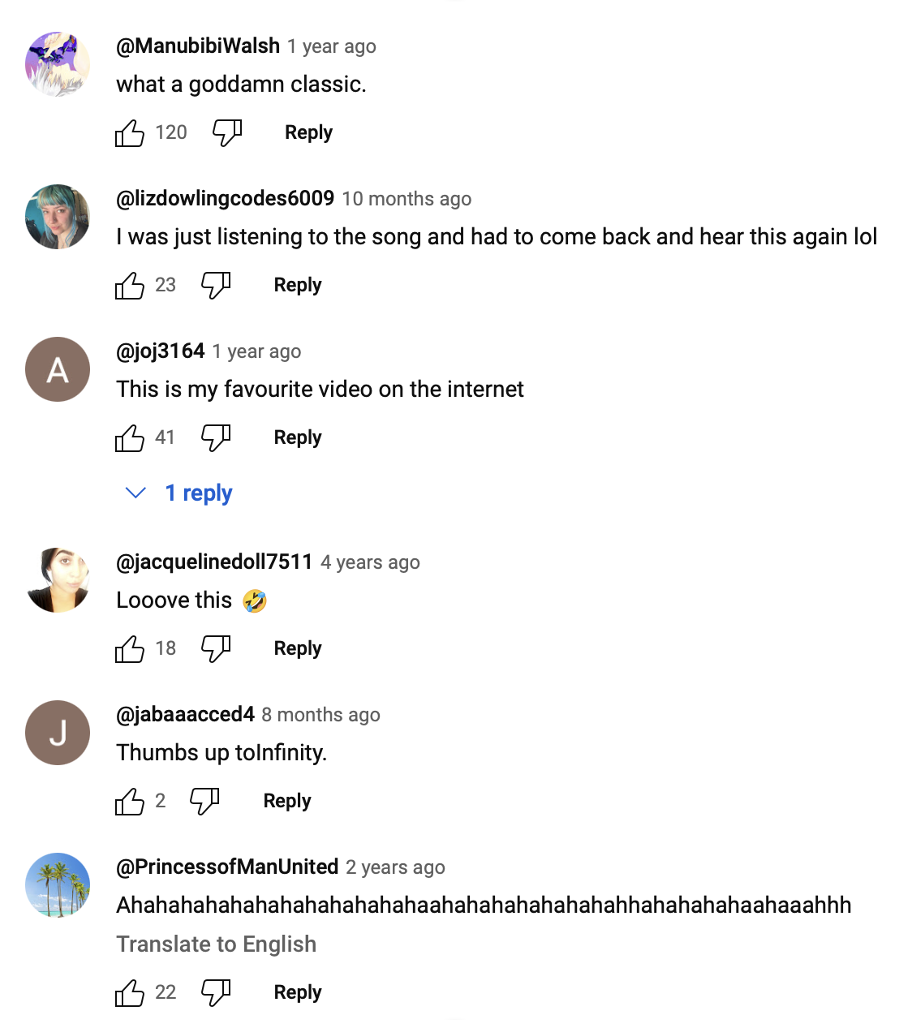
“Eso son Reebok o son Nike” is as a great example not only of a multilingual mondegreen, but also of how important it can be to give someone the benefit of the doubt when you are trying to figure out what they are saying. This DJ is such a generous listener. And he very satisfyingly guesses that the caller is requesting “This is the Rhythm of the Night.” Does this have the same absurd joyfulness as the monolingual Classic Rock mondegreen examples above? Judging by the reaction of the DJ, who ends up laughing spontaneously through the second half of the video, yes! And my students also expressed love for this example. Under the English translated YouTube version, the comments echo this enthusiasm: 

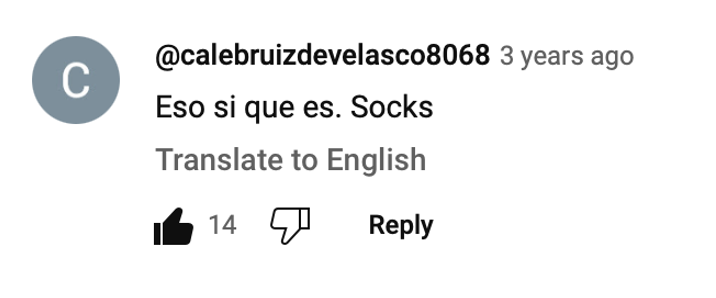
One commenter even added another multilingual pun in their response:

So, it seems that at least this Spanish/English multilingual mondegreen has the same effect as those old classic rock mondegreens.  Joyful absurdity! Plus more—a little revelry in multilingual punning.

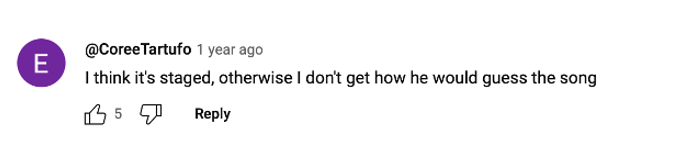
Still, one commenter suggested that this was all a staged performance. At first they couldn’t believe that this DJ could get to the bottom of this multilingual mondegreen.  

But multiple people reply, explaining how, as bilinguals themselves, they see how this could realistically be deciphered by the DJ: 

Importantly, one of these replies also mentions another, all-English, mondegreen (“We like papaya” for “Relight my fire”) to illustrate that this type of mishearing is common.  Collectively, these commenters convince the skeptic.

But there are other multilingual mondegreens that are not nearly so popular, nor so generously deciphered.  When the misheard words immediately seem offensive in another language, people don’t work as hard as that DJ to get to the bottom of the multilingual mondegreen mystery—that is, to match the misheard word to the original song lyric.  Most infamously, K-pop lyrics that contain the word “Nega,” which some speakers hear as the offensive and racist English language “N-word,” have led some artists to issue trigger warnings before live performances of songs that prominently feature that word. This is another multilingual mondegreen, but one that seems less innocent.  

I recently heard from my students about a similar problematic mondegreen of a viral Chinese pop song (“Nae Ni**a”) that foregrounds, again, a word that sounds very much like the “n-word” in English.  (https://www.youtube.com/watch?v=NjD0H4eBfng):

How do listeners interpret this potentially racist multilingual mondegreen?

Some insist the original lyric and its literal translation render it innocent (the video accompanying it, including a rainbow unicorn and dozens of teens dancing in tuxedo suits, seems to underline that interpretation):

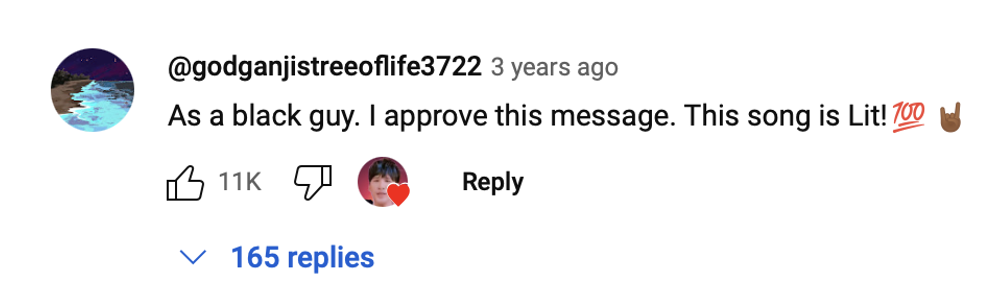
But the awareness of the potential for offense is still there, since more than one fan also points out their Black identity as they express their appreciation: 

And other comments point out that this song is in Chinese—even though some might hear the words as English (the essence of a multilingual mondegreen):

But the existence of the potential for multiple racist interpretations seems to act as a lightening rod for more toxic comments, not to be repeated here.  And, I get the sense that people may be using this song as an excuse to, in other contexts, use the n-word in offensive ways, without being held accountable. Several comments mention the possibility of getting an “n-word pass” because of this song. 

All of these mondegreens highlight how we stretch our ears to hear things in new ways when multiple languages are involved, and how misunderstanding arises even among massively homogenous groups like monolingual classic rock fans in the United States. Mondegreens, both the hilariously absurd, and the interculturally awkward, can make us pay attention to lyrics (and their translations) and help us appreciate them.  They also highlight the ever so human possibility for mishearing in any language, and the exponentially greater possibility of miscommunication when multiple languages are involved.  

The DJ who impressively deciphered “Eso son Reebok o son Nike” illustrates the interactional rewards that follow from generous listening: Very little in life is as sweet as a laugh shared at nobody’s expense! Rather than refusing to understand, that DJ stretched his ears, puzzled a bit, then found “The Rhythm of the Night,” to lasting and entertaining effect.  In our complex multilingual world, multilingual mondegreens help us to recognize the crazy ways our varieties of communication will overlap and near-miss, and that, if we empathically listen to each other, we might be rewarded by learning a little about each other’s languages, and even, if we’re lucky, share a hilarious “aha” moment that brings us a little bit closer together. 

What are your favorite and least favorite mondegreens, multilingual or otherwise? What kind of impact do they have?  Please comment below! 

Citizen Self-Transcription and Eye Dialect 

Screen Shot 2016-09-24 at 6.37.24 PM.pngHave you ever had to transcribe oral speech?

If so, you know it can be a tedious process–listening to a recording and then typing out utterances word for word.  Word. For. Word.

But transcription is not as easy—nor necessarily as boring—as it sounds.  It involves translating spoken language into written words and like any other translation project, this requires some interpretation and finesse.  For example, when a speaker says what sounds like “I’m gonna leave now.”  Should that be written as “I’m going to leave now”? or “I’m gonna leave now”?   If an adult English Teacher says it would you be more likely to write “going to”?  If a 10-year-old in the class says it, would you be more likely to write “gonna”?  How do age, race, gender,  socioeconomic status, institutional role, and any other aspect of the situation figure into that interpretation?

The sociolinguistic, Mary Bucholtz, in her article, “The Politics of Transcription,” has pointed out that even established researchers often make transcription decisions in ways that indicate underlying biases.  When someone uses a certain spelling for one demographic or social role and a different spelling for another, Bucholtz calls this “eye-dialect.”

So, the tedious act of transcription becomes political, and the stakes can be high: A courtroom transcript, for example, that represents a defendant’s speech in stigmatized eye-dialect, could leave a record that unfairly influences a jury’s perception of that individual.  Bucholtz urges transcribers to be mindful of the choices they make when they transcribe—accounting for how their representations create identities for speakers.

Last week, however, when talking about “The Politics of Transcription” in my graduate class on Classroom Discourse Analysis, one of the students pointed out that many individuals—especially teens-these-days—use something like “eye-dialect” to purposefully add nuance to their text messages, Facebook and Instagram posts, snap-chat stories, or any social media that mimics “conversation.”

In these kinds of self-transcriptions, people usually call on eye-dialect to deliberately construct identities for themselves.   In this way, they are creating citizen transcriptions of themselves, calling on their own knowledge of local social value connected to transcribed forms of talk.  Citizen self-transcribers crafting a text message, just like reflective researchers transcribing language “data”, can be painstakingly mindful of the identity they present when they translate a spoken-like message into a social media message.

Here is an example of my own speaking-to-my-son self which I found in our text message history:

screen-shot-2016-09-24-at-5-16-20-pm

In my mind, this message, including its eye dialect, captures my kind yet concerned loving self.  The spelling of “Pleez” conveys my sheepishly earnest need for my teenage son to keep me in the late night loop.

Probably the best guard against bias among social scientists or courtroom transcribers is to treat all speaking the same way and be as uniform as possible.  But when we everyday individuals transcribe our own voices into text messages, we participate in an unstandardized, yet high-stakes world of eye dialect.  My own Emoji smiley-face, heart, and old-lady face probably also convey some middle-aged white lady dialect.  But that’s okay.  That’s who I am. And, I’m the one who transcribed it.

Those same features of transcription that can seem to unfairly bias social science research or stigmatize a defendant in the courtroom, become powerful communicative resources for the citizen self-transcriber.  And, the citizen self-transcriber might have a more sophisticated command of bias than your average social science researcher—because they know that there is not a “correct” way of doing it, only better and worse ways of communicating one’s identity in each unique socially mediated context.

What type of eye-dialect do you deliberately use in your text messages or social media self-transcriptions?  How do you use it to craft identities for yourself?  How do you read other messages and interpret “eye-dialect” there? Do you ever write messages that used your own “speshul” brand of spelling? Please comment and share your ideas and examples below!


The Linguistic Color Line

Screen Shot 2015-08-25 at 9.19.18 AMW.E.B. DuBois has asserted that “The problem of the Twentieth Century is the problem of the color line.” What is the color line? Was this true all over the U.S.? And what about the 21st Century? Have we overcome the problem of the color line?

For the early part of the 20th Century, in the South, Jim Crow laws made the color line very explicit: Blacks were excluded from white public spaces: drinking fountains, sections of the bus, etc .

But these explicit laws permeated the North as well. There were “White’s Only” clubs, like The Cotton Club, even in Harlem.

What about the 21st Century? Does a color line remain? Of course. While there may no longer be Jim Crow laws on the books, there are still implicit ways in which an individual’s race is monitored in public. One key mechanism for this monitoring is what I call the linguistic color line.

Everyday, individuals in the United States modify the way they act and talk when they are in the presence of white people. This is not simply a matter of being “polite” or adjusting one’s talk to fit into certain social situations. Sometimes, it is a matter of “Talk like white people or you will be brutalized.”

This was depicted recently in a brilliant satire of a police stop, performed by Larry Wilmore as commentary on Sandra Bland’s arrest in Texas.

At point 4:16, of the clip linked below, Wilmore identifies precisely the linguistic color line that Sandra Bland was being asked to toe:

http://www.cc.com/video-clips/yjv4ys/the-nightly-show-with-larry-wilmore-mess-within-texas—sandra-bland-s-arrest

WILMORE: I mean, it’s easy to say, “Black people, why aren’t you acting like the Dowager Countess when a cop pulls you over?”, right?

WILMORE (Channeling Dowager Countess in English Accent): Oh, hello, officer. I’m so pleased you’ve unexpectedly dropped in on me. Would you like some tea I brewed in my glove compartment here?

Apparently Sandra Bland was not allowed to act and talk certain ways in her own car when addressing a police officer.

As Wilmore sums up, “We live in a world where black people have to strategize so they’re not brutalized by police.”

And, much of this strategizing involves modifying one’s language.

The linguists Nicole HollidayRachel Burdin, and Joseph Tyler, in their detailed and revealing blog post on the linguistic nuance of this encounter, have, with irony, labeled Sandra Bland’s crime, “Talking While Black.”

As the Sandra Bland encounter illustrates, while we may have fewer explicit laws about where black and white people can congregate, we continue to have tacit rules about ways black people are allowed to talk and act in certain spaces.

This, lately, has been dramatically illustrated in the case of police encounters. But it is often also the case in schools, where certain (white) ways of talking and acting are expected from all children—even (especially?) when most or all of them are not white. Schools have been legally desegregated, Jim Crow laws have been abolished, yet, as soon as any student steps across the threshold of a public school, they are expected to talk and act in certain ways that match white notions of polite and proper.

This is the linguistic color line. Enforcing that color line in classrooms may not be so dramatic as the Sandra Bland encounter, but it can, for children, be silencing.

Have you encountered the linguistic color line? Have you witnessed it being enforced? In institutions? In schools? In service encounters? In social activities? Is it time to lift what W.E.B. DuBois called “The Veil” and let people speak?

Please comment!

Untranslatable and Multilingual Words

pochemuchkaAbout two years ago, a blog listing 11 “Untranslatable words from other cultures” became unexpectedly popular.This list includes beautiful illustrations and words that describe situations or states of mind that we all might recognize, but may not have a single word for, like the Spanish word for post-meal conversation:

Sobremesa: the time after lunch or dinner you spend talking with the people you shared the meal with.

Or the Russian description of a potentially annoying type of person:

Pochemuchka: Someone who asks a lot of questions. In fact, probably too many.

The “pochemuchka” description also includes the aside, “we all know a few of these,” suggesting that, though the word is distinctly Russian, the sentiment may be familiar cross-linguistically.

The voluminous comments following the 11-word list reveal a general recognition of the social arrangement or emotion described by each entry, but also the special added zing that these sentiments take on when a specific word gets attached to them. As one commenter wrote:

Tine • What a lovely post! It gives me great joy to hear about other people’s perceptions and how they cherish it enough to give it its own word.

The subsequent proliferation of sites with “untranslatable words” like this suggests that many people like Tine, above, are drawn to words from afar that name subtle, yet recognizable, feelings, perceptions, situations, or social nuance. (Try googling “untranslatable words” and you will find dozens of lists, videos, and essays). Paradoxically, these “untranslatable” words seem to translate well to readers, as insinuated by at least one commenter on a YouTube video illustrating “8 Untranslatable words” (https://www.youtube.com/watch?v=sPHJp25u7Tw):

Qichin 8 Untranslatable words … and their translations.

If there are words that exist in one language but have widely recognized meanings, could there also be words that exist in many languages (or “cultures”) but have different meanings? Is there a flipside to “untranslatable words?” I call these multilingual words. They exist. But this type of word seems harder to find.   Googling “multilingual words,” yields no entries describing this possibility–only multilingual word lists featuring supremely translatable words like Hello, Goodbye, Thank you and You’re Welcome, or simply definitions of the word “multilingual.” Googling “words that exist in multiple languages” yields the same lists of “untranslatable words” described above.

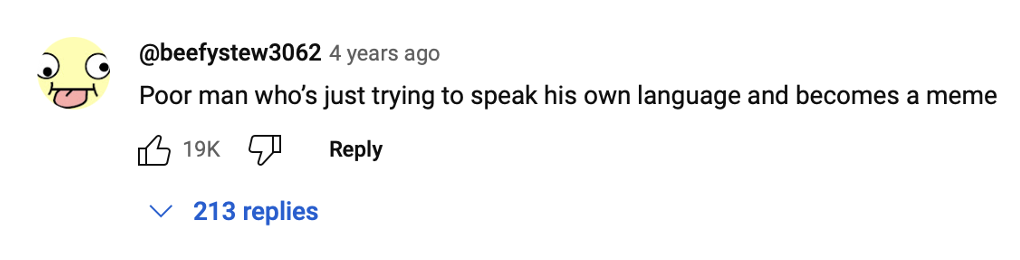
Still, words that look the same and sound the same in different languages but have different definitions in each of those languages do, of course, exist. The recent guest post about Google my Bulbul, a popular YouTube video, provides at least one example. The word “Bulbul” draws a few comments that suggest different definitions:

Insan hor  ‘Bulbul’ means ‘Penis’ in Egyptian.

Yzeed Az no it means beautiful bird 😛

Business Andbusiness is is bird with melodious voice

SillyDodo  Uhh.. bulbul in hebrew is a word for penis..

 These are not subtle sentiments or distinctions. “Bulbul” is not “untranslatable.”  People just disagree on the translation. They also disagree on what language it comes from.  Therefore, in the face of this comment controversy, the best way to understand what “bulbul” means is to see how the video-maker, Funzoa, uses the word in his video. The Bollywood style of the entire video points to the more romantic “beautiful bird” definition. And, Funzoa, perhaps to disambiguate as clearly as possible, illustrates his otherwise whimsical “Google my Bulbul” with a very dictionary-illustration-like bird:
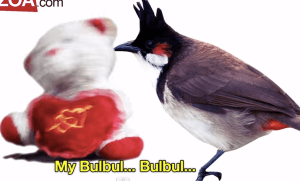
Bulbul bird

Finally, in the comment thread about the meaning of “bulbul,” Fuzoa explicitly disambiguates:

Funzoa It means a beautiful bird in india. Ao either way google bulbul works. Hehe

With this example of a “multilingual word” in mind, I went back to the “untranslatable” words to refine the distinction. Do people disagree about the meaning of these untranslatable words the way they do about multilingual words? I found numerous claims to new “untranslatable” words in dozens of world languages. But all these words seemed isolated to the language claiming them, and most comments agreed on each meaning.

In some cases, commenters argued about the linguistic uniqueness of the word. So, while Brazilians may want to claim “saudade” as uniquely untranslatable, others name new words to describe it. “Saudade” is to Portugese as “dor” is to Romanian as “stesk” is to Czech as “tesknota” is to Polish as “sehnsuchst” is to German. Similarly, “hygge” is to Danish as “cozy” is to English as “gezelligheid” is to Dutch, and so on.

The comments largely confirm that the “untranslatable” words, while new, are readily understood by readers of different languages as distinctive, and descriptive of feelings we generally understand.

But, finally, one comment thread on the 8 Untranslatable words YouTube video posed this challenge:

Jolly Infidel  Good stuff… But i was hoping for a english word that has no foreign translation.!

And the response came:

ThePolocatfan276 I think that’s called “slang”

Is “slang” so special as to be “untranslatable?” Could it be elevated to the level of “saudade” and “hygge”? Or is it more “multilingual,” like “bulbul”?

Recalling my recent discussions with teens, who love to talk about “slang,” several possibilities for each type of word came to mind. Take this current phrase, for example (with definition approximated from multiple 11th grade discussions).

Eyebrows on fleek: When someone is perfectly coifed, eyebrows smooth and plucked, looking supremely socially confident.

Like “saudaje” or “pochemuchka,” “fleek” seems to be an “untranslatable” word. We recognize the feeling of the expression, “Hey, I’m ready to go to the party! Eyebrows on fleek!” but we might not use that phrase in our own “culture.”
GucciThe following words seem more like the multilingual word, “bulbul.”

Drawin’ (drawing a picture or being annoying?)

Gucci (designer brand name or good—as in “it’s all Gucci”?)

Turning up (showing-up or getting-really-excited-for-a-social-event?)

Even though these words are in English, they act like multilingual words because they mean differently across different groups of people. Teens recognize one meaning, older adults another. Rather than naming a feeling we all recognize, with a new and special word (on fleek!), these words are the same words we all recognize. But, they are infused with new, youth-culture meaning (That’s Gucci!). So here we have it:

Untranslatable words show how naming something brings meaning to a widely recognizable aspect of our social or natural world.

Multilingual words show how our social connections bring new meanings to our words.

Assuming this view on multilingual words, we may be speaking many languages even when we think we are only speaking one. And, being lost in translation may not only apply to named languages like Russian or Spanish or Portuguese. It may also happen when we use words that apparently belong to the same language.

As the linguists Sinfree Makoni and Alastair Pennycook wrote in 2006, in their book Disinventing and reconstituting language (p. 36):

All communication involves translation.

This translation involves not only the typical act of one language being translated into another, but also, and more substantively, the act of people talking to each other and trying to make meaning out of each others’ words. Both untranslatable and multilingual words have the potential to open up different kinds of worlds: Those we recognize but haven’t yet named, and those we have yet to know about.

What “untranslatable” or “multilingual words” do you know? How do you use them? Where, when and with whom? Have you every felt lost in translation in your own language? Please comment!
Language Diversity Pies

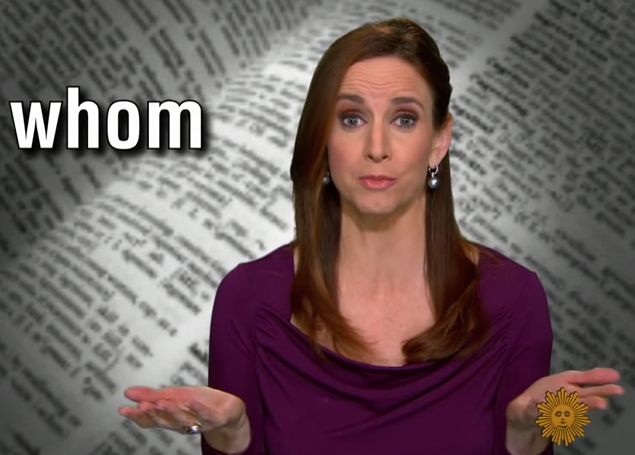
whomCBSWhat if you had to fill in a pie chart with different slices representing all the ways you speak? How many different slices would there be? Or, would you have just one whole pie called “Perfect English”? Would that be ideal?

Some news media, of late, suggest that the “Perfect English Pie” should be the goal. In this editorial today on CBS Morning, Faith Salie bemoaned the fact that many people do not follow her rules for proper “whom” usage.

Salie implies there should be only one uniform type of slice in our language pie, the one in which we are “speaking well.” This is especially true in “America,” Salie says, because according to her, most Americans only speak English:

Very few Americans, myself included, speak more than one language fluently. So, the least we can do is try and honor English by speaking it well.

Besides, she added, using “whom,” just makes you feel more special:

It’s like putting lipstick on your sentence.

The two comments posted, which don’t seem to even hint at irony, endorse Salie’s perspective:

VEGANSAM THANK YOU!

Cfc EditorTerrific vid. It’s nice to know that someone still cares.

Two days earlier, a Saturday New York Times front page story voiced another view on cleaning up language—not “who” and “whom,” but a certain way of saying “Wiscahnsin.” The headline reads:

 For 2016 run, Scott Walker washes “Wiscahnsin” out of his mouth

In this video, and the accompanying article, the author points out that Mr. Walker, now that he is running for national office, has changed how he speaks:

[Scott Walker] has left “Wiscahnsin” back home in Wisconsin. He now wants to strengthen the economy, not the “ecahnahmy.”

At the end of the essay, Jennifer Horn, Chairwoman of the New Hampshire Republican Party remarks:

I didn’t hear it [the Wisconsin honk]. Good for him, good for him.

Both Ms. Horn and Ms. Salie voice the view that we need to avoid certain ways of speaking and use those that are proper or less local seeming. Ms. Horn admires Walker’s new Wiscahnson-free diction, suggesting this makes him more palatable as a candidate. And, Ms. Sadie tells us we need to be especially protective of English, since it is the only language most Americans speak.

But, how do “Americans” really use language? Walker may be ditching his Wisconsin “honk,” but he is not replacing it with a sublime original super-perfect “American” speech. Instead, the article suggests, he is picking and choosing different types of language, adding variety to his language pie. When addressing Republicans in South Carolina Mr. Walker told them, in a characteristically un-Wisconsin-like way, that he enjoyed “talkin’ with y’all.”

To connect with people, even as a Republican in the United States, only speaking English, Mr. Walker’s Language Pie must contain some variety. He might be using “y’all,” in South Carolina, but he probably doesn’t in New Hampshire. And he may still talk about the “ecahnomy” when he is back at the family dinner table in “Wiscahnsin.”

But let’s suppose people are not running for office. Do people in the United States still need several different slices in their Language Diversity Pie? Or should they just focus on “speaking well” as Faith Salie suggests?

Last week, exploring this angle with 11th graders and their teachers, we had them create their own language pie charts. In just a few minutes, many divided their pie up into seven or more sections, including different language for the following slices of social life:

  • Friends
  • Close friends
  • Adults
  • Parents
  • Parents’ friends
  • Home
  • Texting
  • Babysitting
  • With siblings
  • With brothers
  • With animals
  • At work
  • At school
  • With teachers
  • With sports coaches
  • Just Dad
  • Just Mom
  • Nice friends
  • Vulgar friends
  • Girlfriend
  • Professional situation
  • Writing papers for school
  • Writing sentimental texts
  • When complaining
  • When angry or snarky
  • When giddy or happy
  • When tired or depressed

Most students specified slices for “friends,” “adults,” “home,” and “school,” adding varying degrees of nuance. “With animals” was a pie slice only one student came up with at first—but after being reminded of special animal pet voices, many classmates agreed they would add this slice to their pie too. (I doubt they use “whom” with their pets.) Momentary moods were crucial to a few students—clearly different ways of speaking come out when tired or depressed, angry, or giddy.

Nobody spontaneously mentioned anything about languages other than English. But, when I asked about multiple languages in their lives, several students had more slices to add to their Language Diversity Pie:

  • Mandarin with Mom (not Dad)
  • Danish with Mom (not Dad)
  • “Asian”-accented English with Mom, or when ordering Dim Sum in Chinatown
  • Persian with parents
  • Mix of Persian and English in general when at home

A ten-minute discussion revealed a profusion of ways of speaking, languages and “accents” that fit into any one individual’s pie.

These teens easily recognize the distinctive relevance of all the slices of their pie at different moments, or with different people, or to convey different moods. Even these young 16-year-olds, in Honors English, most of whom have spent their entire lives in one suburban community, have wide-ranging communicative repertoires, and can recognize their distinctive utility.

I hope these wise 11th graders can also address those media voices, like Faith Salie, that suggest our language goals should lean toward less language diversity in our pies. Today’s teens will need to use different kinds of language to do many things: babysit, snuggle with their cat, comfort a friend, write poetry, mediate neighborhood conflict, apply for college, be President…

One unitary language pie called “Perfect English” could never do all that.

What slices make up your Language Diversity Pie?

Shakespeare or Hip Hop?

wutang  Shakespeare

Last week in an 11th Grade English class, the English teacher and I started a discussion of language in Hamlet by presenting this poetic musing from D.H. Lawrence:

When I read Shakespeare I am struck with wonder

That such trivial people should muse and thunder

In such lovely language.     

Then we asked students about their experiences reading Shakespeare’s language so far. They shared frustrations (Too repetitive! Confusing word order!) and doubts (No way could one man have written so much!). Nobody fully embraced the idea that Shakespeare was a creative genius.

Nor did anyone take issue with Lawrence’s glib use of the phrase “trivial people” or the condescending tone he took toward them. Why shouldn’t everyone muse and thunder in lovely language?

Then, we trotted out this Shakespeare versus Hip Hop quiz (one I also shared with my Facebook friends, thus the 79 responses).

The questions and answers (quiz adapted from Ammon Shea’s book Bad English (2014)):

Quote Answer % Correct (n=79)
1.   The music, ho! 1.     Shakespeare, Anthony and Cleopatra 78%
2.   But if you don’t, I’ll unsheathe my Excalibur, like a noble knight 2.     Gangstarr, “Step in the Arena” 66%
3.   Holla, holla! 3.     Shakespeare, King Lear 62%
4.   This is the proper way man should use ink. 4.     Big Daddy Kane, “Taste of Chocolate” 45%
5.   Welcome, ass, Now let’s have a catch. 5.     Shakespeare, Twelfth Night 68%
6.   The money that you owe me for the chain. 6.     Shakespeare, Comedy of Errors 48%
7.   Pay me back when you shake it again. 7.     Nas, “You Own Me” 67%
8.   Holla, ho! Curtis! 8.     Shakespeare, Taming of the Shrew 60%
9.   Sabotaged, shellshocked, rocked and ruled, Day in the life of a fool. 9.     Public Enemy, “Brothers Gonna Work it Out” 70%
10.          Every square inch of it, that he chose for himself, is the best part. 10. Wu-Tang Clan, “Wu-Revolution.” 37%
AVERAGE PERCENTAGE CORRECT:       60%

People seem to get the right answer an average of about 60% of the time. Just barely a collective D-.

As some astute 11th graders pointed out, they were able to choose the “right” answers by second-guessing the test, not by deciding whether the language represented the “essence” of Hip Hop or Shakespeare.

Number 1 (78% correct!), for example, seemed to point to Shakespeare only because it sounds obviously like Hip Hop. Typical test-designers, students speculated, would include “ho” just to trick people.

Number 9 (70% correct) includes the word “shellshocked,” which another student pointed to as a giveaway, since that word didn’t exist until after the First World War. Shakespeare didn’t have any shells of that kind!

So, unless you know the exact lyric or play, or recognize testing tricks or oversights, the average person seems to have about a 50/50 chance of correctly guessing whether these quotes come from “Shakespeare” or “Hip Hop.” What does this tell us? Perhaps Shakespeare’s forte was not in his isolated mastery of “The English Language.” Instead, he may have been capturing exactly what “trivial people” said. Their wondrous language (including “ho” and “holla holla”), gleaned from Shakespeare’s active life in the pubs (so we’ve heard), may be precisely what Shakespeare wrote down.

What does that tell us about literary language? About Hip Hop? About our collective language resources? Do you know some “trivial people” that “muse and thunder” in lovely language? How do today’s artists—musicians, screen-writers, poets, playwrights—take up the talk of everyday people and use it for effect?   Please comment!

Language “Rules” and the Common Core State Standards

CCSSImageWhat do the controversial Common Core State Standards (CCSS) have to say about language? I’ve heard teachers and students, colleagues and friends, talking about the Common Core, hinting at worries about yet more standardization and inevitable high-stakes testing. I can agree that more standardization, especially regarding language in a massively multilingual and rapidly changing educational context is worrisome. But, what do the CCSS actually say?

Anyone with Internet access can take a look and navigate through all the standards on the website (www.corestandards.org). So, I did. I had one guiding question: What are the CCSS telling teachers to teach our kids about language? I found some happy surprises.

First, I found this statement in the introduction to the “Language” standards:

Language: Conventions, effective use, and vocabulary

The Language standards include the essential “rules” of standard written and spoken English, but they also approach language as a matter of craft and informed choice among alternatives.

Those quotation marks around “rules” were my first hint of potential CCSS flexibility. Perhaps the crafters of these standards take the concept of language “rules” with a grain of salt. If “rules” are in quotes and craft and informed choice considered important, teachers could be liberated, rather than constrained by the Common Core.

Could this stance be consistently maintained from Kindergarten through Senior Year? I continued through the Language standards to see.

The word nuance in one of the Kindergarten standards (#5) caught my attention and supported my first impression that strict definitions and rigid “rule”-learning wouldn’t be the focus. So, I began there:

K5: With guidance and support from adults, explore word relationships and nuances in word meanings.

K5C:Identify real-life connections between words and their use (e.g., note places at school that are colorful).

K5D: Distinguish shades of meaning among verbs describing the same general action (e.g.,walk, march, strut, prance) by acting out the meanings.

This sounds like a nice way to learn about language and meaning in context: Walking through a school, noting places that are “colorful”–or, marching, strutting and prancing, accentuating the nuance in each gait (and word)!

But, Kindergarten is supposed to be fun. Even standards writers might think so. What happens in first grade? They must start memorizing dictionary definitions then, right? No!

In first grade, this standard remains the same:

With guidance and support from adults, demonstrate understanding of word relationships and nuances in word meanings.

Now students note “places at home that are cozy” and continue to “distinguish shades of meaning,” of verbs like look, peek, glance, stare, glare, scowl or adjectives like large, gigantic.

And in second grade, students must demonstrate their recognition of nuance without “guidance and support from adults”:

Demonstrate understanding of word relationships and nuances in word meanings.

In third grade the standard adds “figurative language” but maintains the need to find nuance.

Demonstrate understanding of figurative language, word relationships and nuances in word meanings.

This standard remains exactly like this through 12th grade. Children go from marching, strutting and prancing around school to analyzing the shades of meaning of hurl versus throw to identifying hyperbole and paradox. Students’ understanding of word nuance consistently grows along the way.

But by starting with the “nuance” standard, I may have created a biased impression.  What about other standards? Are the rest more “rule” bound, standardized and lacking in nuance?

I started over in Kindergarten, this time with the most boring looking standard I could find, 1A. No nuance there:

Print many upper- and lowercase letters.

1A progresses to first grade like this, with even less nuance, as many changes to all:

Print all upper- and lowercase letters.

To second grade:

Use collective nouns (e.g., group).

And third grade:

Explain the function of nouns, pronouns, verbs, adjectives, and adverbs in general and their functions in particular sentences.

And, Common Core State Standard 1A continues in the same vein from 4th to 10th grade:

4th: Use relative pronouns (who, whose, whom, which, that) and relative adverbs (where, when, why).

5th: Explain the function of conjunctions, prepositions, and interjections in general and their function in particular sentences.

6th: Ensure that pronouns are in the proper case (subjective, objective, possessive).

7th: Explain the function of phrases and clauses in general and their function in specific sentences.

8th: Explain the function of verbals (gerunds, participles, infinitives) in general and their function in particular sentences.

9th and 10th: [in an abrupt and ironic break with previous grades] Use parallel structure.

Grammar rules seem to be piling up.

But I also noticed a healthy pattern of explanation of rules of “proper” usage (grade 6), interspersed with the slight concession to context, noting these features may function differently in “particular” (grade 5 and 8) or “specific” sentences (grade 7). But where does this all lead? What happens in 11th and 12th grade. Certainly you can’t be teaching more grammar points to 17 and 18 year olds?

Nope! In 11th and 12th grade, rules become “rules,” or, more explicitly, a “matter of convention” that “can change over time” and be “contested”:

11th and 12th: Apply the understanding that usage is a matter of convention, can change over time, and is sometimes contested.

After this dip into the Common Core website, following the ripples of a couple standards through the grades and into adulthood, I began to feel reassured that the CCSS (on their own) will not doom us to decades of robotic teaching and learning.

Understanding nuance is officially Language Standard #5. Nuance also infuses these standards and their interpretation. Like so many educational tools, they can be used and abused. I’m hoping to use them to support more critical thinking about language in classrooms, among students and their teachers, the community, and beyond. I’m also hoping that when students are exploring “shades of meaning,” (CCSS language standard 5D) those who speak several languages, or varied dialects, will be invited to share those shades of meaning too. (See Nelson Flores’ post on Multilingualism and the CCSS). Ideally, up to and beyond graduation, students will engage with the nuance of language, knowing they can also be the ones who change language “rules” and contest conventions.

What have your experiences been with the CCSS? Have you been aware of them as a teacher, a professor, an administrator, policy-maker, or a parent? As a citizen who consumes media about education policy? What do the CCSS ignore or leave out? How are they constraining? How might they be liberating?

Language Diversity Laugh Tracks

Laugh tracks, those recordings of canned laughter that at one time predictably accompanied all TV comedies, are supposed to cue an audience response, anointing certain comments, actions, or dialogue as funny. The laugh track says: It’s good to laugh now.

FreshOfftheBoat     laughingpeople

Laugh tracks also suggest we are similar. We are all part of an audience that laughs at the exact same things. One reason laugh tracks were originally created was to provide that feeling of shared laughter—the pleasure you get in a movie theater or a live performance when the entire audience is laughing together.

But, usually in life, we don’t have laugh tracks to cue that laughter. And, increasingly, we don’t have that shared background with those in the theater, or even in our living room. As audiences become more diverse, who laughs (at what and why) becomes more divided.

This becomes especially apparent when comedy lampoons different ways of speaking. A lot of humor depends on stereotyped portraits of speech-types. These depictions can be hilarious at times, offensive at others—and often simultaneously so to different groups of people. So, creating one unified laugh track would be impossible.

Why can’t we all laugh together?

Sometimes, we don’t all get it. For example, a few weeks ago, a student showed me this depiction of Asian accented Englishes (including Japanese, Korean, Chinese, Cantonese, Thai, Filipino, and Indonesian):

SingaporeAccents

https://www.youtube.com/watch?v=2OiDvo_XtV4

On watching this video with others in the class, half of us—those from China and Singapore—laughed heartily. The other half—those of us from the United States—just sat there, fascinated and puzzled. Not laughing. We weren’t trying to be tasteful or polite, expressing our offense at the crass depictions of stereotypes across East and Southeast Asia. We didn’t even know enough to make such judgments. We just didn’t get it.

In other cases, everyone “gets it” but in a slightly different way. Then laughing together may be possible–but complicated. Many comics build their routines through self-mocking depictions of their own (or their parents’ and grandparents’) ways of speaking English. When humor depends on this kind of linguistic self-mockery, laughing “with” someone might border on laughing at them, or at an entire imagined group.   In this clip, for example, Russel Peters imitates his dad, who moved to Canada from India, through easily recognizable stereotypes of Indian English:

https://www.youtube.com/watch?v=63_lFztZ0rw

And in this performance, Margaret Cho mocks her mother’s Asian accent:

https://www.youtube.com/watch?v=gevWOlEI5cc

In each of these live performances, the audience laughs with gusto. They clap and chuckle enthusiastically at Peters’ imitation of the many different ways his father says “Come!” in stylized Indian intonation, his eyes growing wide, head bobbling from side-to-side. Similarly, Cho’s audience enjoys her depictions of stereotyped guttural, r-less Asian speech. The YouTube comments immediately savor Cho’s portrait of her mother’s accent, attempting to represent it in their direct quotes:

fossilmusictv dis is da best mothas day. eva.

Ferd617…Oh, dere was one mudder day dat was a little bit bettuh.

But, this savoring of stereotyped accent, gestures and demeanor can also be troublesome. As the sociolinguist Elaine Chun points out, sometimes Margaret Cho’s depictions of Asians are such stark caricatures it seems okay for Asians and Asian Americans to laugh along, but disconcerting when white people join in. She writes of Cho’s performance at a show in Austin, TX, where more than half the audience appeared to be “European American”:

I had feelings of both pleasure and discomfort when hearing peals of laughter from non-Asians who seemed to profoundly enjoy her caricatures of Asians and Asian speech. (2004, p. 278, fn17)

For Chun, Asians’ enjoyment of Cho’s stereotyped versions of Asian speech seemed more straightforward then “out-group” laughter.

Cho’s TV show, All-American Girl, was canceled after one season, in 1995.

Now, depictions of Asian Accents are surfacing again as mainstream TV material. Fresh off the Boat, a new comedy about an Asian American family, premiered last month to mixed reviews. Many have critiqued the stereotypes and, specifically, the stereotyped language used in the show. Angela Tom, wrote:

Eddie’s mother played by American actress Constance Wu must fake a Chinese accent throughout the show. It hurt my ears even more when I heard Wu speaking in her normal, unbroken, smooth-as-silk English during a TV interview.

But other reviewers appreciate the negotiation between ways of speaking depicted in the show. Wu’s accent is not necessarily “fake,” but a performance. Like Tom, Shalini Shankar points out that the parents in the show perform stereotyped “Chinese” accents. But, she also stresses the importance of getting these performances out there:

As we get to know these more well-rounded accented English speakers as people, hopefully it will make it harder to see them as one-dimensional punch-lines.

Another critic’s list of “8 Reasons to Catch Fresh off the Boat” includes this observation:

 Fresh off the Boat is blessedly absent a laugh track.

Language variety and stereotypes of talk seem to be fodder for humor. But, the humor may appeal in different ways to different audiences, in ways the universalizing presuppositions of a laugh track could never capture. At least leaving the laugh track out of shows like Fresh Off the Boat lets the audience figure it out for themselves—and with each other.

How do you react to comedic depictions of language diversity like those in Fresh off the Boat? Have you found yourself wondering why certain accents are funny? Or whether you should be laughing at all? Please comment.


Frank Underwood Versus the Accent Commandos

spacey

Is Kevin Spacey’s accent as a South Carolina politician in House of Cards any good?

After Season 3 debuted this week, a posting by VOX took him through the wringer. In a little over three minutes, this YouTube video presents a history of Southern accents and intro linguistics, explaining how Spacey’s accent misses the mark. The narrator asserts, “R-dropping probably can’t be the shortcut that actors use in the future to sound Southern.” The video advises, instead, actors try “/ay/-ungliding.”

https://www.youtube.com/watch?v=mgCeH3xovDw

But, the viewers don’t buy it! A revealing critique of this perspective on Kevin Spacey’s performance comes from the citizen sociolinguists who comment on this video. 53 comments have already piled up.

A few agree with VOX, though on terms that wouldn’t be in an Intro Linguistics textbook:

XBLArmory As a southerner I find it interesting but by no means is it authentic; he sounds more like Foghorn Leghorn to me than any real southerner.

But many more disagree. Some point out the show is a performance. There may be deliberate reasons the accent is not right:

Nicodin Bogdan I think it’s interesting to point out that it might not be super correct geographically but maybe this is a trade-off for accuracy versus feel. We feel like Spacey comes off as an old-school, “elite” southern gentlemen and that’s what the show wants.

Echoing this point of view, another commenter suggests Spacey’s verion of “southern” relates to social class:

David Parker That is interesting, however, as a man from the Southern US, his accent is pretty accurate for the background of his character. The video really undercuts the significance of economic status and power and it’s influence on accents in the American South

As ZestyItalian points out, maybe Spacey wants the character to sound a little phony. Ahem, while Spacey is not a linguist, he is a professional actor:

ZestyItalian2… [his accent is] not “off”, per se. It’s just an older accent that’s associated with the southern aristocracy. It’s not extinct- just less common than it used to be. And considering the character background of Frank Underwood- poor boy, self-made man from the small town south- it’s not unreasonable to suggest that he affected a highborn, genteel southern accent, just as Scots and Irish of a certain generation (think Peter O’Toole) affected a semi-aristocratic RP English accent to bolster their careers and statuses.

And trust me- Spacey leaves nothing to chance- least of all something as essential as an accent. Spacey is a technician. One of the most technical of all American actors, in fact. He draws characters out as if they had blueprints or schematics. Nothing he does, physically or vocally, is an accident. And I have a very hard time believing that he didn’t do his research into the specific type of dialect Frank Underwood would have. I’ve always thought he sounded a lot like Jimmy Carter.

Another group of comments point out that labeling things with scientific terminology does not make them into an argument.

Furball Ay-ungliding. So glad I know what that phonetic mechanism is now. [I’m assuming sarcasm here]

And, as this person points out—no matter how scientific VOX attempts to appear with all their fancy sagittal diagrams and lingo, the links to “social class” are specious:

Robert Heinl Cut this out, Vox.  No one cares about you or your useless linguistics college major…. youre obviously incapable of making any substantive contribution to society whilst diagramming the posterior oropharynx and somehow linking it to socioeconomic status…

I appreciate the smart relevance of these comments that contest VOX’s sociolinguistic exegesis. Given the nuance that goes into the performance of a fictional character, the VOX video critique seems to me to be analogous to those of Grammandos who assert their grammatical expertise by criticizing people who write the phrase “comprised of” or use the word “literally” figuratively (The Language Experts).

Are Accent Commandos are now taking up that gauntlet? Fortunately, citizen sociolinguists, like these commenters, are out in force, making nuanced points revealing the complex way languages work in social life, the theater, Hollywood, politics –and Netflix.

What do you think of Frank Underwood’s accents? Or others in the public view? President Obama, for example, has also been criticized and mocked (Language Awareness or Linguistic Insecurity?) about the “authenticity” of his various performances of language variety. Why grant authority to the categorical decrees of Accent Commandos? Please comment below!